Last Updated on September 18, 2026
No. Taking naltrexone does not make you an alcoholic. It isn’t addictive or habit-forming, and deciding to take it is not itself a diagnosis of alcohol use disorder.
Maybe you drink more than you want to, but the idea of taking medication for it feels like crossing some invisible line. If you’re working, showing up, and generally keeping your life together, you might wonder what the fact that you’re considering naltrexone “means” about you.
The answer is: not much. Looking into a medication means you’re considering a tool that could help you change your drinking. It doesn’t require you to adopt a label or decide that your drinking has reached some particular level of severity.
Can Naltrexone Help Me Drink Less or Quit?
Part of what makes this question so loaded is that alcohol sits at the intersection of behavior, health, identity, and stigma.
But “alcoholic” isn’t a medical diagnosis. Clinicians use the term alcohol use disorder, or AUD, which can range from mild to severe. And whether someone meets the criteria for AUD is determined by a pattern of symptoms, not by whether they’re interested in medication.
So asking about naltrexone doesn’t require you to settle the question of what your drinking “makes” you. A more useful question is whether naltrexone could be an appropriate tool for changing it.
If your drinking feels like it falls somewhere between “no problem at all” and the traditional picture of alcohol addiction, our guide to gray-area drinking explores that middle ground.
What Is Naltrexone, and How Does It Work?
Naltrexone is an opioid antagonist, meaning it blocks opioid receptors involved in alcohol’s rewarding effects. For some people, that can make drinking feel less rewarding and reduce cravings or the urge to keep drinking.
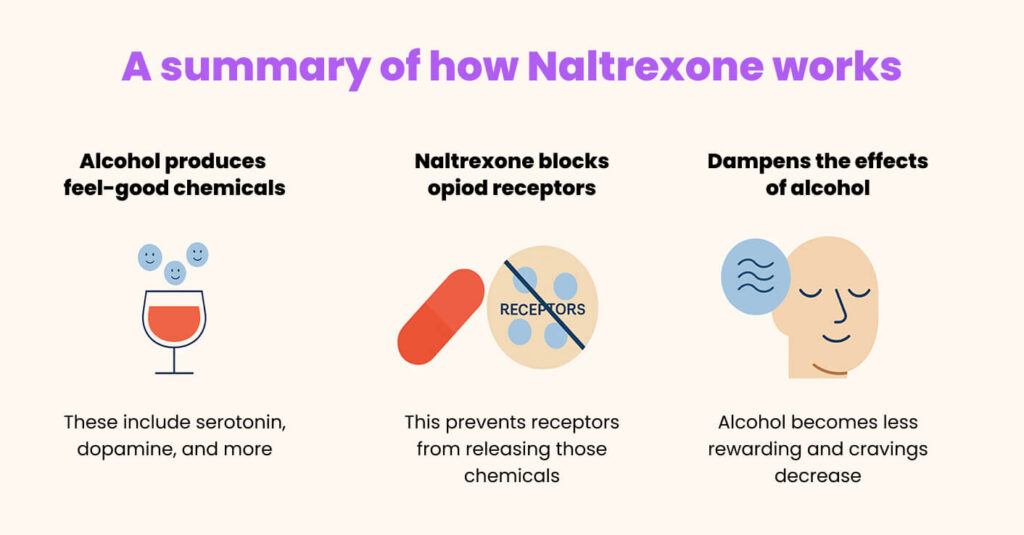
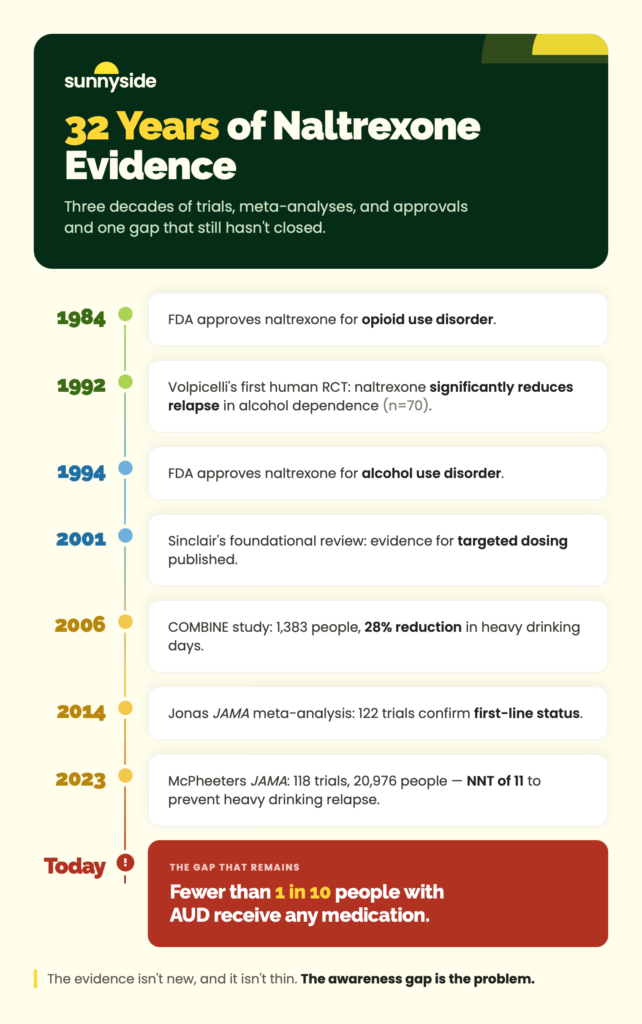
Naltrexone has been FDA-approved since 1994 for alcohol use disorder. It isn’t a controlled substance, doesn’t produce a high, and isn’t addictive or habit-forming. Stopping it also doesn’t produce a withdrawal syndrome.
Research supports its overall tolerability. A large safety study, Croop et al. (1997), followed more than 800 people and found that naltrexone was generally well tolerated, with side effects typically described as mild.
Researchers are also interested in whether naltrexone can change the learned pull of alcohol over time. One proposed mechanism is called pharmacological extinction: repeatedly experiencing alcohol with less of its usual reward may gradually weaken the association between drinking and reward. A 2026 review discusses this possibility, although evidence for pharmacological extinction needs further validation in humans.
What we know more firmly is that naltrexone can help some people reduce their drinking. A 2023 JAMA systematic review found that oral naltrexone had a number needed to treat of 11 for preventing a return to heavy drinking. That means that for every 11 people treated with oral naltrexone rather than a control intervention, one additional person avoided returning to heavy drinking over the periods studied.
For a fuller look at the evidence, see our roundup of naltrexone research.
You Don’t Need a Label to Ask About Naltrexone
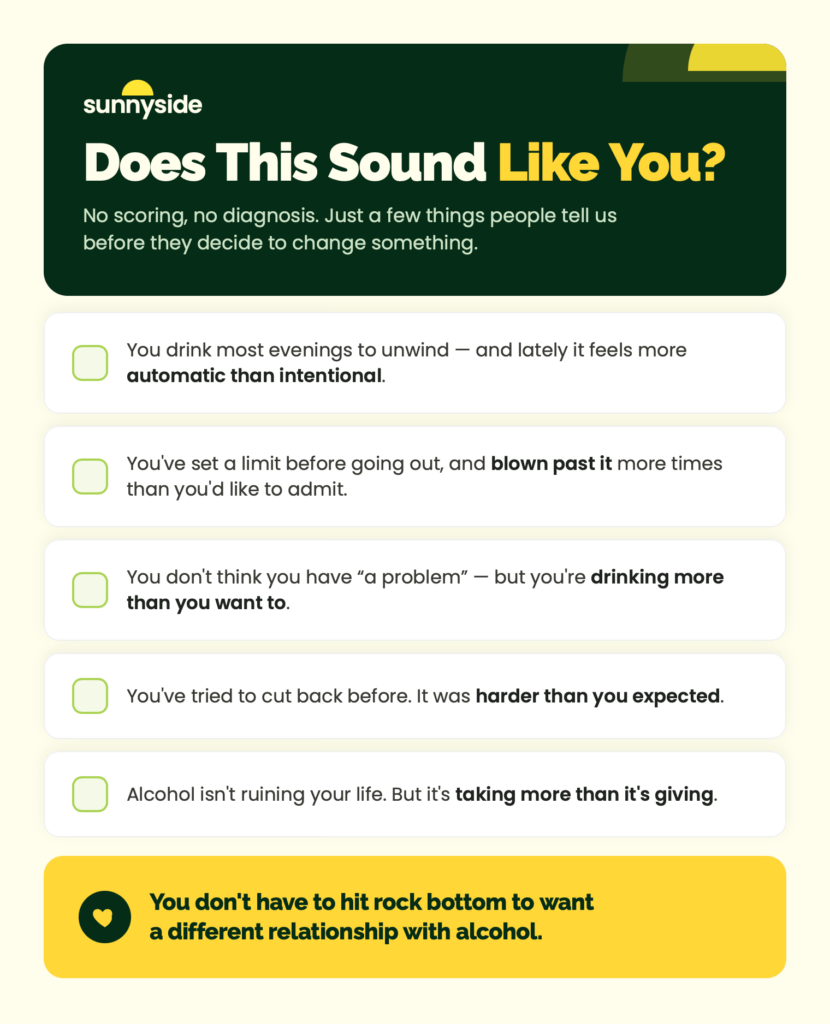
AUD is diagnosed based on a pattern of symptoms over a 12-month period, not on whether someone decides to look into medication. Considering naltrexone doesn’t tell you whether you have AUD or, if you do, how severe it is.
Research has also looked at people who wanted to reduce their drinking, not only people seeking abstinence or formal alcohol treatment. A pooled analysis, Hendershot et al. (2017), found that naltrexone reduced alcohol craving and consumption, with similar effects among alcohol-dependent and non-dependent participants.
There is an important caveat: the evidence for naltrexone is strongest in people with AUD and more limited among people without a formal diagnosis.
Other research has specifically examined moderation. In a randomized trial, Kranzler et al. (2009) studied problem drinkers whose goal was to reduce rather than stop drinking. Naltrexone was associated with less drinking, particularly among men.
So, do you have to consider yourself an alcoholic to ask about naltrexone? No. A licensed clinician can look at your drinking, health history, current medications, and any opioid use to determine whether the medication is appropriate for you.
If you’re wondering what that evaluation involves, we recommend our guide to naltrexone eligibility.
GLP-1s Are Changing How We Think About Medication
The growing use of GLP-1 medications has made conversations about medication and behavior much more visible. Drugs like semaglutide are now widely discussed as tools that can affect appetite and food-related reward, rather than as evidence that someone simply wasn’t trying hard enough. (Some people taking semaglutide have also reported a decrease in alcohol cravings.)
There are obvious differences between treating metabolic conditions and changing your relationship with alcohol. But the broader idea is useful here: using medication to change a behavior doesn’t have to be a statement about your character.
The same is true of naltrexone. You can want help drinking less without deciding that alcohol defines you or waiting until your drinking reaches a crisis point.
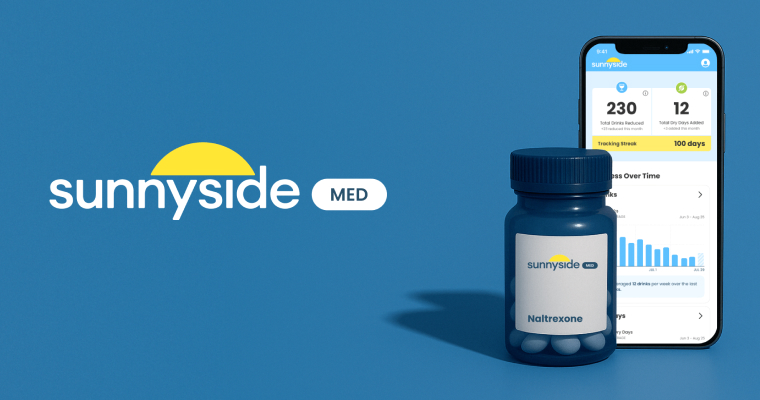
Sunnyside Med: Support That Meets You Where You Are
One reason people put off asking for help with their drinking is the uncertainty of whether their situation is “serious enough.” But you don’t have to wait for alcohol to become a crisis before deciding you’d like to change something.
Sunnyside Med is designed for people who want to explore medication-supported change, whether their goal is to drink less, take a break, or quit. As Nick Allen, Sunnyside’s co-founder and CEO, puts it: “This isn’t only for people at or approaching rock bottom. We’re building Sunnyside Med to provide proactive and preventive access to medication before alcohol becomes a massive negative part of your story.”
The program is 100% online. A licensed clinician reviews your information and determines whether naltrexone is medically appropriate. If you’re eligible, medication is paired with behavioral tools and support designed to help you work toward your drinking goals.
How to Respond to Someone Who Asks You About Your Naltrexone
If someone notices you’re drinking less or asks why you’re taking naltrexone, you don’t owe them a detailed explanation. How much you share is up to you!
If you do want to answer but don’t necessarily want to share everything, keep it simple:
- “I’m trying to drink less, and it helps with cravings.”
- “I wanted some extra help cutting back, so my doctor recommended naltrexone.”
- “I’m just trying to be more proactive about my relationship with alcohol.”
- “It makes drinking less appealing to me, which makes it easier to stick to my goals.”
- “It’s a medication I’m taking for my health. I’d rather not get into the details.”
There’s no reason you need to explain or defend the decision if you don’t want to. Taking naltrexone is personal, private health information, and you get to decide who knows about it.
Why Naltrexone Is Still Underused
Naltrexone has been FDA-approved for alcohol use disorder since 1994, but relatively few people who could benefit from medication receive it.
In a multisite survey, Leung et al. (2022) found that just 23.3% of surveyed prescribers had prescribed naltrexone for AUD in the previous three months. The most commonly reported barrier was unfamiliarity with the medication.
That lack of familiarity is only part of the picture. Limited clinician training, stigma, access to care, and low awareness of medication options can all make it harder for people to learn about naltrexone in the first place. According to NIAAA, only 2.5% of people with past-year AUD received medication treatment in 2024.
That means it’s entirely possible to have spent years thinking about your drinking without ever hearing that medication could be an option. Our guide to why naltrexone remains underprescribed looks more closely at the reasons.
How Sunnyside Med Works
Sunnyside Med offers a private, 100% online way to explore whether naltrexone could be appropriate for you.
You start with a short assessment, which is reviewed by a licensed clinician. If you’re eligible, medication is shipped discreetly to your door. No insurance is required, and the program is HSA/FSA eligible.
Medication is only one part of the program. Members also get access to drink tracking, goal setting, coaching, community, and ongoing clinical support. The idea is to address both sides of changing your relationship with alcohol: the cravings that can make cutting back difficult and the habits that have formed around drinking.
In internal observational data, 78% of active Sunnyside Med members achieved a meaningful reduction in drinking. (Individual results vary, and this figure isn’t from a randomized clinical trial.)
One member described starting the program this way: “I realized I needed, wanted the support available to me through the naltrexone program… A weight has been lifted.”
Naltrexone is a prescription medication, and a licensed clinician reviews every Sunnyside Med application to determine whether it’s appropriate. The program costs $99 per month plus a one-time intake fee and is available in all 50 states.
Ready to find out whether it could be a fit? Get started with a short online assessment.
Frequently Asked Questions (FAQ): Does Naltrexone Make You an Alcoholic?
Does taking naltrexone mean you’re an alcoholic?
No. Taking naltrexone doesn’t mean you’re an alcoholic, and “alcoholic” isn’t a medical diagnosis. Clinicians diagnose alcohol use disorder based on specific criteria, and it can range from mild to severe. Taking medication doesn’t determine whether you have it.
Is naltrexone addictive or habit-forming?
No. Naltrexone is an opioid antagonist and isn’t addictive or habit-forming. It doesn’t produce a high, isn’t a controlled substance, and stopping it doesn’t cause a withdrawal syndrome.
Do you have to drink for naltrexone to work?
No. You don’t have to drink alcohol for naltrexone to work. Naltrexone can help reduce alcohol cravings and the rewarding effects of drinking, and it is commonly taken on a daily schedule. Follow the dosing instructions provided by your clinician.
Do you have to be diagnosed with alcohol use disorder to get naltrexone?
You don’t need to “diagnose” or label yourself before asking about naltrexone. A licensed clinician will evaluate factors including your drinking, health history, current medications, and any opioid use to determine whether it’s appropriate for you. The evidence for naltrexone is strongest among people with AUD and more limited among people without a formal diagnosis.
What happens when you stop taking naltrexone?
Stopping naltrexone doesn’t cause withdrawal because the medication isn’t addictive or habit-forming. Its effects don’t continue indefinitely after you stop taking it, however, so talk with your clinician about how long treatment makes sense for you.
Can you take naltrexone if your goal is to drink less, not quit entirely?
Yes. Naltrexone can be used as part of a plan to reduce drinking rather than stop completely. Sunnyside Med supports both moderation and abstinence goals, so you can work toward drinking less, taking a break, or quitting.
Why haven’t more people heard of naltrexone for alcohol?
Naltrexone remains underused despite having been FDA-approved for alcohol use disorder since 1994. Leung et al. (2022) found that unfamiliarity with the medication was the most commonly reported barrier among surveyed prescribers. Training, stigma, awareness, and access can also play a role.
If the question “does naltrexone make you an alcoholic?” has been keeping you from looking into it, the answer is no. Naltrexone is simply one tool that may help some people change their relationship with alcohol.
Naltrexone is a prescription medication. This content is educational and should not be taken as medical advice. A licensed clinician reviews every Sunnyside Med application.