
Last Updated on August 8, 2026
How do you qualify for naltrexone? A licensed clinician reviews your drinking history, medical history, and current medications to determine whether naltrexone is appropriate for you. You don’t need to identify as an “alcoholic,” stop drinking first, or enter rehab. Many people who want to drink less already meet the criteria for mild alcohol use disorder (AUD) without realizing it.
Let’s say you’ve been reading about naltrexone. You think it might help. But then… the doubts start.
“My drinking isn’t that bad,” you think. “Would a doctor even prescribe it to someone like me?”
People ask versions of that same question every day. They wonder if they need to identify as an alcoholic to receive naltrexone, or they’re convinced their drinking is in too much of a gray area for them to qualify. But you don’t have to hit rock bottom or be in full crisis to be a candidate for naltrexone.
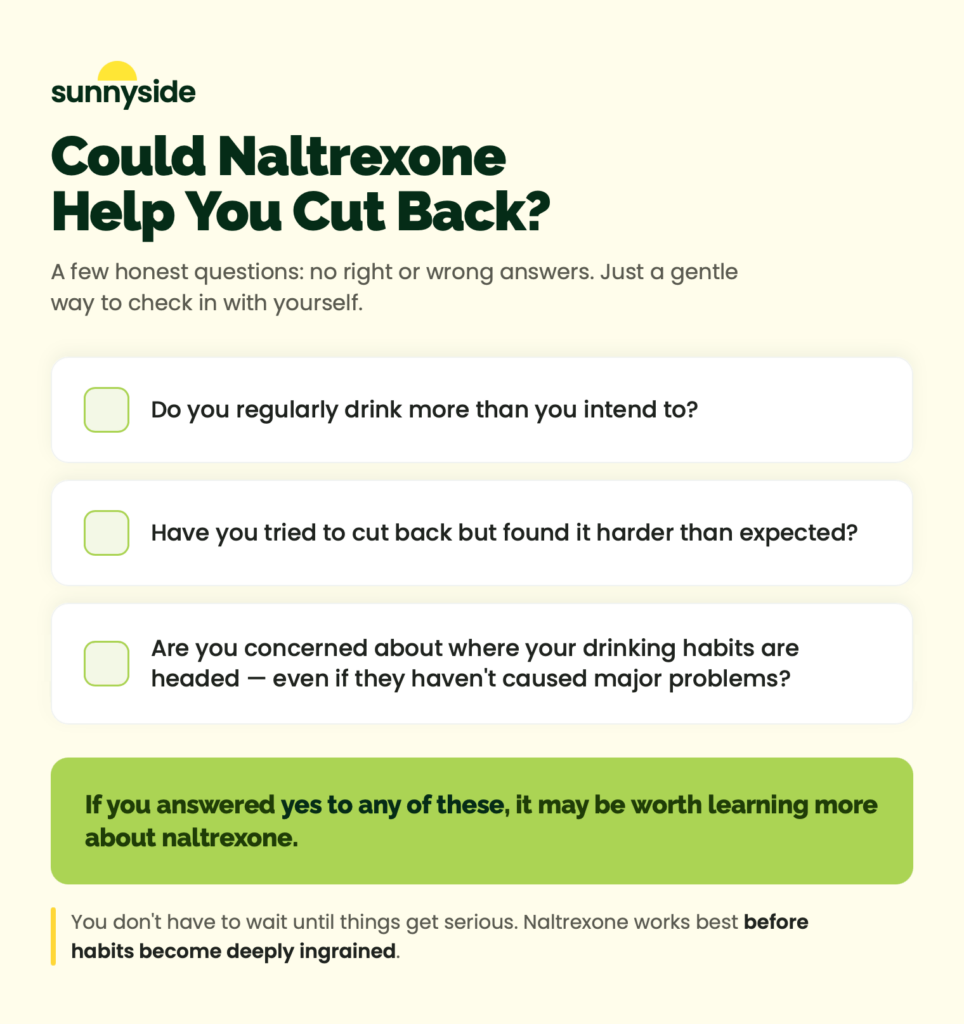
It’s often more useful to ask yourself a different set of questions. For example, do you regularly drink more than you intend to? Does alcohol feel harder to control than you’d like? If so, it’s worth talking with a clinician. You may already meet the criteria for mild alcohol use disorder (AUD) — the threshold is much lower than many people realize.
You’re Probably More Likely to Qualify for Naltrexone Than You Think
Many articles about how to qualify for naltrexone tell you that you need an alcohol use disorder (AUD) diagnosis. What they often leave out is what that diagnosis actually looks like.
Doctors use the 11 criteria in the Diagnostic and Statistical Manual of Mental Disorders (DSM-5). If you’ve met 2 of the 11 criteria during the past 12 months, that meets the definition of mild AUD.
It’s easier to qualify than many people expect, which is why someone can meet the criteria for treatment without feeling like their drinking is necessarily “that bad.”
AUD is divided into three categories:
- Mild: 2–3 criteria
- Moderate: 4–5 criteria
- Severe: 6 or more criteria
Naltrexone can be prescribed at any of these levels if a clinician thinks it’s a good fit. It isn’t only for people with severe alcohol use disorder.
It’s also helpful to know that “alcoholic” isn’t a medical diagnosis. NIAAA describes it as a colloquial term rather than a clinical one. A clinician isn’t deciding whether you fit a particular label. They’re looking at your symptoms, your health history, and whether naltrexone is likely to be both safe and helpful.
The DSM-5 is only one part of qualifying. A clinician will also review your medical history, check for opioid use and certain liver conditions, evaluate your current medications for potential naltrexone interactions, and make sure naltrexone is a safe option for you.
The 11 DSM-5 Criteria for Alcohol Use Disorder
If you’ve been wondering whether your drinking is “serious enough,” you may recognize yourself in more of these 11 criteria than you expect.
Over the past 12 months, have you:
- Drunk more or for longer than you intended?
- Tried to cut back or stop but found it difficult?
- Spent a lot of time drinking or recovering afterward?
- Experienced strong cravings or urges to drink?
- Had drinking interfere with work, school, or responsibilities at home?
- Continued drinking even though it was causing problems in your relationships?
- Given up activities you once enjoyed because of drinking?
- Drunk in situations where it was physically dangerous, such as before driving?
- Kept drinking even though you knew it was making a physical or mental health problem worse?
- Found that you needed more alcohol than before to get the same effect?
- Experienced withdrawal symptoms when you stopped drinking?
Meeting two or more of these criteria within the past year meets the DSM-5 definition of mild alcohol use disorder. For example, if you regularly drink more than you planned and you’ve tried to cut back without much success, you’ve already met the threshold.
“I was googling ‘am I drinking too much’ at 11 pm and somehow convinced myself I didn’t qualify for medication,” one Reddit user wrote.
The point of this list isn’t to convince you to adopt a label. It’s to show that the medical threshold for treatment is often lower than people assume. Many people who think they’re “not bad enough” already meet the criteria a clinician uses when deciding whether naltrexone could help.
Mild AUD Doesn’t Mean You Have A Problem: A Note From Our Founder
“AUD exists on a wide spectrum, and the sooner you take charge, the less likely it is that alcohol will pull you down.
I’ll be straight with you. Don’t worry so much about AUD or your AUDIT score. If you want to cut back but have a hard time doing it on your own, you can likely get naltrexone.
I took naltrexone for two years. Now I barely drink. Alcohol isn’t a priority anymore, and I feel in control. I’ve rewired my brain around drinking.
There’s no shame in taking care of your health. Drinking less is one of the biggest things you can do for your health, happiness, and longevity.”
—Ian Andersen, Sunnyside co-founder
What Sunnyside Med’s Naltrexone Evaluation Actually Involves
When it comes to the actual naltrexone evaluation, many people picture an in-person appointment and a long Q&A. Through telehealth, the process is often much simpler.
Step 1: Complete an online assessment.
You’ll answer questions about your drinking, your health history, your current medications, and your goals. It typically takes 5 to 10 minutes.
Step 2: A licensed clinician reviews your information.
A physician, nurse practitioner, or other licensed prescriber determines whether naltrexone is medically appropriate for you.
Step 3: If you’re approved, your prescription is issued.
With Sunnyside Med, compounded naltrexone is shipped discreetly to your home.
Step 4: Start building new drinking habits.
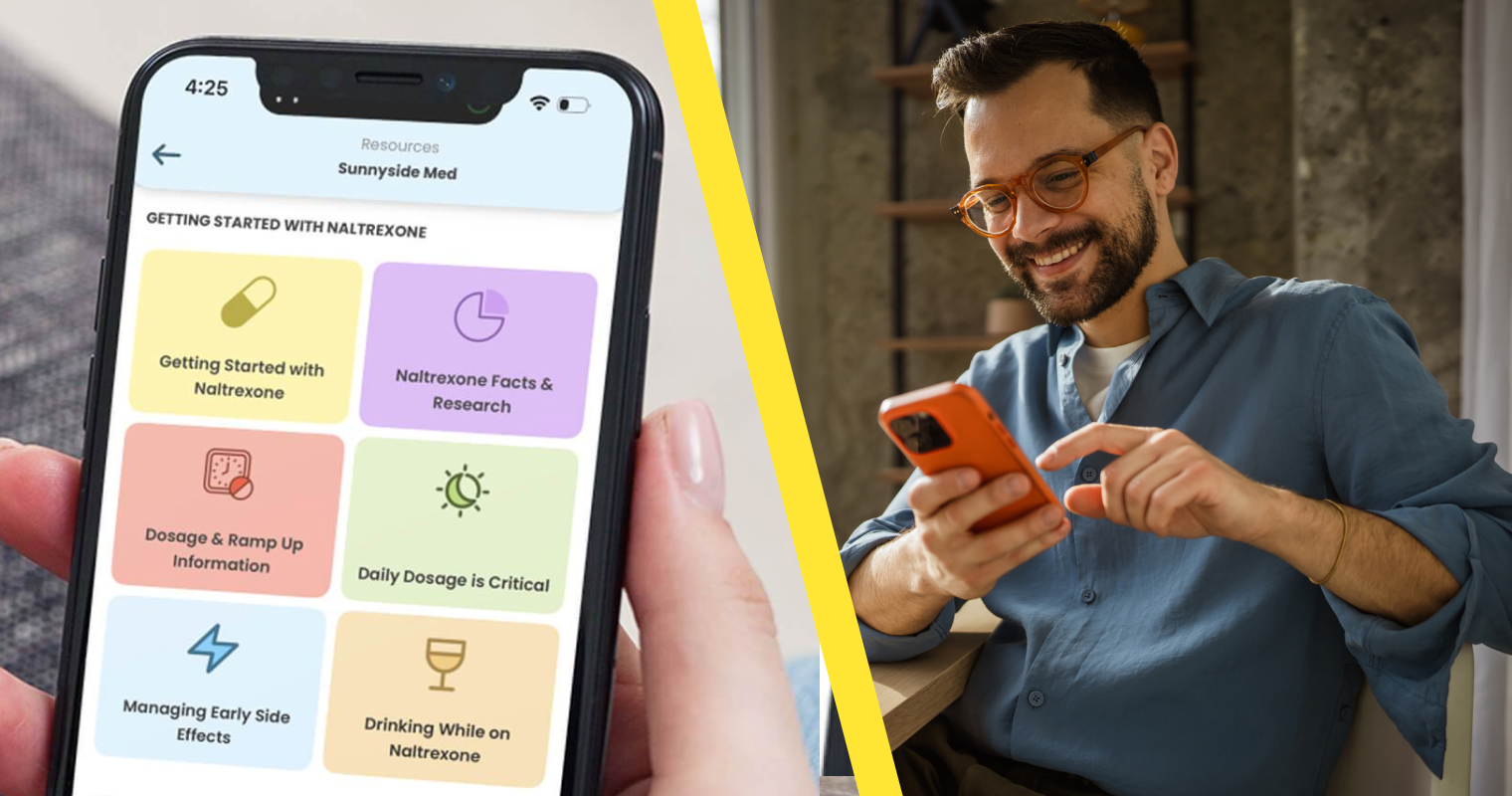
While you’re waiting for your prescription to arrive, you’ll have access to Sunnyside’s behavior change program, including drink tracking, coaching, educational resources, and a private community.
For many people, the biggest obstacle isn’t meeting the medical criteria. It’s finding a clinician who regularly prescribes naltrexone. A 2022 survey of primary care and psychiatry clinicians found that many providers were unfamiliar with prescribing naltrexone for alcohol use disorder or believed patients needed to be in a formal treatment program before starting it, even though any appropriately licensed clinician can prescribe it when it’s clinically appropriate.
What You Do NOT Need to Qualify for Naltrexone
Many people rule themselves out before they ever talk to a clinician. In reality, you don’t need to check nearly as many boxes as you might think.
You don’t need:
- A formal alcohol use disorder diagnosis before your appointment. The clinician evaluates that as part of your assessment.
- To have “hit rock bottom.” Naltrexone isn’t reserved for the most severe cases. Many people start it while they’re trying to cut back, long before alcohol has caused major consequences.
- To enroll in a formal treatment program. Any licensed clinician who is comfortable prescribing naltrexone can determine whether it’s appropriate for you.
- To stop drinking before you begin. Unlike some treatments for alcohol use disorder, naltrexone doesn’t require you to complete detox before starting. Your clinician will explain how and when to take the medication.
- To have abstinence as your goal. Naltrexone is one of the few medications that has been studied for people who want to moderate their drinking as well as those who want to quit entirely.
- To use insurance. Sunnyside Med is an out-of-pocket program, so the medication and clinical evaluation aren’t billed through your health insurance.
Why Hasn’t Your Doctor Mentioned This Before?
If you’ve seen a primary care doctor and they never mentioned naltrexone, that says more about prescribing patterns than your eligibility.
Seeing your primary care doctor more often doesn’t mean you’ll be offered naltrexone. Fewer than 2% of people with alcohol use disorder in the US receive any medication for it. A 2022 survey by Leung et al. in Frontiers in Psychiatry points to the reason: provider unfamiliarity, not patient ineligibility, is the main barrier.
If you’ve wondered why your doctor hasn’t brought this up, they may not know to offer it. But telehealth providers like Sunnyside Med, who specialize in alcohol reduction, do.
Does Naltrexone Actually Work?
Yes. Oral naltrexone is one of the best-studied medications for alcohol use disorder. A 2023 JAMA systematic review of 118 clinical trials found it reduced the risk of returning to heavy drinking, and current clinical guidelines consider it a first-line treatment for many patients.
Like most medications that help facilitate behavior change, naltrexone works best when paired with other support. Rather than eliminating the desire to drink overnight, naltrexone reduces alcohol’s rewarding effects over time, making it easier to change long-standing habits.
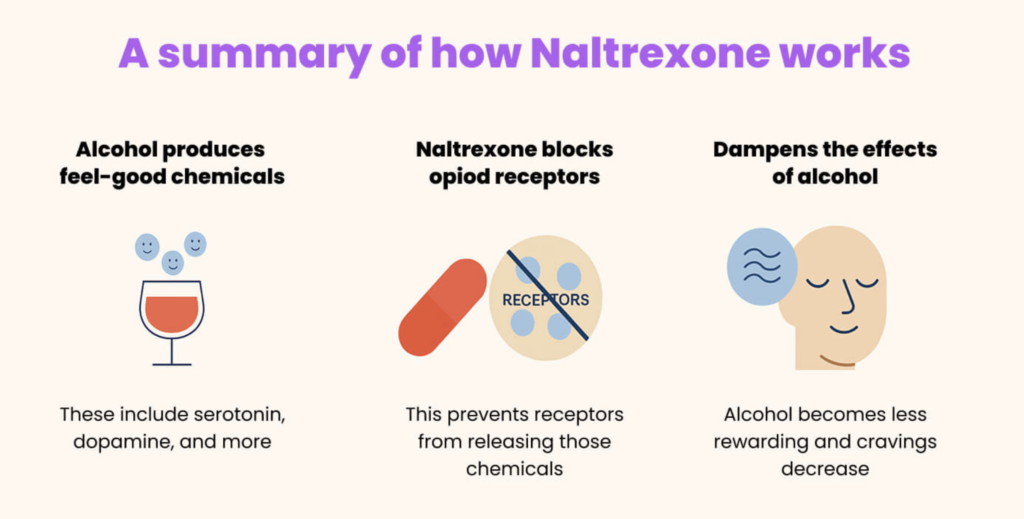
“Drinking might feel different, and that’s the point,” said Sunnyside co-founder Ian Andersen. “Less exciting. Less rewarding. Sometimes just less fun. That’s the medication doing its job.”
Among active Sunnyside Med members with at least 50% app engagement, 78% achieve a meaningful reduction in drinking within 12 weeks. Individual results vary.
Why Sunnyside Med Is the Best Online Naltrexone Provider
If you’ve read this far, you’ve probably realized that qualifying for naltrexone isn’t really about fitting a particular “type.” It’s more about whether a clinician thinks it could help you reach your drinking goals.
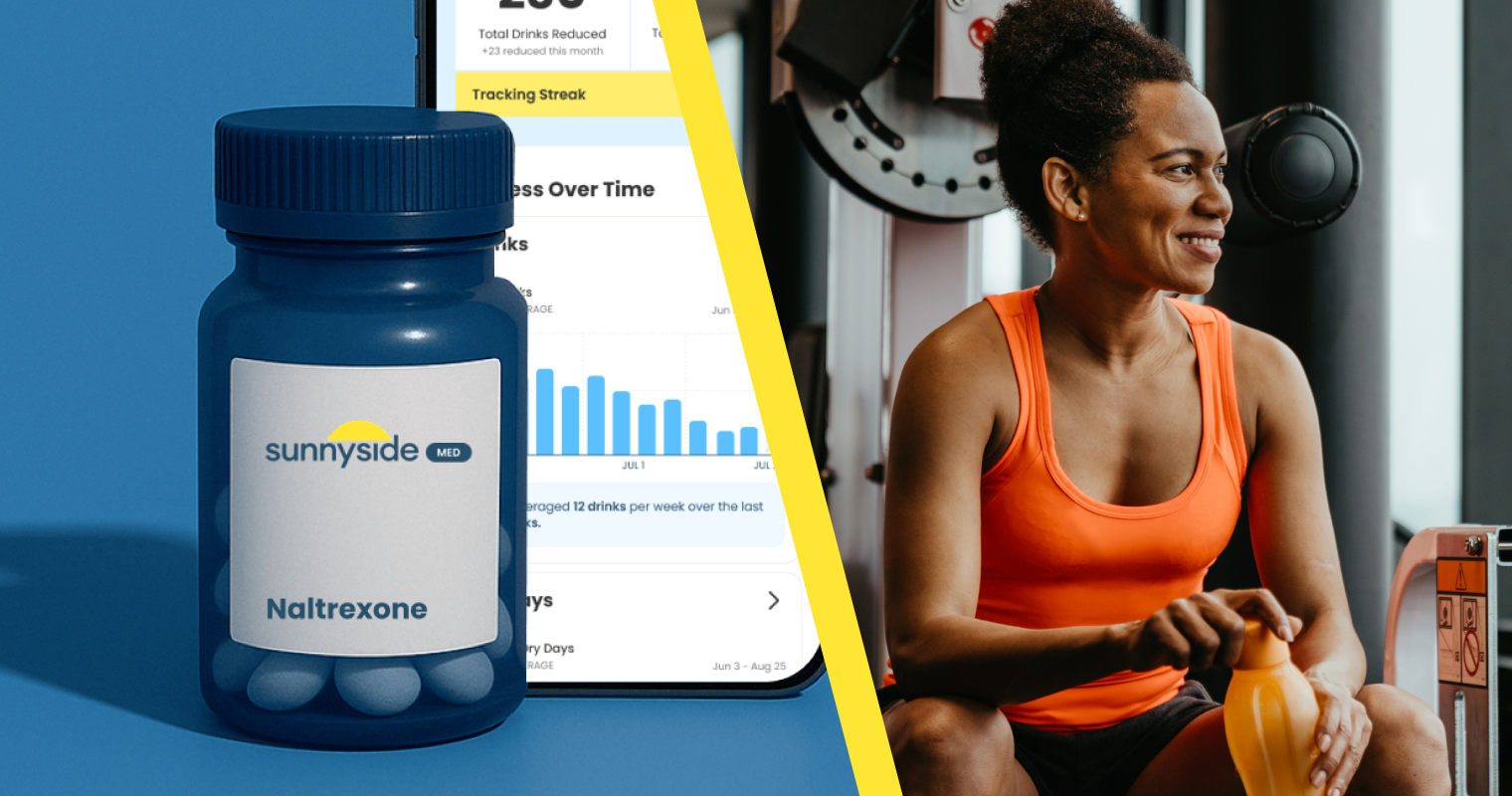
Sunnyside Med combines an online clinical evaluation with compounded naltrexone shipped discreetly to your door, plus the tools that help people stay with treatment: drink tracking, human coaching, a supportive community, and ongoing clinical care.
“I prescribe naltrexone regularly as a safe, effective way to curb heavy drinking,” said Dr. Hrishikesh Belani, M.D., Sunnyside Medical Advisor. “I highly recommend pairing it with a behavioral health program like Sunnyside.”
The program includes:
- Short online assessment
- Licensed clinician review
- Compounded naltrexone with vitamin B6
- Behavior-change app and drink tracking
- Human coaching and weekly community calls
- Care team available seven days a week
- $99/month, HSA/FSA eligible, no insurance required
Frequently Asked Questions (FAQ): How to Qualify for Naltrexone
Do you need a formal AUD diagnosis to get naltrexone?
No. You don’t need to arrive with a diagnosis. A licensed clinician determines whether you meet the criteria for alcohol use disorder (AUD) during your evaluation and whether naltrexone is appropriate for you.
Do you need to be an “alcoholic” to get naltrexone?
No. “Alcoholic” isn’t a medical diagnosis. Clinicians evaluate you using the DSM-5 criteria for alcohol use disorder, not whether you identify with a particular label.
How many DSM-5 criteria do you need for naltrexone?
Meeting 2 of the 11 DSM-5 criteria within the past 12 months meets the definition of mild AUD. Many people who want to drink less already meet that threshold.
Can a gray area drinker qualify for naltrexone?
Yes. Many gray area drinkers meet the criteria for mild AUD without realizing it. If alcohol regularly feels harder to control than you’d like, it’s worth talking with a clinician.
Do you have to stop drinking before starting naltrexone?
No. Naltrexone doesn’t require a detox period before starting. Your clinician will explain how and when to take your first dose.
Can you get naltrexone online without seeing a doctor in person?
Yes. Many telehealth providers, including Sunnyside Med, offer online evaluations. In many states, a clinician can review your assessment asynchronously, though some require a brief video visit.
What happens during a naltrexone evaluation?
You’ll complete a short assessment about your drinking, medical history, and goals. A licensed clinician reviews your answers, checks for contraindications such as current opioid use, and determines whether naltrexone is appropriate.
Does your employer or insurance company find out you’re taking naltrexone?
Not through Sunnyside Med. The program is paid for out of pocket rather than billed through insurance.
Can my primary care doctor prescribe naltrexone?
Yes. Any licensed clinician can prescribe naltrexone. However, many primary care providers don’t prescribe it regularly, which is one reason telehealth has expanded access.
Find Out Whether You Qualify with Sunnyside Med
If you’ve made it this far, you probably have a better sense of whether naltrexone could be a good fit. The next step is finding out by completing a simple online assessment reviewed by a licensed clinician.
Sunnyside is the #1 mindful drinking app. Since 2020, we’ve helped more than 400,000 people cut over 22 million drinks from their baseline habits. In a third-party study, our approach reduced weekly drinking by 33% after 12 weeks, and 96.7% of members report success drinking less.
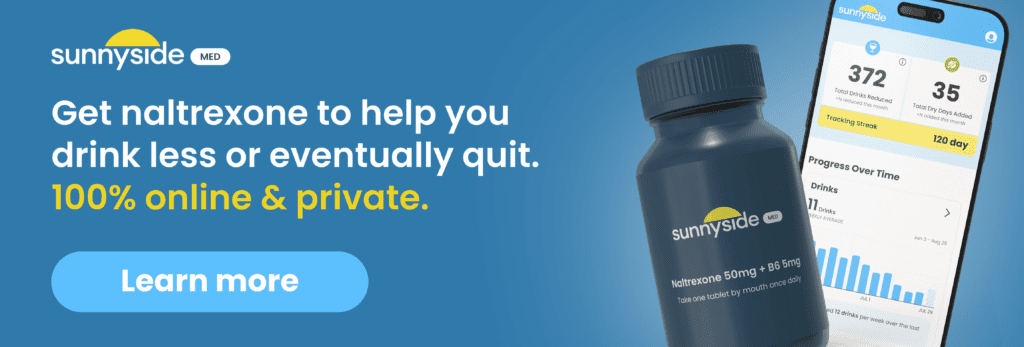
When you sign up, you’ll start with a quick 3-minute assessment. If a licensed clinician determines that naltrexone is appropriate for you, you’ll receive ongoing support that goes beyond the prescription—including drink tracking, personalized weekly plans, one-on-one coaching, educational resources, and a private member community.
Whether your goal is to drink less, build more alcohol-free days, or eventually stop drinking altogether, Sunnyside Med is designed to help you make lasting changes, not just for a few weeks, but for the long term.
Each new member receives a 15-day free trial, so you can explore the program and decide whether it’s the right fit for your goals.
Naltrexone is a prescription medication. This content is educational and isn’t a substitute for medical advice. A licensed clinician reviews every Sunnyside Med application.