You drink more than you planned.
You intend to have one or two, then regularly drink more or for longer than you meant to.

If drinking is affecting your mornings, your mood, or the people you care about, the number of drinks is only part of the answer.
An evidence-based guide, with key facts checked against the cited research and clinical guidance. Understand what alcohol can affect, what may change when you drink less, and the options for getting support.
Explore Sunnyside’s tools and support
Illustrative image created with AI. Drink sizes in the photograph are not measurements.
Your health, your time, and your relationships belong in the conversation.
Explore the research on the body, mood and everyday life.
Moderation, sobriety, counseling and medication are options to discuss.
Look at how much you drink and how it affects your health, relationships, and daily life.
You don’t have to hit a particular number before you’re allowed to question your drinking. You might be tired of waking up anxious, arguing about another late night, or making the same promise to yourself on Sunday. You might simply want your evenings back.
Those concerns deserve attention. The amount matters. So does what drinking is doing to your life.
You intend to have one or two, then regularly drink more or for longer than you meant to.
You’ve tried to cut back, but the change has been harder to keep than you expected.
Planning, drinking, or recovering crowds out time you wanted for something else.
You notice missed responsibilities, repeated arguments, or activities you no longer make time for.
You’re worried about the effect on your physical or emotional health, yet the pattern continues.
Shaking, sweating, or feeling unwell when reducing can be signs to discuss promptly with a clinician. Don’t try to manage withdrawal with this guide.
These are reflections, not a diagnosis or a scored test. They draw on areas clinicians assess, including control, consequences and withdrawal. You don’t have to recognize all of them to ask for support.[15]
Research has studied the benefits of substantially reducing drinking, including for people who continue to drink.

You may want to keep drinking and change the amount. You may want to stop completely. Treatment can support different goals, depending on your health and what has or hasn’t worked for you.[18][19][23]
Analyses of the COMBINE and UKATT treatment studies found that people who substantially reduced their drinking had better functioning and fewer alcohol-related problems. That included people who continued to drink.[17][18]
The studies measured reductions using defined drinking-risk categories. People were not randomly assigned to achieve a particular reduction, so these findings show an association. They do not prove the reduction caused every improvement. Related COMBINE analyses use overlapping participants.[17][18]
Abstinence is one meaningful goal. It isn’t the only outcome alcohol-treatment research recognizes. In 2025, the FDA qualified a substantial reduction in drinking as another way medication trials can demonstrate benefit in adults with moderate-to-severe alcohol use disorder. The measure is a drop of at least two World Health Organization drinking-risk levels, alongside the existing outcomes of abstinence and no heavy drinking days.[16]
A 2025 research review links reductions in these risk levels with better physical and mental health, fewer alcohol-related problems, and improvements in how people feel and function. Some analyses share participants, and the associations do not prove that drinking less caused every improvement.[34]
A 2026 editorial in European Addiction Research explains why this matters: recognizing meaningful reductions gives treatment research more ways to measure progress beyond quitting completely. If your goal is to drink less, that progress deserves to count.[33]
A smaller pour or lower-strength drink can change the alcohol in an occasion. Start by understanding the actual amount.
Look at when you tend to go beyond your plan. Consider what you could do differently and what support would help.
The evidence on blood pressure, liver markers, metabolism, weight, sleep, heart rhythm and long-term cancer risk. The findings depend on who was studied, how much they drank, and what changed.

The largest pooled changes were in the highest-consumption group, who started at six or more 12-g study drinks a day and reduced their intake by roughly half.
Researchers followed people who chose a month without alcohol and people who continued their usual drinking. Several liver markers fell in the abstinence group. That is encouraging, but it does not show a percentage of liver repair or prove that liver disease was reversed.
In one month-long study, people who chose not to drink had a lower HOMA score, a marker of insulin resistance. That is a promising finding about how the body responds to insulin.[9]
Among 89 people with paired weight data who chose abstinence. This was not a weight-loss trial.
The group’s median weight was 81.1 kg before and 79.5 kg at one month. Those are group medians, not an average amount every participant lost. Self-selection and other behavior changes mean alcohol alone cannot be credited for the result.[9]
In controlled studies, nights without alcohol had more rapid eye movement (REM) sleep and an earlier first REM period than nights with alcohol. These comparisons show less disruption to this stage of sleep without alcohol.[10]
95% CI 1.8–20.8 minutes more
96 participants across this outcome
95% CI 8.8–27.1 minutes earlier
212 participants across this outcome
The estimate was 10.1 minutes more on control nights, with a 95% confidence interval from 4.4 minutes less to 24.6 minutes more (n=284).
Atrial fibrillation, or AF, is an irregular heart rhythm. A randomized trial studied 140 adults who already had it. Over six months, another episode occurred in fewer people assigned to an abstinence program than in those assigned to usual drinking. Most participants were men.
The intervention group greatly reduced alcohol on average, but not everyone became completely abstinent. This was not a trial of preventing AF or heart attacks in otherwise healthy people.[27]
Researchers have found lower risks of mouth and esophageal cancer among people who stopped drinking long term than among people who continued. The International Agency for Research on Cancer (IARC) judged the evidence sufficient for these cancers.[29]
Oral cavity
The tube connecting the mouth and stomach
This is a long-term benefit, not an immediate reset. The evidence is not equally strong for every cancer and does not show that cutting back and stopping produce the same benefit. No personal risk reduction or fixed recovery timeline is predicted.[29] See the alcohol and cancer evidence.
Research in some groups links drinking less or quitting with better mental wellbeing, fewer alcohol-related problems and better social quality of life. These are encouraging findings, though much of the evidence shows associations rather than cause and effect.[17][18][20][21]

Sometimes the change you care about most is a calmer morning, being present with your family, or keeping a plan you made for yourself. Those are worth discussing even when a study can’t predict exactly how you’ll feel.
Some observational studies link reductions or quitting with better mental-health outcomes. The results vary by population. In one randomized study, extra alcohol support reduced drinking without a clear added benefit for depression.[20][21][22]
What to notice: how drinking and the next morning relate to your mood. If anxiety or low mood is part of the pattern, it deserves its own support.
Analyses of treatment studies link reductions with better social quality of life and fewer alcohol-related consequences. That does not mean reducing alcohol automatically repairs a relationship.[17][18]
What to notice: whether drinking changes the time, attention, or follow-through you want to give other people.
Missing activities and responsibilities can be part of the picture clinicians assess. You don’t have to wait until every part of life is affected to bring it up.[15]
What to notice: the plans you cancel, the mornings you lose, or the commitments that become harder after drinking.
Counting glasses alone can underestimate how much alcohol you drink. A generous wine pour, a strong beer or a cocktail can contain more than one standard drink. Knowing the amount makes tracking more accurate and helps you compare your drinking with the research. In the US, one standard drink contains about 14 grams of pure alcohol.[1]
At 5% alcohol by volume
1 US standard drinkAt 12% alcohol by volume
1 US standard drinkAt 40% alcohol by volume
1 US standard drinkCheck the label for strength. A cocktail may contain several ingredients with alcohol.
Calculated from serving volume × alcohol fraction ÷ 0.6 fl oz of pure alcohol. Rounded to one decimal. This estimates alcohol content, not a safe serving or blood alcohol level. Inputs stay in this page and are not saved.[1]
A weekly total is only part of the picture. Look at how much you drink at once, how often you drink, and what prompts it. Binge drinking, a daily habit and drinking to cope can overlap. They describe different things to notice, not three diagnoses.[2][15][30]

Several drinks in a short time can create serious immediate risks. NIAAA defines binge drinking by a blood alcohol concentration of 0.08% or higher. For a typical adult, that corresponds to about four or more US standard drinks for women, or five or more for men, in about two hours. Individual responses vary.[2]
A daily habit can involve very different amounts. Look at the size and strength of your drinks, your weekly total, and whether you often drink more than you intended. Drinking every day does not by itself diagnose alcohol use disorder. Control and consequences matter too.[1][2][15]
Notice whether drinking has become your main way to handle stress or a difficult mood. Alcohol can seem to relieve anxiety in the short term, while heavy drinking and repeated withdrawal can make anxiety worse. A clinician can help you address your drinking and mental health together.[30]
One drink on each of seven days.
For any pattern, start by understanding the amount and what prompts it, then choose a goal and support that fit your health. The right care can differ. If cutting back brings physical symptoms, get medical advice before a major change.[11][15][23]
Spreading alcohol out does not remove its long-term risks. Look at both the weekly total and the heaviest drinking occasion.[2][12]
Alcohol can cause cancer. To understand what that means, it helps to see the chance of an outcome alongside the change in that chance.
The evidence linking alcohol to several cancers is well established. The size of the risk varies by cancer, drinking level, and other factors. An alarming relative increase can be hard to interpret without knowing the underlying chance.[5]
Estimated chance of developing one of seven cancers linked to alcohol by age 80, among women. Population estimates, not a personal prediction.
percentage points higher at two drinks a day than at less than one drink a week, in the advisory’s estimates for women.
Reviews disagree about whether moderate drinkers have lower death rates. An association in a study does not prove that alcohol caused people to live longer.

A review of 107 observational studies found that low-volume drinking was not linked with a statistically clear lower death rate after accounting for study differences. That does not prove the effect is exactly zero.[6]
This review found an association between moderate drinking and lower death rates compared with never drinking. It rated that evidence moderate certainty.[7]
Why the difference? Who a study includes, how it measures drinking and who it uses for comparison can change the findings. In a 2026 analysis of the MESA heart-health cohort, changing the comparison group and accounting differently for former drinkers weakened some apparent protective associations. That study still cannot establish cause and effect.[31]
Other findings point in a different direction. A 2026 analysis of healthy Norwegian women estimated slightly lower mortality with sustained moderate drinking, particularly after age 50. The researchers cautioned that remaining differences in health and other sources of bias could help explain the result. Neither study is a reason to start drinking for your health.[32]
Support can help you work toward sobriety or a reduction in drinking, depending on your situation.

You don’t have to adopt a label, join a particular group, or decide today that you’ll never drink again in order to ask for help. Start with what you want to change. A clinician can help you work out which goal and support fit your health.[23][24]
Cognitive behavioral and motivational approaches can help people change drinking. Care can start in primary care, outpatient treatment, or telehealth.[23]
Alcohol use disorder can be treated with medication. FDA-approved options include naltrexone, acamprosate and disulfiram. They serve different goals and have different safety considerations; a clinician can explain what fits.[23]
AA has strong evidence for helping people achieve abstinence. It is one option, not a requirement. Other peer groups and professionally led treatments are available, and support can be combined.[23][25]
Research supports modest average drinking reductions from personalized digital interventions. The evidence is about the approaches studied, not proof that every app works equally well.[26]
 Support for drinking less or quitting
Sunnyside combines practical habit tools with people who can support you. Set a goal, understand your patterns, and find a program that fits your life.
Track drinks, plan your week, set goals and follow your progress. Use reminders and reflection tools to see your patterns more clearly.
Get human support with motivation, accountability and everyday habit changes. Coaching focuses on your goals; medical questions go to the clinical team.
For plans that include them, live group calls offer a place for questions, practical guidance and shared experience.
Connect with other members working toward their own goals, whether they want to drink less or quit.
Explore guidance, expert-led videos and tools for the situations that make changing your drinking difficult.
Through Sunnyside Med, a licensed care team reviews your health, can prescribe medication when appropriate, and provides ongoing support for medical questions.
Program features vary by plan. Clinical care and medication are available through Sunnyside Med. Medication requires a clinician’s assessment. Sunnyside Med’s compounded medication is not FDA-approved.
What studies have found about naltrexone and alcohol, with results and questions to discuss with a clinician.
Read the naltrexone guide
Explore the emerging research, trial results, and questions researchers are still working to answer.
Read the GLP-1 guideIllustrative guide artwork created with AI. Research findings are discussed in the linked guides.
Practical ideas, familiar questions and a closer look at the habits you might want to change.

Ten practical ways to rethink your routines, set a goal and start cutting back.
Read the article
A closer look at choosing moderation and the questions to ask about your own goals.
Read the article
Explore the connection between drinking, short-term relief and next-day anxiety.
Read the article
Read more about the relationship between alcohol and your nights.
Read the article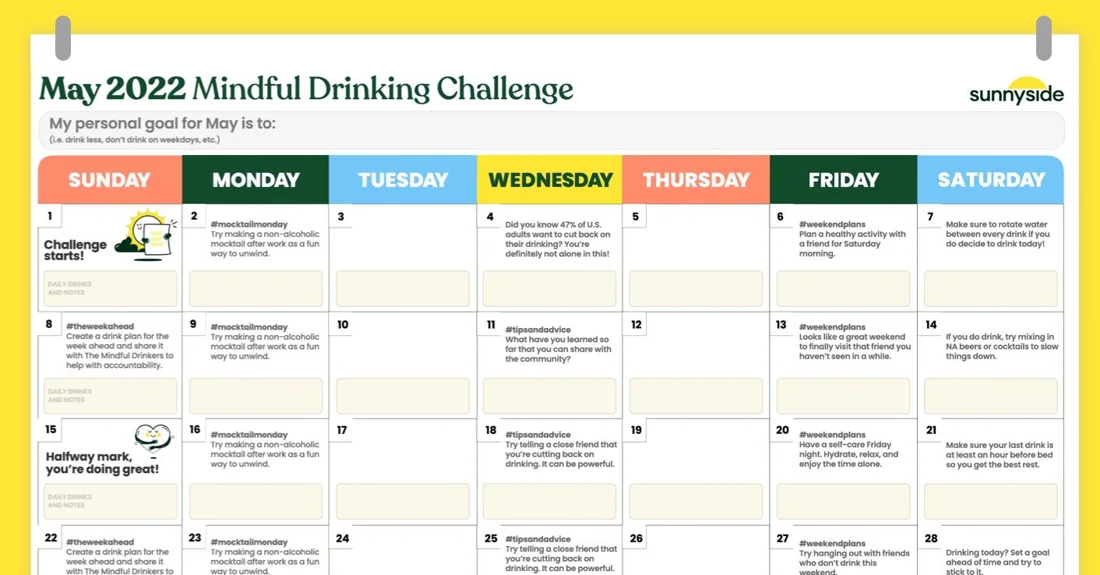
A tracking template to help you notice how drinking fits with your mood and routines.
Read the article
Explore the familiar pattern of having more than you intended, and ways to approach a change.
Read the articleStraight answers, with room for your own circumstances.
Yes. Clinicians consider impaired control and effects on health, responsibilities and relationships, as well as the pattern and amount. A drinking total alone does not diagnose alcohol use disorder.[2][15]
No. Treatment can support quitting or a substantial reduction, depending on your situation. Controlled-drinking treatment is an option to discuss; the research does not establish that it is equivalent to abstinence for everyone.[19][23]
No. AA is a well-supported route to abstinence, but it is not the only one. Behavioral treatment, medication and other support options can be used separately or together.[23][25]
Yes. Naltrexone, acamprosate and disulfiram are FDA-approved AUD treatments. They are not interchangeable, and suitability depends on your goals, health and other medications. Discuss options with a qualified clinician.[23]
Not necessarily. Drinking and mental health can influence one another, and evidence differs across populations. An intervention can reduce drinking without producing a clear added depression benefit. Anxiety or low mood deserves assessment in its own right.[20][21][22]
No amount can be described as risk-free for every person or outcome. Current US guidance advises consuming less and identifies situations where avoiding alcohol is important. Cancer guidance has not established a risk-free exposure threshold.[3][12]
A US standard drink is about 14 grams, or 0.6 fl oz, of pure alcohol. Pour size and strength both matter. The explorer estimates alcohol content, not a safe amount or blood alcohol level.[1]
If you have been drinking heavily for a long time or feel unwell when you cut back, seek medical advice before stopping or making a substantial reduction. Alcohol withdrawal can be dangerous; this guide provides no detox or taper instructions.[11][15]
Yes. Primary care can be a starting point for talking about your drinking. A clinician can assess your health and goals, offer brief counseling or medication when appropriate, and help you find specialist support if you need it.[23]
That is a reason to ask for more support. A clinician can help you review your goal, consider other treatments, and decide whether stopping is the better option for you. If you feel unwell when reducing, seek medical advice before making a major change.[11][15][23][24]
Look beyond the drink count. You might track heavy-drinking occasions, mornings lost to alcohol, missed plans, or problems at home. Research has linked substantial reductions with fewer alcohol-related problems and better functioning, including among people who still drank. Those studies do not predict your individual result.[15][17][18]
Study designs, populations and limitations are part of the story. Follow a numbered citation to the source and its notes.

US measurements: 14 g or about 0.6 fl oz of pure alcohol. The illustrated servings are examples at stated strengths. The pour explorer applies this definition; it does not estimate blood alcohol or a safe intake.
Typical binge-drinking approximations are sex-specific and time-specific. These categories support screening and research; they are not safe allowances or a diagnosis. Calendar examples in this guide are illustrations, not measured study groups.
The current alcohol section advises consuming less and identifies groups who should avoid alcohol. It does not repeat the previous edition’s one/two-drink daily caps. Relevant section: PDF page 6.
Figure estimates concern seven cancers linked to alcohol, up to age 80. The comparator is less than one US drink per week. They include cases with causes other than alcohol. The advisory does not display confidence intervals for these values. Relevant pages: 12–15.
Supports the established causal relationship, differences across cancer sites, and the distinction between absolute and relative risk. Its reference to older federal daily caps is historical; current guidance is source 3.
Review of 107 observational cohorts, with 4,838,825 participants overall. Low-volume exposure: 1.3–24 g/day. The current corrected article reports: unadjusted RR 0.85 (95% CI 0.81–0.88); fully study-level-adjusted RR 0.93 (0.85–1.01). Cohort follow-up varies; this is not a causal experiment.
Eight eligible cohorts in the main comparison; moderate consumption (up to one US drink/day for women or two for men; a study definition) versus never drinking was associated with lower all-cause mortality: RR 0.84 (95% CI 0.81–0.87), rated moderate certainty. Definitions and methods differ from source 6. An association does not establish that alcohol prolongs life.
Review of 36 intervention trials, 2,865 participants, mostly men. Highest baseline group: at least six 12-g study drinks/day, reduced by approximately half. Systolic change −5.50 mmHg (95% CI −6.70 to −4.30); diastolic −3.97 (−4.70 to −3.25). Durations varied. Not all trials were randomized.
Nonrandomized one-month study: 94 chose abstinence and 47 continued usual drinking; known liver disease and alcohol dependence excluded. In abstainers, paired group medians were ALT 25→20 IU/L (n=94), GGT 22.5→15 IU/L (n=92), HOMA 1.4→1.0 (n=86), and weight 81.1→79.5 kg (n=89). Median individual weight change was −1.5%. Multiple outcomes come from one cohort. Self-selection, baseline differences, and concurrent behavior changes limit causal conclusions. No disease-reversal claim.
Review of 27 controlled studies in healthy adults. Original alcohol-minus-control differences: first REM +18.0 min (95% CI 8.8–27.1; n=212), REM duration −11.3 (−20.8 to −1.8; n=96), total sleep −10.1 (−24.6 to +4.4; n=284). This guide displays the equivalent control-minus-alcohol contrast: more REM +11.3 (1.8–20.8), earlier first REM 18.0 min (8.8–27.1 earlier), total sleep +10.1 (−4.4 to 24.6), uncertain. This is an arithmetic reversal of the same comparisons, not a new abstinence trial or recovery timeline.
Heavy, prolonged drinking can make withdrawal dangerous. Seek medical advice before stopping in that situation. This guide provides no detox, taper, or individualized treatment instructions.
No safe alcohol-exposure threshold has been established for cancer. This is an outcome-specific statement; it does not mean every drink causes cancer, or that all health outcomes have identical evidence.
Published June 1, 2026. Synthesis of 843 cohort and case–control studies published through 2023. Low-to-moderate associations varied by outcome, with higher exposure associated with harm across all assessed outcomes. Main text checked; outcome-by-outcome supplementary curves need further review.
Models lifetime alcohol-attributable outcomes, using US exposure and cause-specific risk data. Findings depend on modeling choices and are not directly interchangeable with all-cause cohort associations. Included for context; no personal forecast or current-policy claim is drawn from it.
Impaired control, time spent drinking or recovering, effects on responsibilities and relationships, and continued use despite problems are clinical assessment domains. The six reflections here are not a diagnostic questionnaire, validated screen, or score.
FDA announced qualification of a specified two-level WHO risk-drinking reduction endpoint for adult moderate-to-severe AUD medication trials. This qualifies an outcome measure, not a medication or a universally safe amount. Public announcement checked; full qualification package not independently reviewed.
Secondary analysis with 1,142 participants with data, including a non-abstinent sensitivity sample of 806. Achieved reductions were associated with better physical, psychological, social and environmental quality of life. Reductions themselves were not randomized. This overlaps the COMBINE population in source 18.
Secondary analyses of COMBINE (1,383) and UKATT (742), with 924 and 604 in non-abstinent samples. Reductions were associated with better functioning and fewer alcohol consequences, including among people still drinking. Treatment was randomized, achieved reduction was not. Selected treatment-seeking samples; not proof of relationship repair or a causal effect of a given reduction.
22 studies, 4,204 participants; five randomized trials, only two pooled for the primary randomized comparison. The randomized estimate was imprecise (OR 1.32, 95% CI 0.51–3.39). Supports controlled-drinking treatment as an option to discuss, not equivalence or superiority to abstinence. Goal-specific treatment and selection matter.
Observational Hong Kong FAMILY and US NESARC cohorts; heavy drinkers excluded. Female quitters had a more favorable mental-wellbeing trajectory than lifetime abstainers. In the US cohort that meant less decline, not an average absolute increase. Sex-specific associations, not evidence that stopping cures anxiety. US population overlaps source 21.
NESARC observational analysis: 22,005 current drinkers, 512 in the very-high baseline group, about three years between waves. Lower odds of later depression/anxiety were associated with reductions in the highest group; findings were inconsistent in lower groups. Confounding and reverse causation remain possible; do not generalize as a cure.
163 adults aged 18–35 with depression and problematic drinking. An alcohol-focused digital add-on reduced weekly drinking at six months, without a statistically clear added depression benefit (difference −0.44, 95% CI −3.69 to 2.82). This was not a Sunnyside intervention.
Behavioral treatment, FDA-approved AUD medications, and mutual support can be combined. Care can be delivered in primary care, outpatient services or telehealth. Naltrexone, acamprosate and disulfiram have different indications and goals; this guide does not provide prescribing advice or transfer evidence to a company formulation.
A starting resource on counseling, medication, programs and peer support. Support can be matched to individual needs. Used for pathway context, not as evidence that every approach suits every person.
27 studies, 10,565 participants. Manualized facilitation designed to increase AA participation generally improved continuous abstinence compared with other established treatments. AA is a supported option, not a required route. Results do not establish equal evidence for every peer-support group.
Review supports modest average reductions with personalized computer or mobile interventions. This is class-level evidence, not proof of a particular app or company program. Digital support does not replace medically necessary care.
140 adults already diagnosed with atrial fibrillation, mostly men, randomized 70/70 to an abstinence program or usual drinking for six months. Recurrence after a two-week blanking period: 37/70 (53%) versus 51/70 (73%); HR 0.55, 95% CI 0.36–0.84. Intervention average fell from 16.8 to 2.1 study 12-g drinks/week. Not a primary prevention trial in people without AF.
Small nonrandomized study of 25 Latino adults without diabetes or cirrhosis, including people with hepatitis C. More direct measures of hepatic insulin resistance worsened after six weeks without alcohol. Populations and measures differ from Mehta. Biomarker results cannot support a universal blood-sugar or diabetes-prevention promise.
IARC Handbook 20A classifies evidence for reduction or cessation lowering oral-cavity and esophageal cancer incidence as sufficient. The epidemiology explanation emphasizes lower risk after long-term cessation compared with continued drinking. Other cancer-site findings are limited or inadequate. No equal benefit from cutting back versus stopping, fixed recovery timeline, all-cancer reversal or personal percentage is inferred. Original evaluation table and official Q&A were read; the full handbook and every constituent study were not independently reread.
Current official causes/effects, anxiety, mood and treatment-context sections checked 2026-10-28. Supports short-term apparent anxiety relief and potential worsening with heavy drinking and repeated withdrawal, plus joint assessment of alcohol and mental health. Guidance, not a new trial, diagnosis, recovery timeline or company-program efficacy claim. No prevalence estimates or individualized treatment advice are drawn from it.
Srivatsa et al. doi:10.1093/eurjpc/zwag201. Final issue October 28, 2026; manuscript available July 29, 2026. Full main manuscript checked October 30; supplement not inspected. Comparison-group and former-drinker choices affected apparent protective associations in MESA. Baseline self-report and residual bias remain; this is not a randomized trial or causal finding.
doi:10.1093/aje/kwag232. Published online September 21, 2026. Abstract and accessible publisher discussion/limitations checked October 30; direct full-body access was restricted and supplement not inspected. Modeled mortality findings in healthy Norwegian women may reflect remaining confounding or reverse causation. The analytical populations overlap. No numerical personal risk estimate, US-drink conversion or recommendation to start drinking is drawn from this source.
Published June 1, 2026; July issue. doi:10.1159/000552370. Full editorial checked October 30, 2026. Commentary on the 2025 FDA endpoint qualification, not a new clinical trial or medication approval. The FDA announcement in source 16 supplies the precise regulatory scope.
34 papers: 27 examining how people feel and function, seven examining medication-trial endpoints. Full main article checked October 30, 2026. Includes overlapping cohorts and secondary analyses; associations are not independent randomized proof of all health benefits. Not a safe-drinking guideline.
October 30, 2026 · Drinking-reduction evidence. Expanded the Drinking less chapter with the 2026 reduced-drinking editorial and its supporting 2025 review. Clarified FDA’s 2025 endpoint decision and the distinction between meaningful treatment progress and risk-free drinking. Existing health evidence and charts are unchanged.
October 30, 2026 · Weekly evidence update. Expanded the explanation of why alcohol-and-health studies disagree, with the MESA methods analysis and contrary Norwegian mortality findings. Kept observational limits and the advice not to start drinking for health. Practical guidance, the cancer discussion and existing charts are unchanged. Human clinical review remains pending.