
Why Naltrexone Is Not Addictive
Naltrexone is not addictive or habit-forming. It blocks opioid receptors rather than activating them, so it doesn't produce...

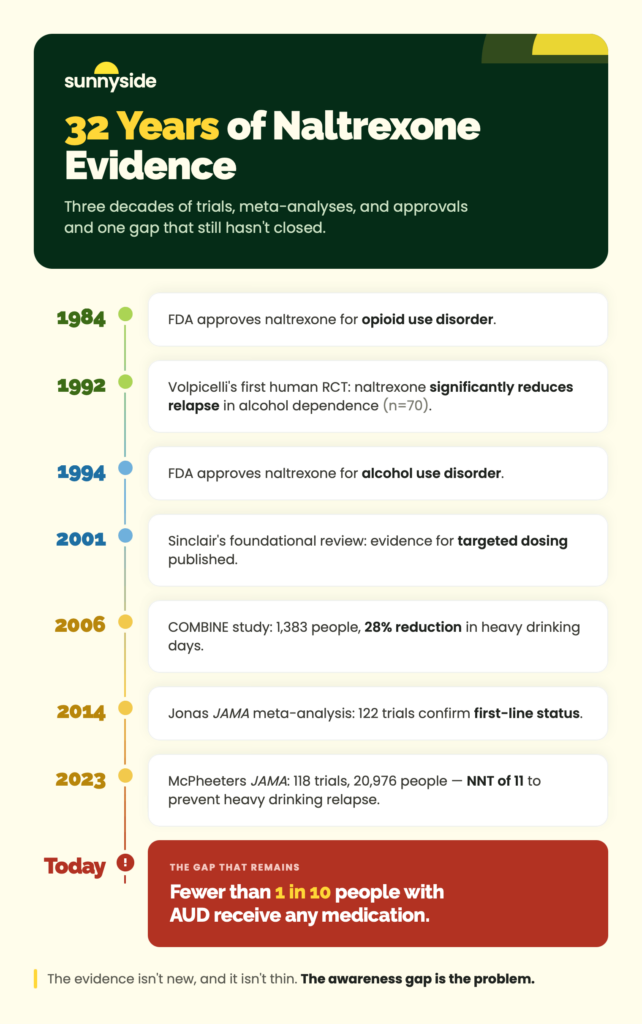
Naltrexone has been studied for alcohol use for more than 30 years, and the evidence shows that it can reduce heavy drinking and relapse in people with alcohol use disorder. A 2023 JAMA review found that oral naltrexone reduced the risk of returning to heavy drinking, with a number needed to treat (NNT) of 11. Large trials such as COMBINE have also found benefits for drinking outcomes, although naltrexone does not work equally well for everyone.
Naltrexone isn’t a new or experimental drug. Researchers began studying its potential for alcohol use in the 1980s, after animal studies found that blocking opioid receptors could reduce drinking. But a surprising number of people don’t know just how well-researched it is.
In 1992, Joseph Volpicelli and colleagues published a randomized, double-blind, placebo-controlled trial of 70 men with alcohol dependence. After 12 weeks, 23% of the men who received naltrexone had returned to heavy drinking, compared with 54.3% of those who received a placebo. Another randomized trial published that same year also found that naltrexone could reduce drinking and relapse. The FDA approved naltrexone for alcohol dependence two years later, in 1994.
That was more than 30 years ago. Since then, dozens of trials have looked at naltrexone for alcohol use. Some have produced stronger results than others, but taken together, the research shows that naltrexone can reduce heavy drinking and the risk of relapse.
Despite that track record, naltrexone remains underprescribed. We’ll get into why later. First, here’s what the research tells us about how naltrexone works for alcohol.
Naltrexone is an opioid receptor antagonist. Alcohol activates the brain’s endogenous opioid system, which is involved in the rewarding effects of drinking. Naltrexone blocks those receptors, which can make alcohol feel less rewarding and reduce the urge to keep drinking.
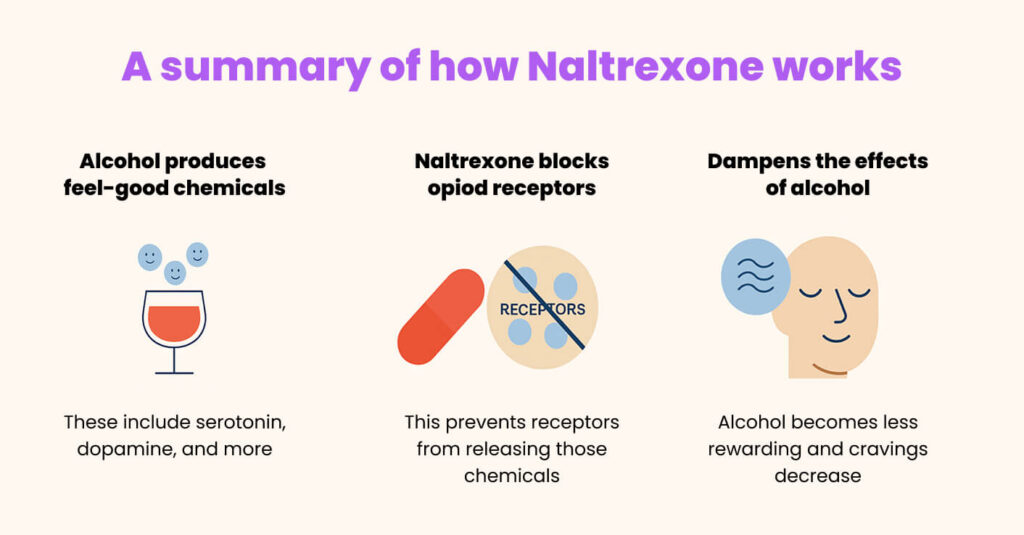
One Trustpilot reviewer described it as “unlinking the connection between the reward centre of your brain and the substance.” That’s a simplified version of what’s happening, but it gets at the basic idea.
Naltrexone isn’t disulfiram, which makes you physically ill if you drink. It’s not a sedative, doesn’t produce euphoria, and isn’t addictive. And while researchers are still working out exactly how it reduces alcohol consumption, the opioid system appears to play an important role.
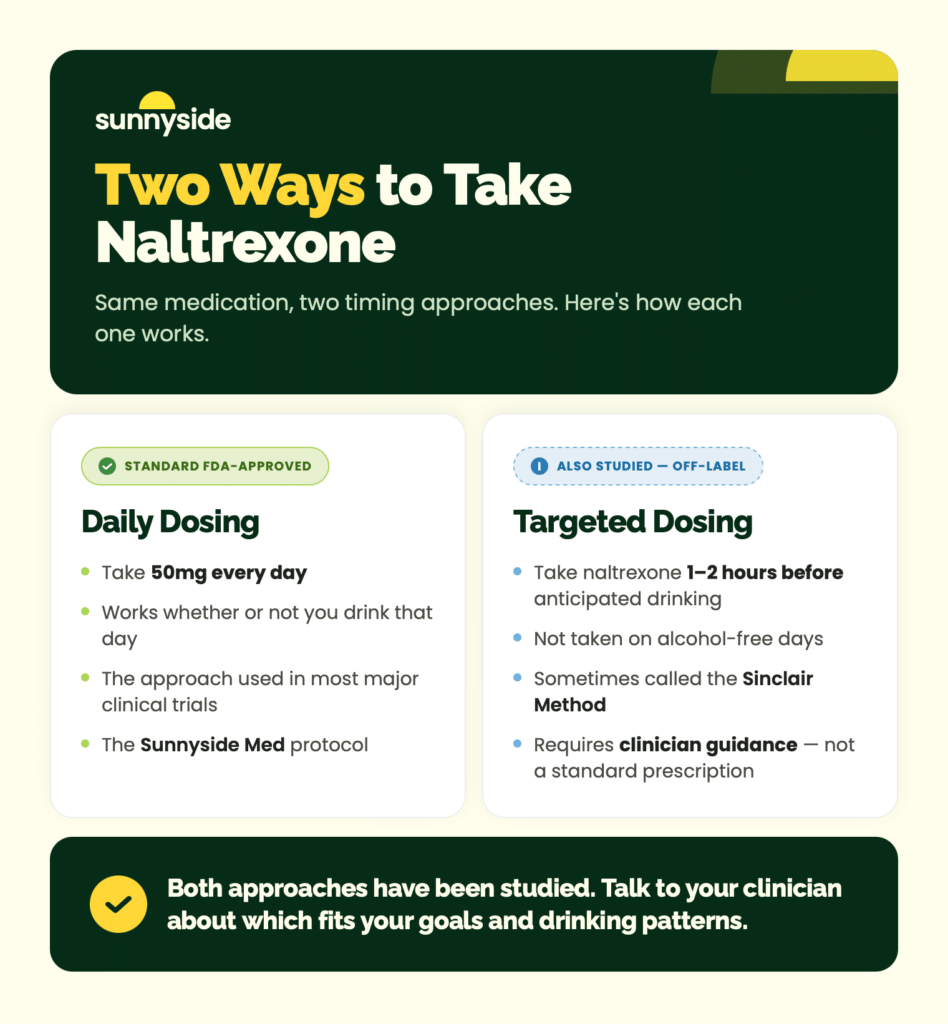
Two dosing strategies have been studied. Daily oral naltrexone is the standard FDA-approved approach. Researchers have also studied targeted dosing, where naltrexone is taken before anticipated drinking. This approach is off-label and should be discussed with a prescribing clinician. We’ll get into that research below, or you can read more about the Sinclair Method versus daily naltrexone.
Research can tell us whether naltrexone works. But people also have to be able to access it and stick with it.
Sunnyside Med is a 100% online alcohol health program that combines naltrexone with behavioral support. A licensed clinician reviews every application, and members get coaching seven days a week, drink tracking, goal setting, weekly planning, group calls, and access to a private community.
Sticking with the medication matters. Sunnyside Med members who engage with the full program are 2.5x more likely to stay on their medication at month four. (Individual results vary.)
Co-founder Ian Andersen takes naltrexone daily. As he puts it, “You’re not here because you hate alcohol. You’re here because it’s been taking more than it’s been giving.”
Sunnyside Med costs $99 a month, is HSA/FSA eligible, and is available in all 50 states. Learn more about Sunnyside Med.
One useful way to look at the evidence for naltrexone is through a 2023 systematic review and meta-analysis published in JAMA. The researchers reviewed 118 clinical trials involving 20,976 participants across medications for alcohol use disorder.
For oral naltrexone specifically, the results were consistent across several drinking outcomes. In 16 trials involving 2,347 participants, naltrexone reduced the likelihood of returning to any drinking compared with placebo. In 23 trials involving 3,170 participants, it reduced the likelihood of returning to heavy drinking.
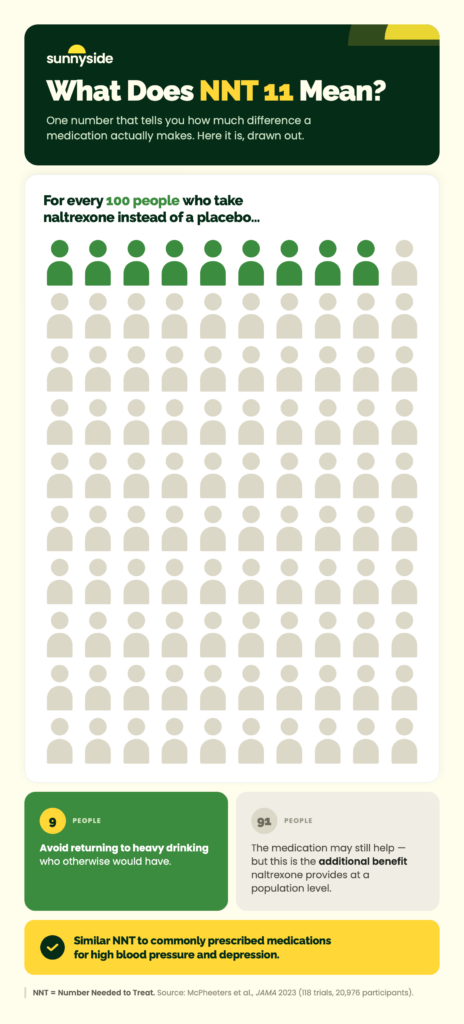
The number needed to treat, or NNT, was 18 to prevent one person from returning to any drinking and 11 to prevent one person from returning to heavy drinking. In other words, for every 11 people treated with naltrexone instead of placebo, one additional person avoided returning to heavy drinking.
The review found moderate-strength evidence for oral naltrexone across several outcomes, including return to heavy drinking, percentage of drinking days, and percentage of heavy drinking days. The authors concluded that oral naltrexone and acamprosate had the strongest evidence among the medications they reviewed.
There are limits to what those numbers tell us. Most of this research involves people diagnosed with alcohol use disorder, so we can’t assume the same results in people who drink more than they want to but don’t meet the criteria for AUD.
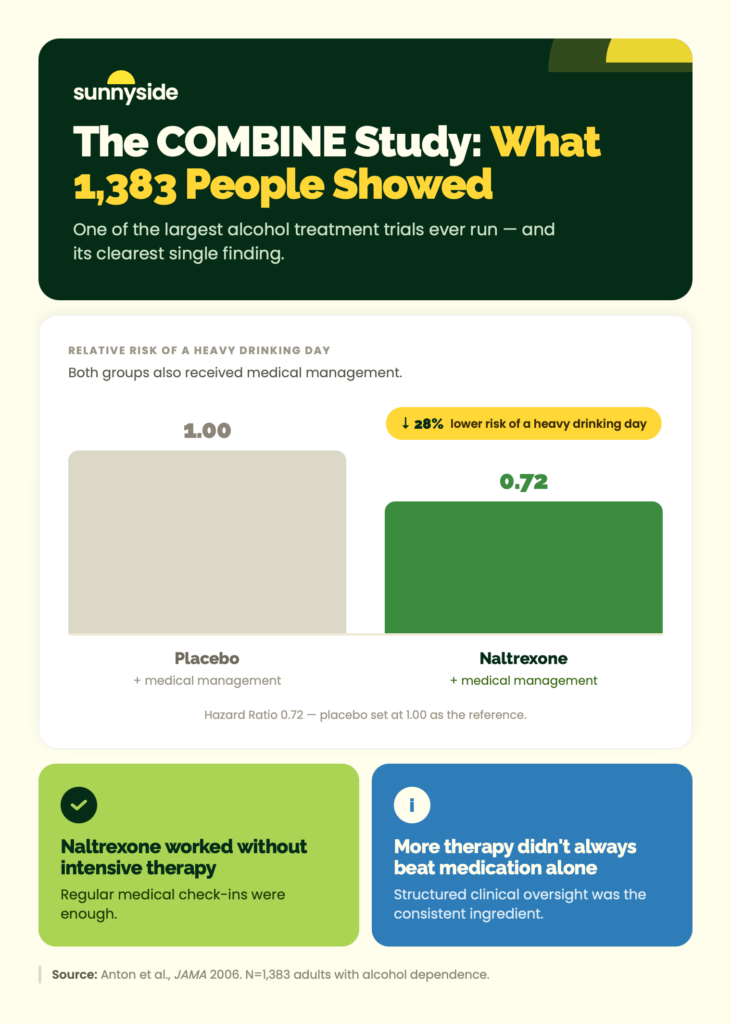
The 2006 COMBINE study enrolled 1,383 adults with alcohol dependence across 11 sites. It compared naltrexone, acamprosate, behavioral treatment, and medical management in several combinations.
Naltrexone reduced the risk of a heavy drinking day during treatment, with a hazard ratio of 0.72. People who received naltrexone with medical management also had more abstinent days than those who received placebo with medical management.
One of the more interesting findings was how well naltrexone worked with relatively straightforward medical support. The medical management used in COMBINE included brief appointments with a healthcare professional rather than intensive specialty treatment.
Adding the study’s more intensive behavioral intervention didn’t improve the effect of naltrexone. The researchers concluded that naltrexone with medical management could be delivered in regular healthcare settings, making treatment available to people who might not otherwise receive it.
COMBINE participants had alcohol dependence and had recently stopped drinking when they entered the study. That’s worth keeping in mind when applying its results to people with less severe drinking patterns.
Not every naltrexone trial has been positive. In 2001, a large VA study tested naltrexone in 627 veterans with chronic, severe alcohol dependence. Almost all of the participants were men, and all received psychosocial treatment.
The researchers found no significant difference in time to relapse between the naltrexone and placebo groups. At one year, they also found no significant differences in drinking days or drinks per drinking day (Krystal et al., NEJM, 2001).
It’s an important result, especially because the study was large and well designed. But the researchers also noted that their participants were older, heavier drinkers with a long history of alcohol dependence, and that the findings might not apply to people with less severe alcohol problems.
Later trials and meta-analyses have found an overall benefit from naltrexone, even with this negative study included. The broader picture is positive, but not every person or population responds the same way.
Most of the evidence for oral naltrexone comes from daily use. Researchers have also studied targeted dosing, where the medication is taken around anticipated drinking rather than every day.
A 2022 randomized trial tested that approach in 120 sexual and gender minority men who binge drank and had mild to moderate alcohol use disorder. Participants received either targeted naltrexone or placebo, along with weekly counseling (Santos et al., American Journal of Psychiatry, 2022).
During the 12-week study, the naltrexone group reported fewer binge-drinking days, fewer drinks per month, and lower alcohol cravings. Some reductions in drinking were still present six months after treatment ended.
Because participants had mild to moderate AUD rather than severe alcohol dependence, this study is especially interesting for people who want to cut back before their drinking becomes more severe. But it isn’t a study of “gray-area drinkers” generally. It involved a specific population, and everyone met criteria for AUD.
Targeted dosing is also off-label. Daily oral naltrexone remains the standard FDA-approved approach. You can read more about the differences between targeted and daily naltrexone.
Naltrexone is available as a daily oral tablet and as a monthly extended-release injection, sold as Vivitrol. Both are FDA-approved for alcohol dependence.
Until recently, there wasn’t much head-to-head research comparing the two. The 2025 ADOPT trial randomized 248 hospitalized adults with alcohol use disorder to oral or extended-release injectable naltrexone (Magane et al., JAMA Internal Medicine, 2025).
Heavy drinking fell substantially in both groups over three months. The oral group had a 38.4-percentage-point reduction in heavy drinking days, compared with 46.4 percentage points in the injectable group. The difference between the groups was not statistically significant.
That doesn’t establish that the two forms are always equally effective. It does suggest that either option can be reasonable, and the researchers pointed to factors such as cost, availability, and patient preference when choosing between them.
The practical differences are considerable. Oral naltrexone is generic and can be prescribed through telehealth, but it has to be taken consistently. The injection lasts about a month at a time and removes the need to take a pill each day, but it requires an injection and can be more expensive.
ADOPT also studied hospitalized adults with AUD, so its results shouldn’t automatically be applied to people with less severe drinking patterns. For a fuller breakdown, see oral naltrexone versus Vivitrol.
Naltrexone has been available for alcohol treatment for more than 30 years, but medications for AUD are still rarely used. According to NIAAA, only 2.5% of people with past-year AUD received medication treatment in 2024.
One reason appears to be clinician familiarity. In a 2022 survey of 146 prescribers across internal medicine, family medicine, and psychiatry, only 23.3% said they had prescribed naltrexone for AUD in the previous three months (Leung et al., Frontiers in Psychiatry, 2022).
Among those who hadn’t prescribed it, the most common reason was unfamiliarity with naltrexone for AUD. Another common concern was that patients wouldn’t have adequate follow-up or weren’t enrolled in a formal treatment program.
Insurance coverage can create another obstacle. A 2025 study examined 241 Medicaid managed care plans and found that 84.2% covered oral naltrexone, but only 42.7% covered all four FDA-approved AUD medications included in the analysis (Stewart et al., JAMA Network Open, 2025).
The result is a pretty big gap between what the research supports and how often these medications are actually used. Naltrexone isn’t obscure because researchers haven’t studied it. For many patients, it simply never comes up in conversation with their clinicians.
Naltrexone doesn’t work equally well for everyone, and researchers have spent years trying to figure out why.
One area of interest is the OPRM1 gene, which codes for the mu-opioid receptor. A 2012 meta-analysis of six studies found that people carrying one version of this gene, commonly called the G allele, had lower relapse rates while taking naltrexone than people without it (Chamorro et al., 2012).
But the finding isn’t strong enough to use as a clinical test. The analysis found no difference in abstinence rates, and its relapse result became nonsignificant when some individual studies were removed. Other studies have also produced mixed results.
For now, genetic testing isn’t part of routine naltrexone prescribing. Researchers are still looking for reliable ways to predict who is most likely to respond, but in practice, response is something clinicians and patients find out through treatment.
Naltrexone can only help if people keep taking it. That sounds obvious, but adherence has been a recurring issue in alcohol-treatment research.
A follow-up analysis of the COMBINE study looked specifically at medication adherence and drinking outcomes (Zweben et al., 2008). The relationship was complicated by the different treatment groups, but inadequate exposure to naltrexone was associated with poorer outcomes.
That doesn’t mean naltrexone necessarily works better when it’s paired with intensive therapy. In COMBINE, adding the study’s intensive behavioral intervention didn’t produce an additional benefit for people taking naltrexone. But regular medical follow-up was part of the treatment, and taking the medication consistently still mattered.
That’s part of the thinking behind Sunnyside Med. Members have clinical oversight along with drink tracking, goal setting, coaching seven days a week, weekly group calls, and a private community. Sunnyside Med members who engage with the full program are 2.5x more likely to stay on their medication at month four. Individual results vary.
Dr. Hrishikesh Belani, M.D., a Sunnyside Medical Advisor, puts it this way: “I prescribe naltrexone regularly as a safe, effective way to curb heavy drinking. I highly recommend pairing with a behavioral health program like Sunnyside.”
One member described the change this way: “For the first time in years I have control over my drinking and my cravings. I know I can have a drink, but I just don’t really want one.”
78% of active Sunnyside Med members achieved a meaningful reduction in drinking over 12 weeks. Individual results vary. Sunnyside Med costs $99 a month, is HSA/FSA eligible, and is available in all 50 states. A licensed clinician reviews every application.
If you’re interested, you can see if you’re eligible with a short quiz or read more about how naltrexone works with behavioral support.
Naltrexone has been studied in dozens of randomized trials over more than 30 years. A 2023 JAMA review included 118 trials and 20,976 participants across medications for alcohol use disorder overall. Within that review, 23 naltrexone trials contributed evidence on return to heavy drinking and 16 contributed evidence on return to any drinking.
COMBINE was a 1,383-person randomized trial published in JAMA in 2006. Naltrexone reduced the risk of a heavy drinking day during treatment and increased the percentage of abstinent days when paired with medical management. Adding a more intensive behavioral intervention didn’t produce an additional benefit for naltrexone.
Most naltrexone research has involved people diagnosed with alcohol use disorder or, in older studies, alcohol dependence. So we don’t have the same level of evidence for people who drink more than they want to but don’t meet the criteria for AUD.
Some newer research has included people with less severe AUD. The 2022 targeted-dosing trial, for example, involved people with mild to moderate AUD who binge drank. That’s encouraging, but it isn’t the same as studying people without AUD.
There isn’t one reason. Research has identified barriers including limited clinician familiarity, concerns about follow-up, and gaps in access to alcohol treatment. Despite decades of research, medications remain a small part of AUD treatment in the U.S.
The evidence for naltrexone is much more established. It has been FDA-approved for alcohol treatment since 1994 and has been studied in dozens of randomized trials.
Research on semaglutide is much newer. A 2025 randomized trial of 48 adults with AUD found that semaglutide reduced alcohol consumption during a laboratory drinking session and showed reductions in some measures of drinking and craving. Those findings are promising, but larger trials are still needed. Semaglutide is not FDA-approved to treat AUD.
You don’t necessarily need to see an addiction specialist. Primary care clinicians can prescribe medications for AUD, and alcohol treatment is also available through telehealth.
Sunnyside Med is 100% online and available in all 50 states. A licensed clinician reviews every application, and the program combines medication with coaching and behavioral tools. You can learn more about Sunnyside Med and see if it fits your goals.
Naltrexone is a prescription medication. This content is educational and should not be taken as medical advice. A licensed clinician reviews every Sunnyside Med application.
Ian has a family deeply hurt by alcohol, and is on his own personal journey to drink less and live his healthiest life. He’s took naltrexone daily for two years and saw incredible results. As Sunnyside Med’s first customer, he’s deeply entrenched in alcohol health and naltrexone.
Naltrexone is not addictive or habit-forming. It blocks opioid receptors rather than activating them, so it doesn't produce...

Getting a prescription for naltrexone doesn't have to mean a long sit in a doctor's waiting room. With...

Naltrexone eligibility is determined through an individual clinical evaluation, not a single pass-or-fail test. You don't need to...
If you’re interested in trying naltrexone to help you drink less, the natural next question is where to...