
Anxiety and Alcohol: Why Drinking Feels Like It Helps, Then Makes Things Worse
The relationship between anxiety and alcohol is more complicated than most people realize. Alcohol can absolutely calm anxiety...


President, Assisted Recovery Centers of America (ARCA)


Hangxiety is anxiety that occurs after drinking alcohol as your brain and body recover from alcohol’s effects. Researchers believe it’s caused by temporary changes in brain chemistry, elevated stress hormones, and disrupted sleep. Symptoms can include racing thoughts, a pounding heart, feelings of dread, and heightened worry. Sunnyside Med combines prescription naltrexone with behavioral support to help eligible adults drink less and reduce the cycle that contributes to hangxiety.
“Hangxiety,” the surge of anxiety and dread many people experience the day after drinking, is a real and well-documented phenomenon. A systematic review published in Drug and Alcohol Review in 2025 found that alcohol hangovers are consistently associated with increased anxiety, stress, and depressed mood, even among otherwise healthy social drinkers.
While not everyone experiences anxiety after drinking, many people report feeling more emotionally vulnerable or on edge during a hangover. Not just fatigued or nursing a headache—feeling real anxiety, dread, racing thoughts, or a sense that something bad is about to happen.
If you’re experiencing hangxiety, the first thing you should know is that the feeling does not indicate a character flaw. It’s brain chemistry. Here, we’ll move beyond the usual “sleep and drink water” advice and actually explain the phenomenon: why the anxiety can feel worse every year, why it can last beyond the initial hangover, and why willpower is an unreliable solution when your brain chemistry is working against you.
“Hangxiety” is a portmanteau of “hangover” and “anxiety.” Researchers typically refer to the phenomenon as hangover anxiety or post-drinking anxiety, but anyone who has experienced it knows it’s more than a clinical label.
The term caught on because millions of people recognized themselves in it. Sunday-morning dread. A racing heart when you check your phone. Replaying conversations from the night before and filling in the blanks with worst-case assumptions. A lingering sense that something is wrong, even when nothing specifically is.
Perhaps the most important thing to understand is that hangover anxiety isn’t limited to people with alcohol use disorder. A systematic review published in Drug and Alcohol Review in 2025 found that alcohol hangovers are consistently associated with increased anxiety, stress, and depressed mood across the research literature, including studies of otherwise healthy social drinkers. In other words, you don’t have to be a “problem drinker” in the traditional sense to wake up feeling like your nervous system caught fire.
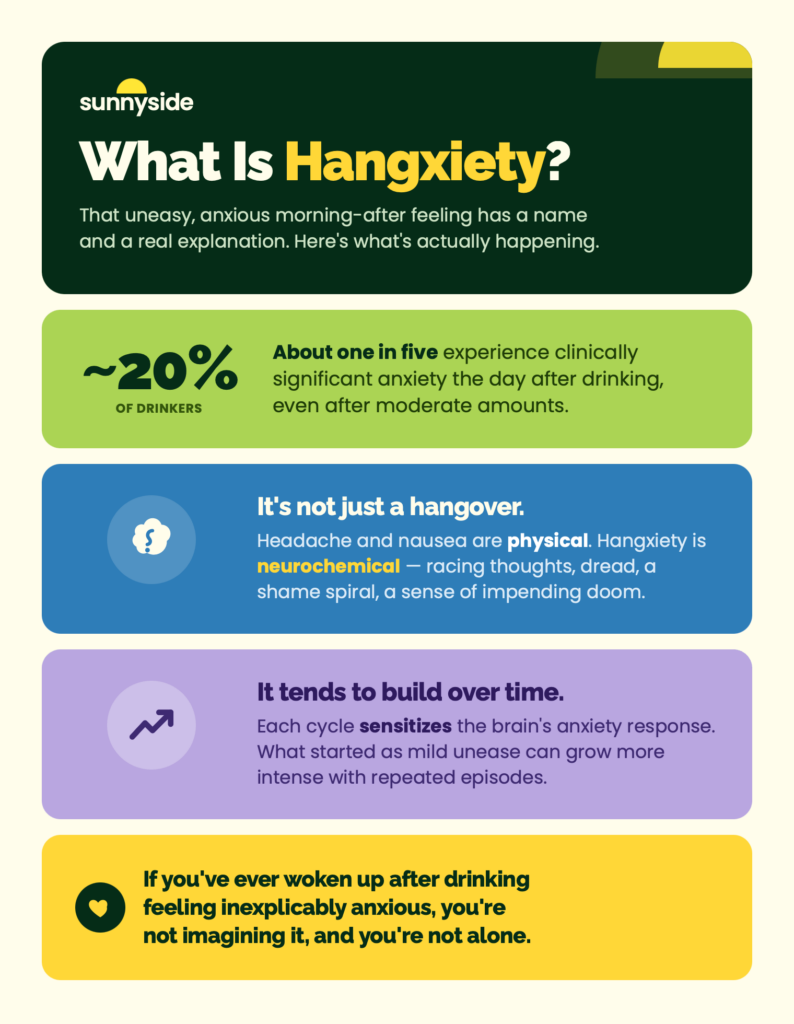
The experience of hangxiety ranges from mildly uncomfortable to genuinely debilitating. Where you land on that spectrum depends on how much you drank, your personal neurobiology, your baseline anxiety, and how long this cycle repeats.
At the more severe end, hangxiety can begin to resemble the early symptoms of mild alcohol withdrawal, especially after heavy or repeated drinking. The two aren’t the same, but they share some underlying biology. As alcohol leaves your system, your brain temporarily shifts away from the calming effects it had adapted to, leaving your nervous system in a more activated state.
These are still hangover symptoms. But when anxiety becomes the dominant feature, it can create a feedback loop of racing thoughts, physical tension, and catastrophizing that lasts long after the headache or nausea has started to fade.
Hangxiety isn’t just “in your head.” Researchers have spent decades studying what alcohol does to the brain during and after drinking, and many of the symptoms people describe—including racing thoughts, dread, a pounding heart, and waking up anxious at 3 a.m.—can be explained by temporary changes in brain chemistry, stress hormones, and sleep.
Understanding what’s happening inside your body can make the experience feel less mysterious. It also helps explain why hangxiety can feel so intense, even when nothing in your life has actually gone wrong.
This is the core mechanism behind hangxiety.
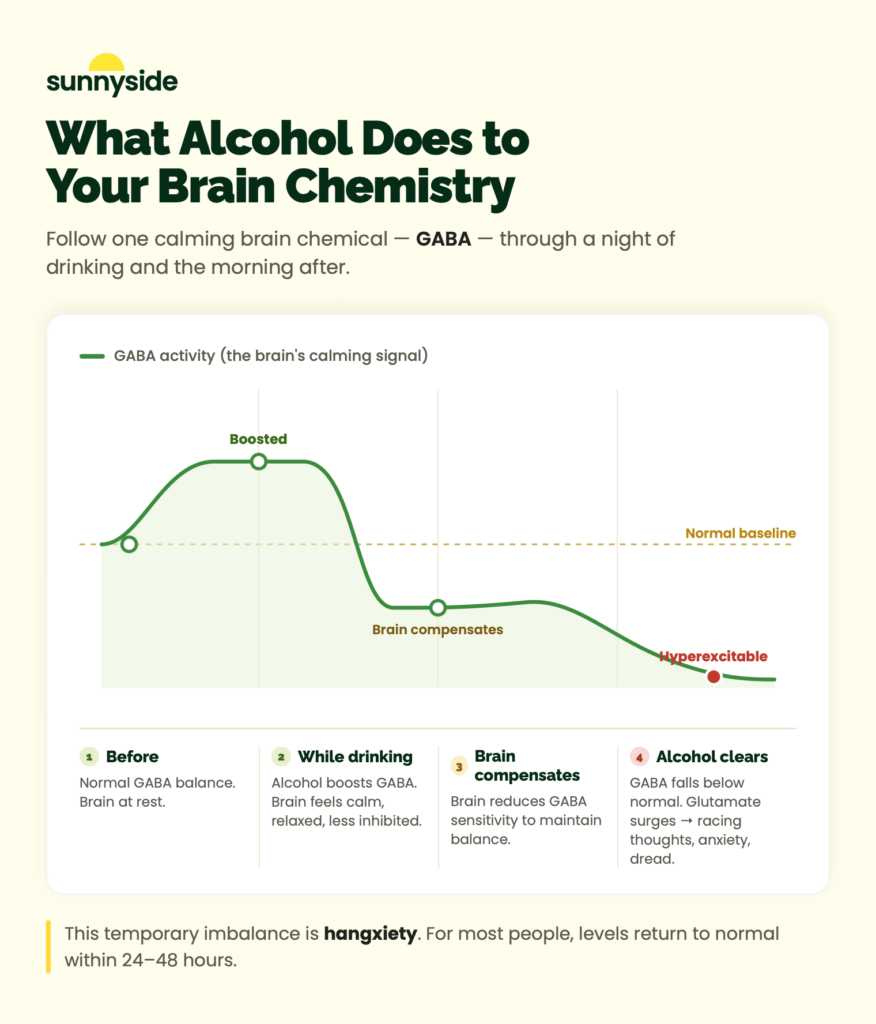
GABA (gamma-aminobutyric acid) is your brain’s primary inhibitory neurotransmitter. Think of it as the brain’s natural “brake pedal,” slowing down neural activity and promoting calm. Glutamate, by contrast, is the brain’s primary excitatory neurotransmitter. It acts more like the “gas pedal,” increasing alertness and neural activity.
Alcohol temporarily tips that balance. It boosts the brain’s calming GABA system while dialing down the stimulating effects of glutamate. That’s a big reason drinking initially feels relaxing: your brain becomes quieter, less inhibited, and less reactive.
However, your brain is always trying to maintain equilibrium. As alcohol continues boosting GABA signaling, it begins compensating by making GABA receptors less responsive and increasing glutamate activity. Those adjustments help keep the brain functioning while alcohol is present.
The problem arises when the alcohol leaves your system. The compensatory changes don’t disappear immediately. For a period of time, there’s less inhibitory signaling and more excitatory signaling than your brain is used to. The result is a temporary state of hyperarousal: racing thoughts, irritability, restlessness, increased heart rate, and anxiety.
One way to think of it: Hangxiety reflects a brain that is temporarily working harder to restore its normal balance.
The research supporting this mechanism comes from multiple lines of evidence, including Littleton (1998) on the neurochemical mechanisms underlying alcohol withdrawal and Koob & Volkow’s 2016 landmark review on the three-stage addiction cycle in The Lancet Psychiatry.
Changes in GABA and glutamate explain much of the brain’s excitability, but they aren’t the whole story. Alcohol also affects the hypothalamic-pituitary-adrenal (HPA) axis, the body’s primary stress-response system. As alcohol leaves your body, cortisol—the body’s main stress hormone—can remain elevated, adding another layer of physical anxiety on top of the changes already occurring in the brain.
Research by Stephens and Wand (2012) in Alcohol Research describes how repeated alcohol use can disrupt this stress-response system, helping explain why many people feel especially anxious or on edge as alcohol wears off. This same stress response may also contribute to anxiety after a night of heavy drinking.
Elevated cortisol can make your body’s normal stress response feel more intense. Your heart may beat faster, you may feel more alert or restless, and ordinary worries can suddenly seem much more threatening than they really are.
When your brain is already in a temporarily hyperexcitable state, and your stress-response system is dialed up at the same time, the combined effect can feel overwhelming. Many people describe it as a persistent sense that something terrible is about to happen, even when there is no actual threat.
If you’ve ever jolted awake at 3 a.m. after drinking with your heart pounding and your mind immediately spiraling, there’s a biological explanation for that, too.
Alcohol may help you fall asleep faster, but it disrupts sleep architecture throughout the night. As alcohol is metabolized—often six to eight hours after your last drink—the sedating effects wear off while the brain’s compensatory changes remain. REM sleep becomes fragmented, autonomic nervous system activity increases, and cortisol begins its normal pre-dawn rise.
The result is one of the hallmark experiences of hangxiety: waking suddenly with a racing heart, sweating, and a mind that immediately jumps to worst-case scenarios.
Research by Roehrs and Roth (and subsequent reviews) documents how alcohol disrupts the second half of the night’s sleep, a pattern researchers believe may contribute to poorer mood and greater anxiety the following day.
Not everyone experiences hangxiety the same way. Two people can drink the same amount and wake up feeling completely different.
Researchers believe several factors influence who is most susceptible:
Put together, these biological changes create the perfect conditions for hangxiety. The brain becomes more excitable, the body’s stress response stays elevated, and sleep becomes less restorative. A perfectly ordinary thought—”Did I say something embarrassing?”—can suddenly feel like evidence that something is terribly wrong.
The brain is remarkably adaptive. Every time you drink heavily and then clear alcohol from your system, it goes through the same cycle of compensation described above. Over months and years, those repeated cycles can become more pronounced. The brain begins to anticipate alcohol and adjust accordingly, so when alcohol is absent, the rebound toward anxiety and hyperarousal happens faster and feels more intense.
Researchers studying alcohol dependence refer to this process as “kindling.” Repeated withdrawal episodes appear to sensitize certain neural circuits, making future withdrawal symptoms more severe. Most of the research on kindling has been conducted in people with alcohol dependence, as described by Becker (1998), but the underlying principle helps explain why frequent heavy drinking can make next-day anxiety feel worse over time.
For many people, the shift is gradual. In your twenties, a hangover might have meant a headache, greasy food, and a lazy Sunday. Years later, the physical symptoms may be manageable—but the anxiety becomes the part you dread most.
There’s also a psychological layer. Once hangxiety becomes predictable, you may begin worrying about tomorrow before you’ve even finished drinking tonight. The anticipation itself becomes stressful. Eventually, the thinking about drinking can become just as exhausting as the drinking itself.
But this process isn’t inevitable. The same brain that adapted to repeated drinking can adapt to a better pattern, too. When they engage in heavy drinking less frequently, many people notice that their hangxiety becomes less frequent and less intense, too.
One pervasive myth about alcohol? That you have to wait until drinking becomes a crisis before you do something about it.
In reality, many people fall into what’s often called gray-area drinking. They’re succeeding at work, maintaining relationships, and functioning day to day. But they’re also tired of negotiating with themselves every weekend and waking up anxious.
“You’re not here because you hate alcohol,” said Sunnyside co-founder Ian Andersen. “You’re here because it’s been taking more than it’s been giving.”
Many Sunnyside Med members aren’t trying to quit drinking forever. Instead, they’re trying to foster a healthier relationship with alcohol— and stop the cycle of overthinking, poor sleep, and next-day anxiety.
One Sunnyside Med member described the change this way: “The thinking about drinking is as bad as the drinking. Now I barely think about it.”
That shift captures the real goal. It’s not simply drinking less. It’s spending less mental energy negotiating with alcohol and getting more of your life back.
If you’re already in the middle of hangxiety, the goal isn’t to erase the underlying biology overnight. It’s to help your nervous system settle while your brain returns to its normal balance.
These strategies can make a difficult day more manageable. But they don’t change the pattern that’s creating hangxiety in the first place. For that, it’s worth looking upstream.
Once you understand the biology behind hangxiety, it’s much easier to conceive of what will help.
Hangxiety is driven by a repeating cycle of alcohol reward, neurochemical rebound, and learned habit. Breaking that cycle works best when you address both the biology and the behavior. That’s why Sunnyside Med combines prescription naltrexone with behavioral support.
Naltrexone has been studied for decades as a treatment for alcohol use disorder. It works by blocking opioid receptors involved in alcohol’s rewarding effects, reducing the “that felt good, let’s have another!” signal that reinforces continued drinking. Many people find that during their naltrexone journey, the urge to keep drinking after the first or second drink gradually becomes more subdued.
Behavioral support addresses the other half of the equation. Medication can reduce the neurological pull toward alcohol, while coaching, progress tracking, and evidence-based behavior change strategies (all tools we offer at Sunnyside) help build new routines that last.
The landmark COMBINE study, a National Institutes of Health trial involving 1,383 participants published in JAMA in 2006, found that naltrexone combined with behavioral support produced better outcomes than either approach alone. That’s the Sunnyside thought process: Medication changes the biological environment. Behavior change helps reshape the habit.
If you’d like to learn more, our comprehensive naltrexone guide explains how naltrexone works, what to expect when starting treatment, and how Sunnyside Med combines medication with behavioral support to help people build a healthier relationship with alcohol.
For some people, hangxiety is an intense but temporary wave of panic after a night of drinking. For others, the connection between alcohol and anxiety can be harder to parse.
Merrilee Burke, LMFT, a licensed psychotherapist specializing in alcohol moderation, says alcohol can contribute to anxiety in ways that extend beyond the familiar middle-of-the-night spiral of wondering, “Oh my god, what did I do?”
“Not only can the effects of hangxiety be more pronounced for those with a predisposition toward heightened anxiety or anxiety disorders, [but] it can also be a hidden cause of someone’s chronic anxiety,” Burke explains.
Among people who drink regularly over a long period of time, alcohol can contribute to a more diffuse, ongoing sense of anxiety without the person necessarily realizing that drinking is playing a role.
That is one reason Burke sometimes encourages people to take a break from alcohol and observe what changes. A temporary break does not have to mean deciding never to drink again. Instead, it can help someone better understand how much of their anxiety may be alcohol-related.
“Knowing that feelings of dread and unease are being caused by a chemical reaction to alcohol can lessen the intensity around those feelings,” Burke says.
For people using naltrexone to reduce their alcohol consumption, Burke sees another potential benefit: reducing cravings can create more space to examine the habits and psychological factors that may be influencing drinking. This is part of the thinking behind Sunnyside Med’s approach, which pairs medication with tools designed to support the behavioral side of changing your relationship with alcohol.
“When naltrexone helps reduce the cravings for alcohol, that clears the path for someone to work on any underlying psychological factors that could be influencing their drinking,” she says. “Simultaneously addressing the neurological and personal aspects of someone’s relationship with alcohol gives them a better chance of meeting their goals.”
You don’t have to quit drinking forever to reduce hangxiety. Drinking less—and especially having fewer heavy drinking episodes—means your brain spends less time cycling through alcohol’s reward-and-rebound pattern. Every heavy drinking episode you avoid is one fewer opportunity for that neurological cycle to reinforce itself.
That’s also why Sunnyside Med combines medication with behavioral support instead of relying on either one alone.
Compounded naltrexone helps reduce alcohol’s rewarding effects, making it easier for many people to stop after one or two drinks instead of continuing to chase the feeling. At the same time, the Sunnyside app, daily tracking, weekly goal-setting, coaching, and evidence-based behavior change tools help you build new habits that last beyond any single night out.
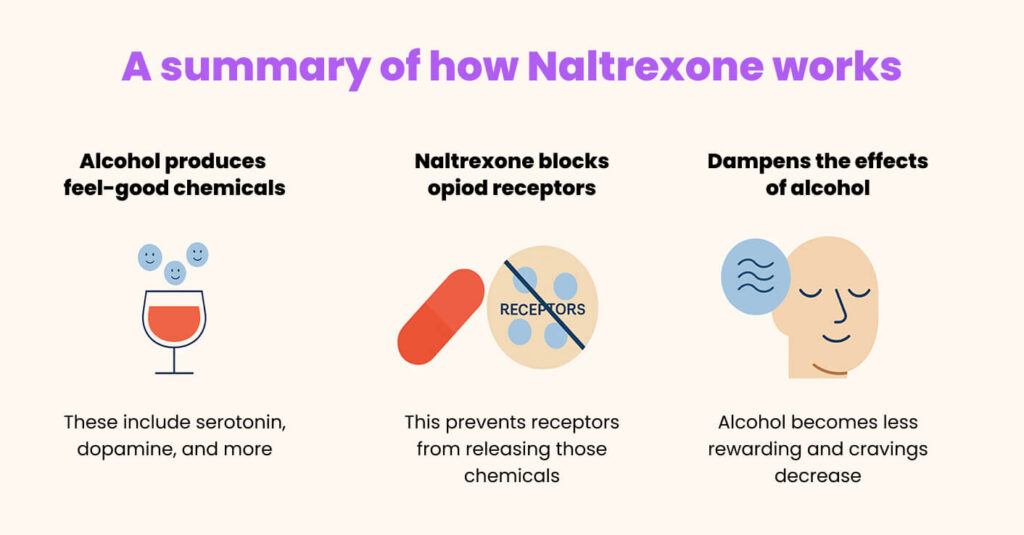
This approach reflects what decades of research have shown: medication changes the biological environment, while behavioral support helps change the habit. Together, they reinforce each other.
“Tracking my drinks and starting the medication has been a game changer,” said one Sunnyside Med member. “This is the first time in many years I’m starting to take control.”
Among active Sunnyside Med members with at least 50% app engagement, 78% achieved a meaningful reduction in drinking over 12 weeks, and members averaged 45.6% fewer drinks per week. (Individual results vary.)
If you’ve recognized yourself throughout this article, remember that the biology behind hangxiety isn’t permanent. The brain can adapt when the pattern changes. For people who want to reduce their drinking, Sunnyside Med offers an evidence-based path that combines clinician-prescribed medication with behavioral support designed for real life.
Everything happens online, from a brief introductory quiz to clinician review and discreet medication delivery in all 50 states. If appropriate, your medication is shipped directly to your door, and you’ll have ongoing support as you work toward a healthier relationship with alcohol.
Hangxiety doesn’t have to be a permanent part of your weekends.
Hangxiety is the anxious, uneasy feeling some people experience after drinking alcohol. It’s driven by temporary changes in brain chemistry, stress hormones, and sleep that occur as alcohol leaves your system. While not everyone experiences hangxiety, it’s common enough to have earned its own name.
For most people, hangxiety is worst during the first 12 to 24 hours after alcohol has cleared from the body and gradually improves as the brain returns to its normal balance. However, anxiety, low mood, and fatigue can linger for one to three days after heavier drinking, particularly in people with underlying anxiety or significant sleep disruption.
Repeated cycles of heavy drinking and recovery can make hangxiety feel more intense over time. Researchers believe the brain becomes increasingly sensitive to alcohol’s repeated reward-and-rebound cycle, while poor sleep and anticipatory anxiety can further reinforce the pattern. The encouraging news is that this process can begin to reverse as heavy drinking becomes less frequent.
There isn’t a medication approved specifically to treat hangxiety after it starts. If hangxiety has become a recurring pattern, though, medications that help people drink less may reduce how often it happens. Naltrexone, which has been FDA-approved for alcohol use disorder since 1994 and studied for decades, reduces alcohol’s rewarding effects in the brain. Many people who drink less and have fewer heavy drinking episodes also find they experience hangxiety less often. It’s a tool for changing the pattern—not a morning-after remedy.
In the short term, another drink may seem to relieve hangxiety because it temporarily restores alcohol’s calming effects on the brain. Unfortunately, that relief is usually short-lived. As the alcohol wears off again, the rebound can return, extending the cycle and making it more difficult to recover. Reaching for “hair of the dog” may feel logical in the moment, but it tends to reinforce the very pattern that causes hangxiety.
No. Many people who experience hangxiety do not meet the criteria for alcohol use disorder. Hangxiety is a physiological response to alcohol leaving the body, and some people are simply more susceptible than others. That said, if hangxiety is becoming more frequent, more severe, or beginning to affect your work, relationships, or quality of life, it may be worth taking a closer look at your drinking habits.
The most effective way to prevent hangxiety is to reduce the frequency and severity of heavy drinking episodes. Practical strategies include eating before and while drinking, pacing alcoholic beverages, alternating with water, prioritizing sleep, and planning alcohol-free days throughout the week. For people who find that willpower alone isn’t enough, evidence-based treatments such as naltrexone—especially when combined with behavioral support—can help reduce alcohol’s rewarding effects and make it easier to drink less over time.
Not necessarily. Hangxiety and mild alcohol withdrawal share some biological mechanisms, so they can feel similar. The difference is that alcohol withdrawal typically occurs in people whose brains have become physically dependent on alcohol through prolonged heavy drinking. You can experience racing thoughts, anxiety, a pounding heart, and poor sleep after drinking without being physically dependent. However, if you regularly need a drink in the morning to feel better, or you develop severe symptoms such as tremors, confusion, hallucinations, or seizures, seek medical care immediately, as those can be signs of alcohol withdrawal that require professional treatment.
Naltrexone is a prescription medication. This content is educational and is not medical advice. A licensed clinician reviews every Sunnyside Med application.
Sunnyside is the #1 mindful drinking app. Since 2020, we’ve been honing our harm-reduction approach and have helped over 400,000 people cut out 22 million drinks from their baseline habits. 96.7% of our members report success in drinking less, and in a third-party study, our approach was demonstrated to reduce weekly drinking by 33% after 12 weeks.
Think of Sunnyside as the front door for anyone who wants to change their relationship with alcohol. If you want to drink less, we can help you get there. If you want to eventually quit, but want to take a gradual approach, we can make that happen.
When you sign up for Sunnyside, you’ll take a quick 3-minute quiz, then hop into the app. It’s as simple and quick as that.
We’ll give you weekly plans to gradually reach your drinking goals, and we’ll provide nudges, coaching, exercises, and advice to help you get there.
We have daily tracking and journaling tools, including the option to chat with a real human coach at any time. And our state-of-the-art analytics help you track your progress over time.
Sunnyside is a full-featured mindful drinking app. Naltrexone will actively help you reduce cravings around alcohol, and Sunnyside will help you understand your triggers and patterns, giving you a healthy system for habit change.
If you choose to stop taking naltrexone, the Sunnyside app remains a tool you can keep using to maintain your healthy habits.
Everyone who signs up for Sunnyside gets a free 15-day trial. After that, the subscription is $8.25/month.
Whether you’re currently taking naltrexone or just doing some research on alcohol moderation, we’d love to have you sign up for our 15-day free trial today.
Ian has a family deeply hurt by alcohol, and is on his own personal journey to drink less and live his healthiest life. He’s took naltrexone daily for two years and saw incredible results. As Sunnyside Med’s first customer, he’s deeply entrenched in alcohol health and naltrexone.
The relationship between anxiety and alcohol is more complicated than most people realize. Alcohol can absolutely calm anxiety...

Why do so many people swear off drinking in the morning, only to find themselves drinking while hungover,...
Shake off the replays and second-guessing.

Understanding these patterns can help you change them.