
Last Updated on September 18, 2026
The naltrexone vs. willpower debate sets up a false choice. Willpower is the conscious effort not to act on an urge, while naltrexone reduces the brain’s reward response to alcohol. For some people, that can make cravings or the urge to keep drinking less intense, making it easier to follow through on a decision to drink less.
You’ve tried Dry January. You’ve set a two-drink limit. Maybe you’ve poured the rest of a liquor bottle down the sink and meant it when you said you were done for the night. Then… Friday comes around, and somewhere around the second drink, that plan starts to feel harder to follow.
It’s easy to interpret that difficulty as a failure of willpower. But drinking isn’t governed by willpower alone. Reward, learned habits, environmental cues, stress, and conscious decision-making can all influence whether you reach for another drink.
So instead of asking why you can’t just try harder, it may be more useful to ask what makes the urge so difficult to resist in the first place. From there, you can explore how naltrexone can help lessen that urge.
Why Willpower Isn’t Always Enough
When you decide over breakfast that you’ll have one drink at dinner, you’re making a deliberate plan. Hours later, you may be making that decision under very different conditions.
Repeated drinking can strengthen associations between alcohol and particular cues. That might be the end of the workday, a familiar mood, the first drink itself, or simply sitting in the place where you usually pour one.
One concept researchers use to describe this process is incentive salience. As the NIAAA explains in its overview of alcohol and the brain, alcohol-related cues can acquire motivational significance and contribute to the urge to drink (or, in other words, make it more salient).
That helps explain why a sincere plan to drink less can become harder to follow later. It doesn’t necessarily tell you much about how disciplined you are in the rest of your life.
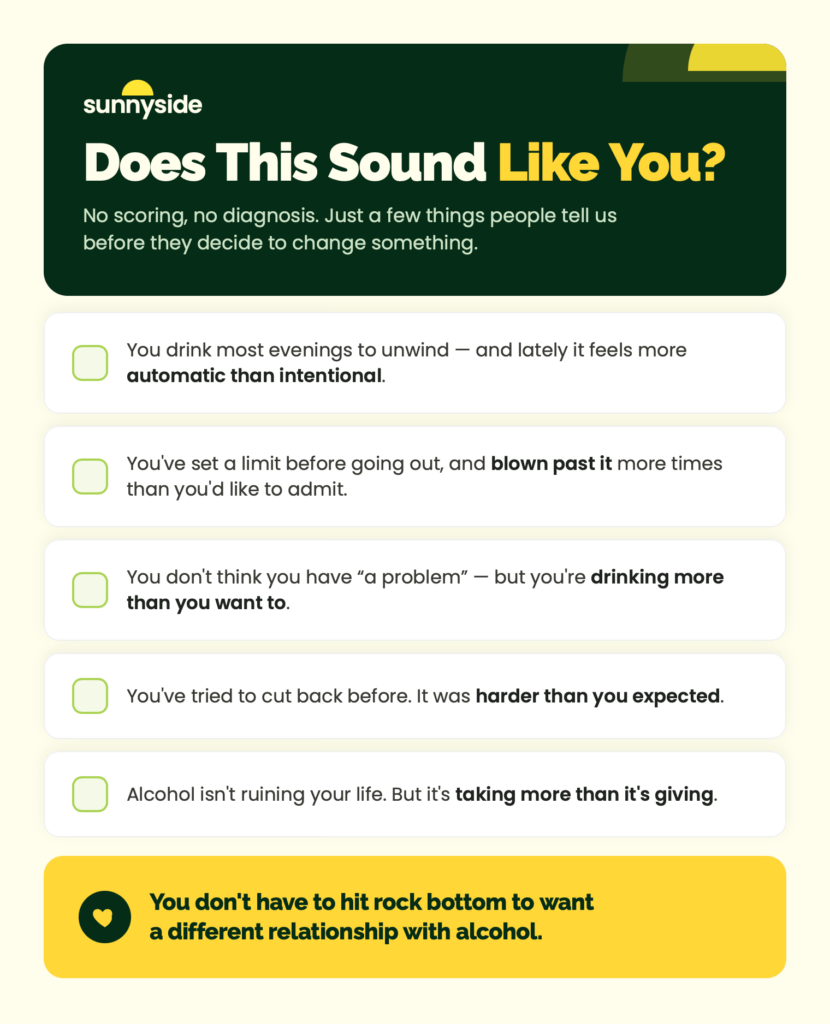
If your drinking feels difficult to change but doesn’t resemble the stereotypical picture of alcohol addiction, you may also recognize yourself in the concept of gray-area drinking.
What Naltrexone Does Differently
Naltrexone doesn’t make decisions for you. Instead, it acts on one of the biological processes that can make those decisions harder.
Naltrexone is an opioid antagonist. It blocks opioid receptors involved in alcohol’s reinforcing effects, which can reduce the rewarding effects of drinking. For some people, that also means less craving or less desire to continue once they’ve started.
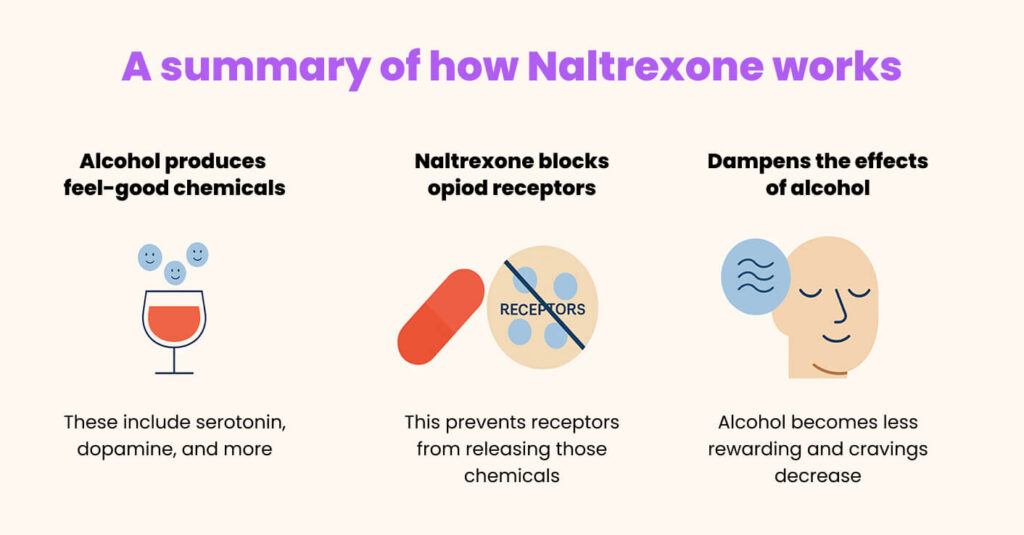
A pooled analysis of human laboratory studies, Hendershot et al. (2017), found that naltrexone modestly reduced both alcohol consumption and craving.
That’s a useful distinction when thinking about naltrexone vs. willpower. Willpower still matters: you still make choices, change routines, and decide what you want your drinking to look like. And naltrexone may make some of those choices easier by reducing the reward or craving you’re working against.
Medication and behavior change don’t have to compete. They can work on different parts of the same goal.
Sunnyside Med: Making Medication Part of the Routine
For naltrexone to help, you have to actually take the medication. And in real-world settings, sticking with medication can be a challenge.
A large U.S. insurance-claims study, Kranzler et al. (2008), found that many people who filled an initial naltrexone prescription didn’t continue taking it over the following six months. Claims data can’t tell us why individual patients stopped, but the study highlights a practical limitation of prescribing medication without considering what happens afterward.
That’s one reason Sunnyside Med pairs naltrexone, when prescribed by a licensed clinician, with behavioral support. Members can track their medication and drinking, set goals, plan their weeks, and access human coaching, group calls, and a private community.
In Sunnyside Med’s internal observational data, members who engaged with the app were 2.5 times more likely to still be taking their medication at month four than less-engaged members. That doesn’t prove the app caused better adherence, but it suggests that engagement with the broader program and medication use may go together.
What the Research Says About Medication and Support
The idea of pairing naltrexone with ongoing support has also been studied in clinical trials.
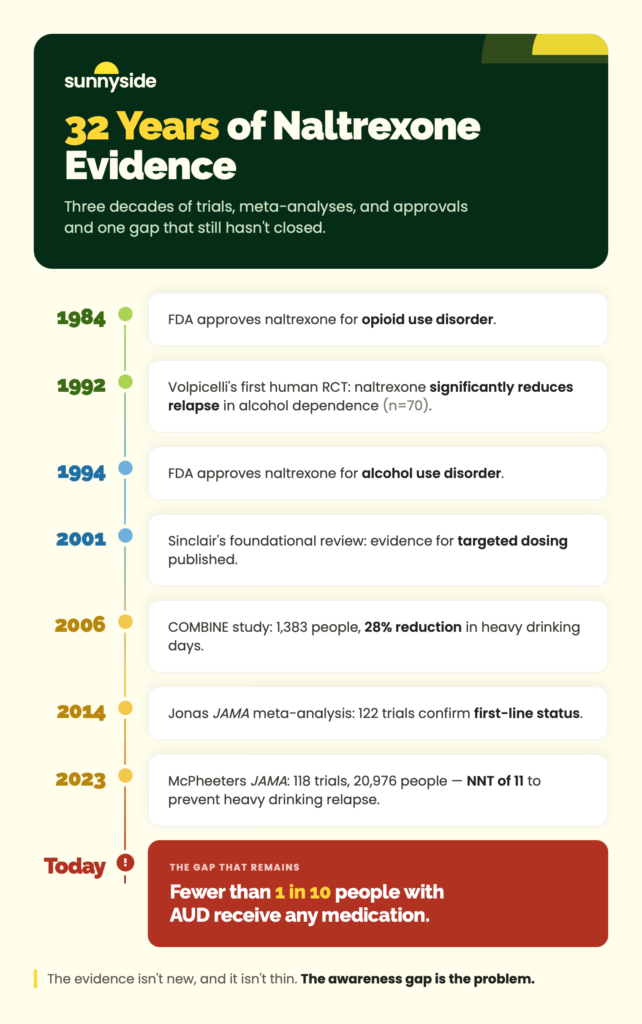
The landmark COMBINE study included 1,383 recently abstinent adults with alcohol dependence and compared naltrexone, acamprosate, behavioral intervention, and structured medical management in different combinations.
Naltrexone paired with medical management improved some drinking outcomes compared with placebo plus medical management. Importantly, medical management involved more than writing a prescription. Participants received clinical monitoring, encouragement to take their medication, and support around their drinking goals.
COMBINE doesn’t tell us that every form of behavioral support will improve naltrexone outcomes, and its participants aren’t necessarily representative of people without an AUD diagnosis. But it does show that medication doesn’t have to stand alone. Clinical support and behavior change can be symbiotic parts of the same treatment plan.
Taking Naltrexone Isn’t a Failure of Willpower
There’s a persistent idea that taking medication for drinking means admitting you couldn’t change on your own. But naltrexone doesn’t make the choice to drink less for you. It may simply change how difficult that choice feels.
When naltrexone works, the effect isn’t always immediately dramatic. For some people—on different timetables—cravings may eventually become less intense, or they may find that drinking simply feels less rewarding. The familiar internal negotiation around having another drink may become easier to interrupt.
That still leaves plenty of room for behavior change. Your routines, triggers, and habits don’t automatically disappear just because alcohol feels different. But if the urge is less compelling, it may be easier to pause, implement a healthy coping strategy, and follow the plan you made earlier in the day.
Choosing medication doesn’t say anything about how hard you’ve tried or how much willpower you have. It’s simply another way of approaching the factors that can make drinking difficult to change.
“I started taking naltrexone earlier this month, and it has decreased the alcohol chatter,” said one Sunnyside Med member. “The thinking about drinking is as bad as the drinking. Now I barely think about it.”
How Sunnyside Med Works
Sunnyside Med is a 100% online alcohol health program for people who want to drink less or quit. You start with a short assessment, and a licensed clinician determines whether naltrexone is medically appropriate. If you’re eligible, medication is shipped discreetly to your door.
The program pairs medication with drink tracking, weekly planning, coaching seven days a week, a private community, group calls, and ongoing clinical care. Your plan is built around your goal, whether that’s drinking less, taking a break, or quitting.
Among active Sunnyside Med members, 78% achieved a meaningful reduction in drinking. (That’s internal observational member data, and individual results vary.)
Sunnyside Med costs $99 per month plus a one-time intake fee. No insurance is required, and the program is HSA/FSA eligible and available in all 50 states.
If medication plus behavioral support sounds like a good fit for your goals, see if you’re eligible with a short online assessment.
Frequently Asked Questions (FAQ): Naltrexone vs. Willpower
Does naltrexone replace willpower?
No. Naltrexone doesn’t make decisions for you. It can reduce alcohol’s rewarding effects and cravings for some people, which may make it easier to follow through on a decision to drink less.
Why can drinking be hard to control even when I’m disciplined in other areas?
Alcohol use can become connected to learned cues, habits, reward, and cravings. That means difficulty resisting a drink isn’t simply a measure of how disciplined you are.
How is naltrexone different from just trying harder?
Trying harder relies on conscious behavior change. Naltrexone acts on opioid receptors involved in alcohol’s reinforcing effects. The two approaches aren’t mutually exclusive: medication can be used alongside changes to your habits and routines.
Can naltrexone help if my goal is to drink less, not quit entirely?
Yes. Naltrexone can be used as part of a plan to reduce drinking rather than stop completely. A licensed clinician can determine whether it’s appropriate based on your health, drinking, medications, and goals.
Naltrexone is a prescription medication. This content is educational and should not be taken as medical advice. A licensed clinician reviews every Sunnyside Med application.