Last Updated on July 3, 2026
If you’re considering naltrexone for cutting back on drinking, you’re not overreacting. Naltrexone was designed for people who want to drink less, not just people who need to stop. And the science increasingly supports using it before things get serious.
Many people who want to cut back on drinking don’t think of themselves as having an “alcohol problem” in the traditional sense. They may be successful at work, keep up with family responsibilities, and rarely experience obvious consequences from drinking. They simply find themselves drinking more often or more heavily than they intend to.
That’s where naltrexone may help. Naltrexone is a prescription medication that reduces alcohol’s rewarding effects, making it easier for many people to cut back. You don’t have to wait until your drinking becomes severe before talking with a healthcare provider about whether medication is appropriate. If alcohol is no longer fitting the life you want to live, it’s reasonable to explore evidence-based tools like Sunnyside Med that can help you change your habits.
The Binary That’s Keeping You Stuck
Conversations about alcohol often fall into two extremes: either your drinking is completely normal, or it’s severe enough to require treatment. That leaves little room for the many people who want to change their drinking habits but don’t really identify with either category.
In reality, alcohol use exists on a spectrum. According to the National Institute on Alcohol Abuse and Alcoholism, an estimated 28 million U.S. adults meet the diagnostic criteria for alcohol use disorder, ranging from mild to severe. Many others don’t meet the criteria for alcohol use disorder but still drink more than they’d like or experience alcohol-related health consequences.
Many people within this “gray area” delay taking action that could meaningfully improve their lives. Research suggests it often takes years between recognizing a problem and seeking treatment, even as drinking habits become increasingly problematic.
You don’t have to wait until your drinking becomes severe to explore evidence-based support. If your goal is cutting back, medications like naltrexone are often most effective when paired with behavioral support. That’s why Sunnyside Med combines prescription treatment with evidence-based habit change tools designed to help you build lasting routines.
How Naltrexone Works for Cutting Back
Naltrexone works by blocking opioid receptors in the brain, reducing the pleasurable and rewarding effects of alcohol. Many people experience fewer cravings, less preoccupation with drinking, and greater control over when to stop.
Rather than making you rely on willpower alone, the medication impacts the biology that drives the urge to keep drinking. For many people, the internal debate over whether to have another drink slows significantly, making it easier to stop after one or two instead of continuing out of habit.
As one Sunnyside Med member put it: “For the first time in a long time, I don’t feel that constant pull to reach for a glass of wine. The urge that used to feel automatic just isn’t there.”
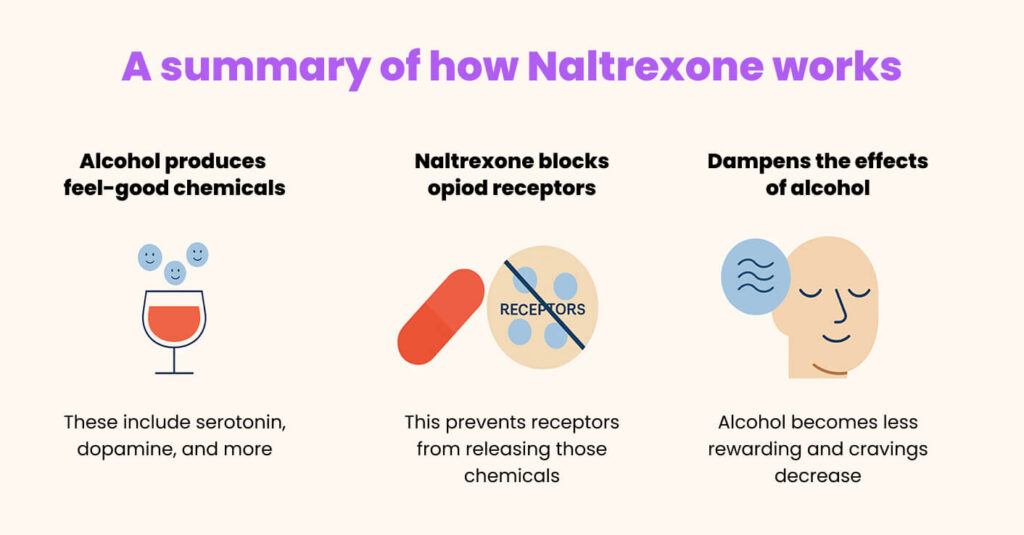
Clinical trials have consistently found that naltrexone reduces heavy drinking days and lowers the risk of returning to heavy drinking, making it one of the best-studied medications for people whose goal is moderation rather than abstinence. Dr. Glenn-Milo Santos of UCSF Health offers a simple way to think about how the medication feels in practice: “Naltrexone is like an appetite suppressant for alcohol.”
Importantly, naltrexone does not make you sick if you drink, and it does not require abstinence to be effective. Many people use it specifically to reduce heavy drinking and build healthier habits around alcohol rather than to quit completely.
The Research on Naltrexone and Non-Dependent Drinkers
Naltrexone is one of the most extensively studied medications for alcohol use disorder (AUD). Large systematic reviews—including a 2023 review published in JAMA—have consistently found that oral naltrexone reduces heavy drinking and lowers the risk of returning to heavy drinking, making it a first-line treatment in many clinical guidelines (McPheeters et al., 2023).
Most of that research has focused on people with moderate to severe alcohol use disorder, where the evidence is strongest. More recently, however, researchers have begun studying whether naltrexone can also help people whose goal is simply to drink less.
The results are encouraging. In a placebo-controlled trial of 128 young adults who regularly drank heavily but did not meet criteria for alcohol dependence, low-dose naltrexone reduced the frequency of heavy drinking episodes (O’Malley et al., 2015). A separate randomized controlled trial found that targeted naltrexone—taken only before anticipated drinking occasions—significantly reduced drinks per drinking day among adults with mild to moderate alcohol use disorder (Santos et al., 2022).
Other research suggests naltrexone may be especially helpful for people who drink primarily for reward or pleasure. In one study, participants with stronger “reward-driven” drinking patterns experienced greater reductions in drinking urges while taking naltrexone (Roos et al., 2021). Earlier research also found dose-dependent reductions in hazardous drinking among people who were not actively seeking alcohol treatment, suggesting the medication may help people reduce their drinking before it becomes more severe (O’Malley et al., 2009).
Taken together, these findings suggest that naltrexone’s benefits may extend beyond people with severe alcohol use disorder. While the evidence for moderation-focused and non-dependent drinkers is still growing, it supports the idea that medication can be a valuable tool for people who want to cut back before their drinking progresses.
A Sunnyside Co-Founder’s Naltrexone Experience
One reason Sunnyside Med focuses on moderation—not just abstinence—is because its co-founder, Ian Andersen, had a goal that many members share: he wanted to cut back on drinking, not necessarily stop altogether. He wasn’t in crisis, but he found that once he started drinking, it was difficult to stop where he intended.
“I just knew I was drinking more than I wanted to,” he said. “That gap, between what you want and what you actually do, that’s where so many people are stuck. We built Sunnyside Med for them.”
After starting naltrexone, Ian noticed a shift that many people describe when the medication is working.
“The alcohol noise went quiet almost immediately. I stopped thinking about drinking so much and started thinking about everything else more,” he said.
While every person’s experience is different, Ian’s story reflects why many people explore naltrexone for cutting back. Rather than waiting until drinking caused serious consequences, he chose to use an evidence-based tool to help change a pattern that no longer matched his goals.
Is Naltrexone Right for Your Mindful Drinking Journey?
Naltrexone isn’t the right choice for everyone, but it may be worth discussing with a healthcare provider if your goal is to cut back on drinking rather than quit completely.
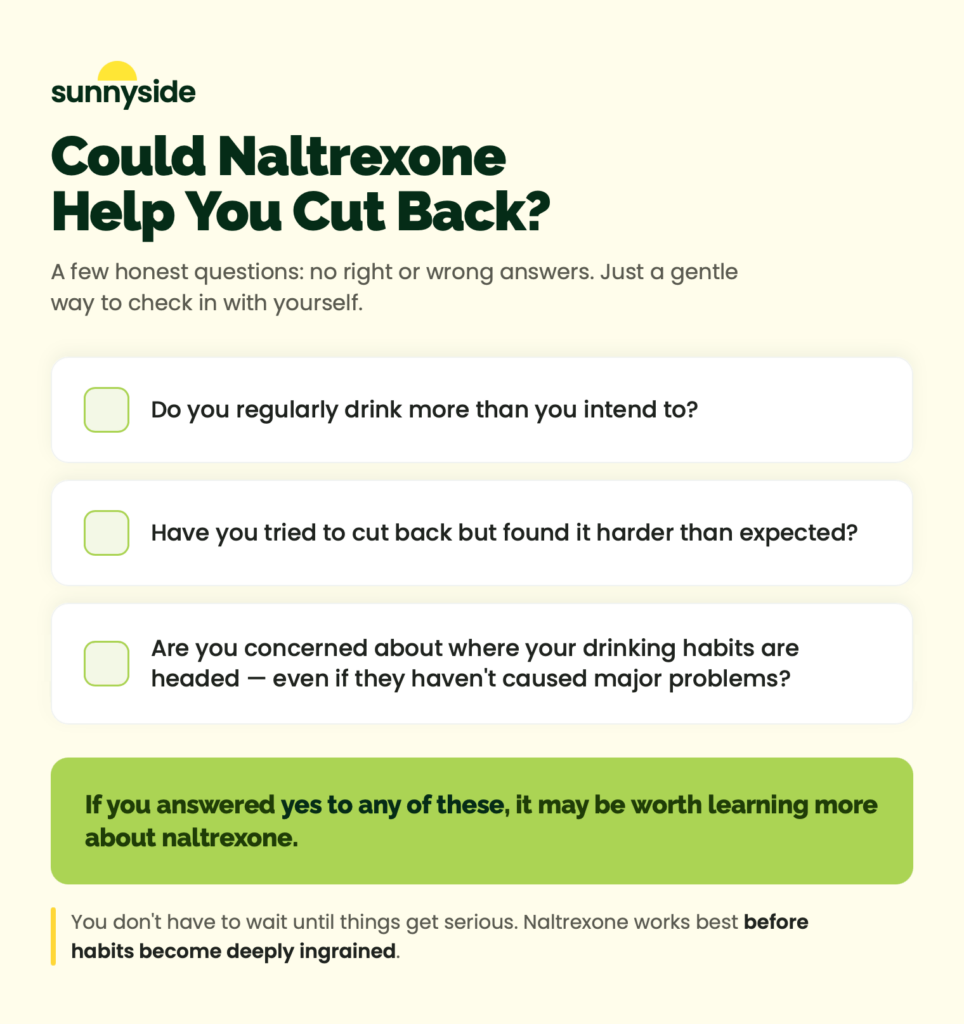
A few questions can help you decide whether it’s worth exploring:
- Do you regularly drink more than you intend to?
- Have you tried to cut back but found it harder than expected?
- Are you concerned about where your drinking habits are headed, even if they haven’t caused major problems?
If you answered yes to any of those questions, it may be worth learning more about naltrexone.
One common misconception is that you have to “drink enough” before medication becomes appropriate. In reality, there isn’t a universal threshold based on the number of drinks you have each week. Instead, clinicians consider your goals, your medical history, and whether naltrexone is safe for you to take.
Because naltrexone blocks opioid receptors, it isn’t appropriate for people currently using opioid medications. Certain liver conditions may also require an alternative approach.
What Naltrexone for Cutting Back Actually Looks (And Feels) Like
Naltrexone doesn’t change your drinking overnight. For most people, the changes are gradual. During the first week or two, it’s common to experience mild side effects such as nausea or fatigue while your body adjusts. These symptoms usually improve within a couple of weeks.
As treatment continues, many people notice something different: Drinking requires less mental effort to control. The urge to keep going after the first drink becomes less persistent, and stopping at one or two drinks starts to feel more natural.
Here are some real testimonials from Sunnyside Med members:
- “Went to dinner with family last night… live music at a bar first… I had three drinks the entire night. This naltrexone stuff is amazing.”
- “I had a cocktail last night and for the first time ever, I didn’t drink the whole thing. In fact, I dumped half of it down the drain.”
- “I wasn’t someone who drank heavily, but I was someone who couldn’t have ‘just one drink.’ I’m proud to say that I am now.”
Medication is only one part of the process, though. The landmark COMBINE study, for example, found that outcomes improved when naltrexone was paired with behavioral support rather than used on its own. That’s why Sunnyside Med combines clinician-prescribed naltrexone with evidence-based behavior change tools designed to help members build lasting routines. These include:
- Daily reminders: Get daily nudges to stay up to date with your medication, with personalized reminders about goals and progress.
- Coaching: Text with a real human coach when you need extra support, 7 days a week. Our peer coaches have been on the journey too.
- Community: Give and get support in the vibrant Sunnyside community, a place to cultivate a positive mindset every day.
- Progress: Whether it’s sleep, dry days, or drinks cut, Sunnyside shows your progress as it matters most to you.
- Resources: Access videos, exercises, and readings to help you get the most out of your medication.
- Drink tracking: Track your drinks and dry days via text or in the app to get real-time feedback about progress on your goals.
If you’re interested in trying naltrexone for cutting back, Sunnyside Med offers a private online assessment, clinician review, and home delivery of compounded naltrexone. These are all designed for people who want to change their relationship with alcohol before it becomes a bigger problem.
Naltrexone is a prescription medication and isn’t appropriate for everyone. A licensed clinician reviews every Sunnyside Med application to determine whether treatment is a good fit.
Frequently Asked Questions (FAQ): Naltrexone for Cutting Back
Is naltrexone only for alcoholics?
No. Naltrexone has been FDA-approved since 1994 for alcohol use disorder across the full severity spectrum, including mild cases. Research also shows benefits in non-dependent heavy drinkers who simply want to drink less.
If I take naltrexone, will people think I’m an alcoholic?
If discretion is important to you, you should know that Sunnyside Med is 100% online. There’s no pharmacy pickup and no waiting room, and medication ships to your door.
Many Sunnyside Med members think of taking naltrexone the same way they’d think of taking a supplement for better sleep: a proactive health choice.
Can I take naltrexone just to cut back on drinking, not quit?
Yes. Naltrexone has been studied alongside moderation-based goals, not just abstinence. Your goal can simply be less.
Do I drink enough to qualify for naltrexone?
There’s no minimum number of drinks that makes you “eligible.” If your drinking concerns you and you want to change, that’s enough of a reason to explore your options. A clinician can help determine if naltrexone is right for you.
Is naltrexone safe for someone who doesn’t drink that much?
Naltrexone has been FDA-approved since 1994 and studied extensively in clinical trials. The main contraindications are opioid medications and certain liver conditions, not the amount you drink. A clinician will review your health history before prescribing.
If you’re looking for extra support for cutting back, naltrexone may be worth discussing with a healthcare provider. Sunnyside Med combines clinician-prescribed naltrexone with coaching, habit tracking, and evidence-based behavior change tools to help members build a healthier relationship with alcohol. Start with our free online assessment to see whether the program may be a good fit for you.
Sunnyside is the Perfect Companion for Your Naltrexone Journey
Sunnyside is the #1 mindful drinking app. Since 2020, we’ve been honing our harm-reduction approach and have helped over 400,000 people cut out 22 million drinks from their baseline habits. 96.7% of our members report success in drinking less, and in a third-party study, our approach was demonstrated to reduce weekly drinking by 33% after 12 weeks.
Think of Sunnyside as the front door for anyone who wants to change their relationship with alcohol. If you want to drink less, we can help you get there. If you want to eventually quit, but want to take a gradual approach, we can make that happen, too.
When you sign up for Sunnyside, you’ll take a quick 3-minute quiz, then hop into the app. It’s as simple and quick as that.
We’ll give you weekly plans to gradually reach your drinking goals, and we’ll provide nudges, coaching, exercises, and advice to help you get there. We have daily tracking and journaling tools, including the option to chat with a real human coach at any time. And our state-of-the-art analytics help you track your progress over time.
Sunnyside is a full-featured mindful drinking app. Naltrexone will actively help you reduce cravings around alcohol, and Sunnyside will help you understand your triggers and patterns, giving you a healthy system for habit change.
If you choose to stop taking naltrexone, the Sunnyside app remains a tool you can keep using to maintain your healthy habits.
Everyone who signs up for Sunnyside gets a free 15-day trial. After that, the subscription is $8.25/month.
Whether you’re currently taking naltrexone or just doing some research on alcohol moderation, we’d love to have you sign up for our 15-day free trial today.