
Last Updated on July 3, 2026
If naltrexone doesn’t seem to be working, the most likely explanation is that it needs more time, more consistent dosing, or to be supplemented with behavioral support. Most people who feel like naltrexone is not working are still in the early weeks of treatment, when changes are subtle and easy to miss. Before stopping, understand what naltrexone actually does, what “working” looks like, and what you can do to give it a real chance.
You’ve been taking naltrexone for a few weeks. You’ve been following your treatment plan. But it feels like naltrexone is not working. Nothing feels different, and you’re starting to wonder whether this whole thing was a mistake.
If you’ve searched online, you’ve probably seen posts to this effect. One person on r/stopdrinking wrote: “I’ve been taking naltrexone every day for the past 3 weeks, but when I drink, I don’t notice any difference.”
That frustration is real. But it doesn’t necessarily mean the medication has failed you, and it definitely doesn’t mean something is wrong with you. Often, the issue isn’t that naltrexone doesn’t work. It’s that people’s expectations don’t quite match what the research shows.
Here, we’ll explain the most common reasons naltrexone may seem ineffective, what you can do about each one, and when it may be time to talk with your clinician about adjusting your treatment plan.
What Naltrexone Is Actually Supposed to Do
Most people start naltrexone expecting it to make them stop wanting alcohol overnight, but that’s not how the medication works.
Dr. Joseph Volpicelli, one of the researchers behind naltrexone’s early clinical trials, described it this way: “It doesn’t stop the performance. It stops the standing ovation.”
Naltrexone blocks opioid receptors involved in alcohol’s reward pathway. When those receptors are blocked, drinking tends to feel less rewarding over time. The medication doesn’t make alcohol taste bad, and it doesn’t stop you from becoming drunk. It also doesn’t erase stress, habits, or the situations that make you want a drink in the first place.
The medication may work more subtly. Instead of waking up one day with no interest in drinking, you might notice:
- Stopping after one or two drinks feels easier
- The “just one more” voice isn’t quite as persistent
- Cravings pass more quickly
- Drinking simply feels less compelling than it used to
Those changes aren’t super dramatic for everyone. Some people don’t recognize them until they look back at their drinking patterns or tracking data—at which point the numbers reveal that they have been cutting back after all.
4 Reasons Naltrexone Might Seem Like It’s Not Working
Reason 1: It’s Still Early
This is the most common reason people think naltrexone isn’t working. Fortunately, it’s often the easiest to fix.
Naltrexone doesn’t usually produce an overnight change. Instead, it makes drinking less rewarding each time you take it. As those experiences accumulate, your brain gradually weakens the learned association between alcohol and reward. That process takes time.
Some people notice a difference after their first few doses. For many others, meaningful changes build gradually over the first several weeks, with additional improvements continuing over the following months.
That’s consistent with the way naltrexone has been studied. Clinical trials demonstrating naltrexone’s effectiveness typically follow participants for at least 12 weeks, and evidence suggests that longer treatment durations are often associated with better outcomes. A 2024 review from the University of Illinois at Chicago concluded that treatment beyond three months consistently produced stronger results than shorter courses and noted that many clinical guidelines recommend continuing treatment for 6 to 12 months when it’s helping.
One challenge is that naltrexone side effects often appear before benefits do. Nausea, fatigue, or headaches are usually most noticeable during the first few days and often improve within the first couple of weeks. Unfortunately, that’s also when many people stop taking the medication.
If you’ve only been taking naltrexone for a few weeks, it may simply be too soon to know whether it’s helping. Unless your clinician advises otherwise, giving the medication a consistent trial gives it the best chance to succeed.
Reason 2: You’re Missing Doses
Naltrexone only works when it’s in your system. Taking it consistently gives it the best chance to reduce alcohol’s rewarding effects over time.
Missing a dose occasionally doesn’t mean the medication will fail. But taking it inconsistently makes it harder to know whether it’s helping. If you’re skipping doses several times a week or stopping and restarting, you may never give the medication a fair trial.
Research consistently shows that adherence is one of the strongest predictors of treatment success. A 2021 systematic review from Pérez-Macia et al identified poor adherence as a major reason people don’t experience the full benefits of naltrexone. Another study from Dermody et al, published in Annals of Behavioral Medicine in 2018, found that simple supports like daily reminders and mobile tracking significantly improved adherence, suggesting that accountability tools like Sunnyside can make a meaningful difference.
Unfortunately, many people stop taking naltrexone much earlier than intended. More than half of prescriptions are never refilled, meaning many people conclude the medication “didn’t work” before giving it a consistent chance to do so.
Reason 3: Misaligned Expectations
If you’re measuring success by “do I still want to drink?”, it’s easy to conclude naltrexone is not working. But if you’re measuring by “is it easier to stop once I start?”, you may already be seeing results and missing them.
One Sunnyside Med member was six weeks in, taking compounded naltrexone daily, and reported no perceived reduction in cravings. But when she looked at her Sunnyside tracking data, she’d added multiple dry days per week and was drinking significantly less on the days she did drink. Naltrexone was very likely helping her without her realizing it.
Can I still get drunk if I drink on naltrexone?
Yes. If you can still feel alcohol after taking naltrexone, that doesn’t necessarily mean the medication has failed. Naltrexone isn’t designed to eliminate intoxication. Instead, it gradually reduces how rewarding drinking feels over time. Because that change is often subtle, many people spend the first few weeks wondering whether anything is happening at all. That’s a normal reaction, and one reason it’s important to look at your overall drinking patterns, not just how you feel after a single drink.
Reason 4: Medication Can’t Change Habits on Its Own
Naltrexone changes how rewarding alcohol feels. It doesn’t automatically change the routines, environments, emotions, or stressors connected to drinking.
One Sunnyside Med member put it this way: “I don’t even crave the drink. I’m just stuck in the daily habit.”
That’s a common experience. Over time, drinking becomes linked not just to alcohol itself, but to finishing work, cooking dinner, sitting on the couch, or coping with stress. Naltrexone can make alcohol less reinforcing, but it doesn’t erase those learned associations overnight.
As alcohol becomes less rewarding, it becomes easier to build new habits—but the habits themselves still require practice. That’s one reason experts recommend pairing naltrexone with behavioral support rather than relying on medication alone.
Why Naltrexone Works Best as Part of a Toolkit
This is the thread connecting all of the reasons above: naltrexone works best when it’s part of a broader strategy, not the entire strategy.
The landmark COMBINE trial (Anton et al., 2006), one of the largest studies ever conducted on alcohol treatment, showed that medication and structured behavioral support can complement one another by addressing different parts of the drinking cycle. Naltrexone reduces alcohol’s rewarding effects, while behavioral strategies help people recognize triggers, build new routines, and respond differently to cravings.
Naltrexone reduces friction. It lowers the activation energy required to make a different choice, creating more space between the urge to drink and what you do next.
What it doesn’t do is replace the routines, social rituals, or coping strategies that alcohol may have provided. That work happens gradually over time through coaching, therapy, journaling, community, or other support.
In addition to medication, Sunnyside Med members have access to app-based tracking, daily reminders, progress analytics, coaching, community support, live Zoom meetings, and practical resources for managing side effects.
Members who actively engage with the program are three times more likely to refill their prescription than those who don’t use the app’s tracking tools (among members with at least 50% app engagement; individual results vary).
Is Genuine Naltrexone Non-Response Possible?
True non-response does happen, but it’s less common than many people assume. Before concluding that naltrexone isn’t working, make sure you’ve given it an adequate trial, and stay in touch with your clinician.
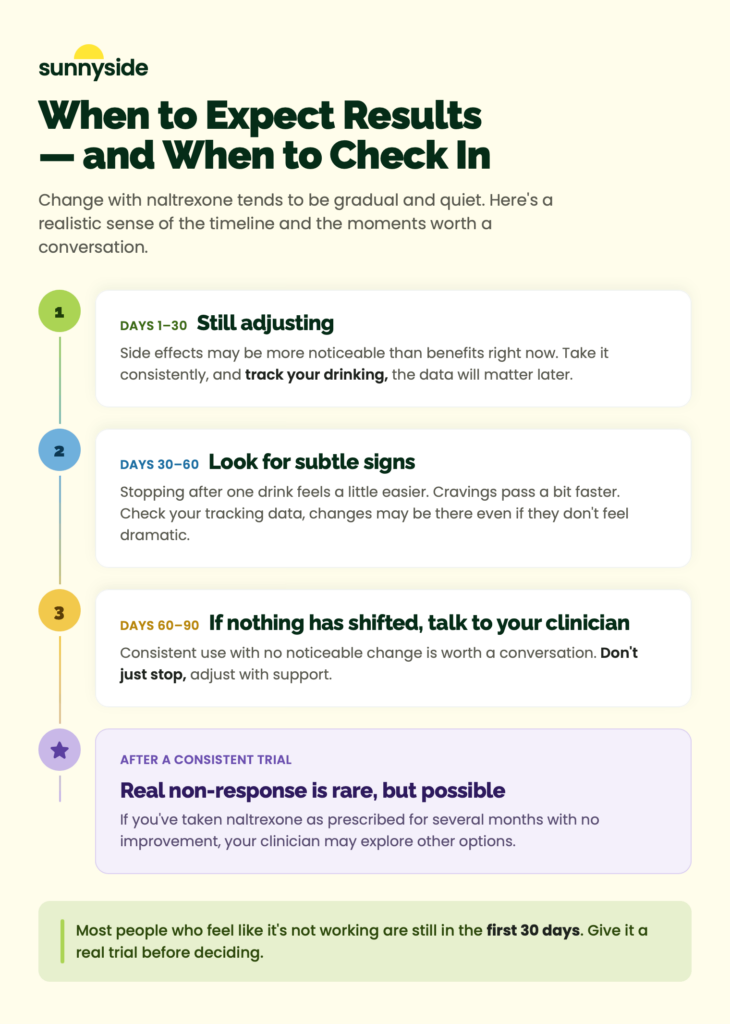
Everyone responds differently, but a potential timeline might look something like this:
- Days 1–30: You’re still adjusting to the medication. Side effects may be more noticeable than benefits. Focus on taking it consistently and tracking your drinking.
- Days 30–60: Some people begin noticing subtle changes, such as drinking more slowly, stopping earlier, or adding alcohol-free days. If you haven’t noticed anything at all, it’s reasonable to mention it to your clinician.
- Days 60–90: If you’ve been taking naltrexone consistently and still haven’t seen meaningful changes, talk with your clinician about whether your treatment plan should be adjusted.
- After a consistent trial: If you’ve taken naltrexone as prescribed for several months and still aren’t seeing improvement, your clinician may recommend a different medication or treatment approach.
Researchers are also investigating why some people respond better than others. A 2020 clinical trial led by researchers at the Medical University of South Carolina found that combinations of genetic differences in the brain’s opioid and dopamine systems were associated with how well participants responded to naltrexone. While this research may eventually help personalize treatment, genetic testing isn’t currently part of routine clinical care.
And remember the Sunnyside Med member from earlier who felt nothing after six weeks? When she looked at her tracking data, she realized she was drinking less, adding alcohol-free days, and making meaningful progress. She just hadn’t recognized it yet.
Naltrexone often works before it feels like it’s working. That’s why tracking your actual drinking, not just your moment-to-moment feelings, can give you a clearer picture.
I’m Thinking About Stopping Naltrexone. What Now?
If you’re thinking about stopping because it feels like naltrexone isn’t working, pause before making that decision on your own.
Many people stop treatment during the first few weeks, before they’ve had enough time to experience the medication’s full effects. Others stop because they’re expecting a dramatic shift when the real changes are gradual.
Ask yourself a few questions:
- Have I been taking it consistently?
- Have I given it enough time?
- Am I measuring success only by whether I still want a drink, or by whether my drinking habits are actually changing?
- Am I employing behavioral support alongside the medication?
One Sunnyside Med member shared: “I was convinced I would not benefit from taking the meds, but I persisted, and just this past week, out of the blue, I could detect a clear and distinct response.”
The right next step usually isn’t to quit the medication; it’s to have a conversation with your clinician. Together, you can decide whether you need more time, additional behavioral support, a dose adjustment, or a different treatment approach.
By combining medication with tracking, reminders, coaching, and community, Sunnyside Med helps you stay consistent, recognize progress that might otherwise go unnoticed, and build the habits that medication alone can’t create.
If you’re wondering whether naltrexone is right for you—or why it doesn’t seem to be working yet—take our two-minute quiz to see whether you may be eligible for Sunnyside Med.
Naltrexone is a prescription medication. This content is educational and should not be taken as medical advice. A licensed clinician reviews every Sunnyside Med application.
Frequently Asked Questions (FAQ)
How long does it take for naltrexone to work?
Many people begin noticing meaningful changes within the first one to three months, although some take longer. Others respond faster, feeling a difference within the first week. The key is consistency.
Can you still get drunk on naltrexone?
Yes. Naltrexone blocks the euphoric reward signal from alcohol, but it does not prevent intoxication. You can still feel the effects of alcohol.
How many days can you miss naltrexone?
Even missing a few doses per week can interfere. Consistency is what allows the brain to relearn its response to alcohol. If you’re having trouble with daily adherence, talk to your clinician about strategies, and consider a program with built-in tracking and reminders.
Why does naltrexone not seem to be working after a month?
A month is still early. If you haven’t noticed changes after 30 days of consistent use, you may need more time. Track your drinks carefully—you may be making progress you can’t feel yet.
Sunnyside is the Perfect Companion for Your Naltrexone Journey
Sunnyside is the #1 mindful drinking app. Since 2020, we’ve been honing our harm-reduction approach and have helped over 400,000 people cut out 22 million drinks from their baseline habits. 96.7% of our members report success in drinking less, and in a third-party study, our approach was demonstrated to reduce weekly drinking by 33% after 12 weeks.
Think of Sunnyside as the front door for anyone who wants to change their relationship with alcohol. If you want to drink less, we can help you get there. If you want to eventually quit, but want to take a gradual approach, we can make that happen.
When you sign up for Sunnyside, you’ll take a quick 3-minute quiz, then hop into the app. It’s as simple and quick as that.
We’ll give you weekly plans to gradually reach your drinking goals, and we’ll provide nudges, coaching, exercises, and advice to help you get there.
We have daily tracking and journaling tools, including the option to chat with a real human coach at any time. And our state-of-the-art analytics help you track your progress over time.
Sunnyside is a full-featured mindful drinking app. Naltrexone will actively help you reduce cravings around alcohol, and Sunnyside will help you understand your triggers and patterns, giving you a healthy system for habit change.
If you choose to stop taking naltrexone, the Sunnyside app remains a tool you can keep using to maintain your healthy habits.
Everyone who signs up for Sunnyside gets a free 15-day trial. After that, the subscription is $8.25/month.
Whether you’re currently taking naltrexone or just doing some research on alcohol moderation, we’d love to have you sign up for our 15-day free trial today.