
Why Naltrexone Is Not Addictive
Naltrexone is not addictive or habit-forming. It blocks opioid receptors rather than activating them, so it doesn't produce...


President, Assisted Recovery Centers of America (ARCA)
Naltrexone does not block dopamine. Instead, it blocks opioid receptors, which can reduce some of alcohol’s rewarding effects and make drinking feel less compelling. While some people report temporary changes in how rewarding everyday activities feel, current evidence does not suggest that naltrexone shuts down or damages the dopamine system.
If you’re considering naltrexone, you may have come across stories from people who say it made them feel flat, numb, or less interested in things they normally enjoy. That can raise an understandable question: If naltrexone makes alcohol less rewarding, does it do the same thing to everything else?
The short answer is no. Naltrexone doesn’t block dopamine. It works primarily by blocking opioid receptors, which changes how your brain experiences the rewarding effects of alcohol. Dopamine is involved in that process, but naltrexone isn’t shutting down your dopamine system.
The goal of naltrexone is to make drinking feel less rewarding, not to take the pleasure out of food, music, exercise, sex, or spending time with people you love. Some people do report feeling a little flat when they first start taking it, but that’s a different issue, and one we’ll get into below.
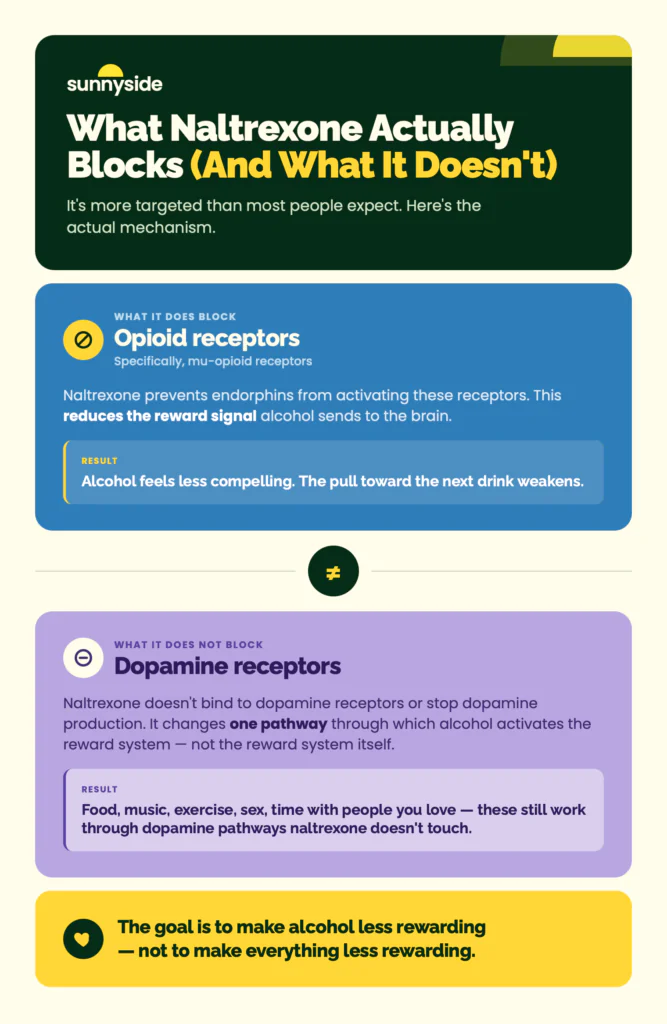
Naltrexone is an opioid receptor antagonist. It binds primarily to mu-opioid receptors and prevents your body’s own opioids, including endorphins, from activating them. It does not bind to dopamine receptors or stop your brain from producing dopamine.
So why does dopamine come up so often when people talk about naltrexone? Because the opioid and dopamine systems interact.
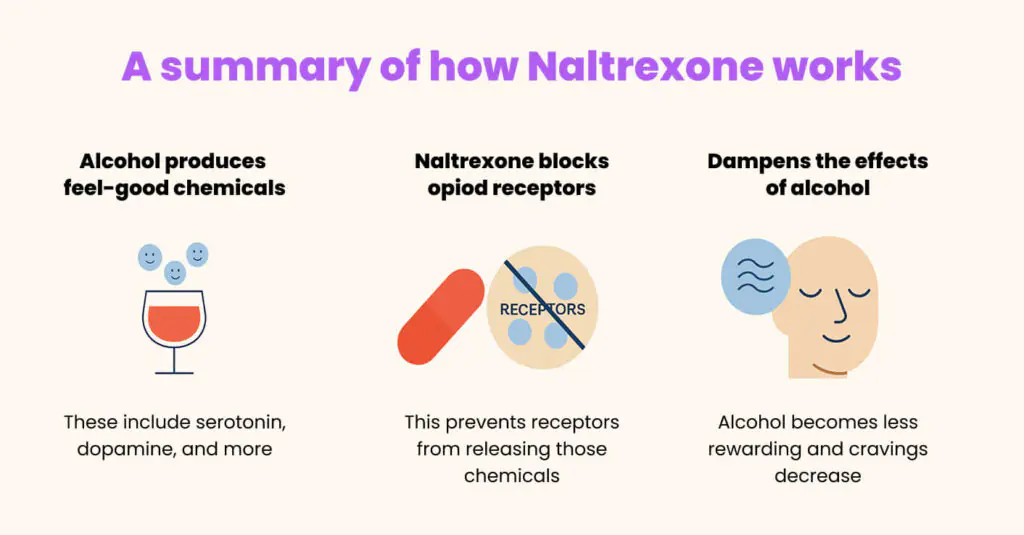
When you drink alcohol, your brain releases endogenous opioids, which can contribute to increased dopamine signaling in the brain’s reward circuitry. Naltrexone interrupts that process by blocking opioid receptors. The result is that alcohol may feel less rewarding or compelling.
That’s different from blocking dopamine itself. Naltrexone changes one of the pathways through which alcohol activates the reward system rather than switching that system off altogether.
As physician and naltrexone researcher Dr. Joseph Volpicelli puts it, “People often equate pleasure as increases in dopamine, and I’m not sure it’s so simple as that.” Pleasure involves several overlapping brain systems, which is one reason the idea that naltrexone simply “kills dopamine” misses what the medication actually does.
(For a broader look at the mechanism, here’s how naltrexone works in the body.)
Knowing that naltrexone doesn’t block dopamine answers one question. But there’s another one that may matter more from a practical standpoint: Will food, music, exercise, sex, laughter, or time with people you love still feel good?
For most people, naltrexone doesn’t appear to erase those everyday pleasures. In a small long-term survey, O’Brien et al. (2011) asked 74 people who had received extended-release naltrexone for an average of 3.5 years to rate the pleasure they got from alcohol and other activities. Participants rated sex, exercise, eating good food, listening to music, being with friends, and other everyday experiences as more pleasurable than drinking alcohol.
There are important limitations here. The study was small, had no placebo group or baseline measurement, and involved extended-release rather than oral naltrexone. So it can’t prove that naltrexone has no effect on everyday pleasure. What it does show is that long-term opioid blockade didn’t prevent these participants from experiencing plenty of pleasure outside alcohol.
That distinction lines up with what Ian Andersen, co-founder of Sunnyside Med, has experienced taking naltrexone daily. “Drinking might feel different, and that’s the point: less exciting, less rewarding, sometimes just less fun. That’s the medication doing its job,” he says.
For many people, that’s the change they’re looking for. Alcohol becomes less compelling without everything else becoming less enjoyable.
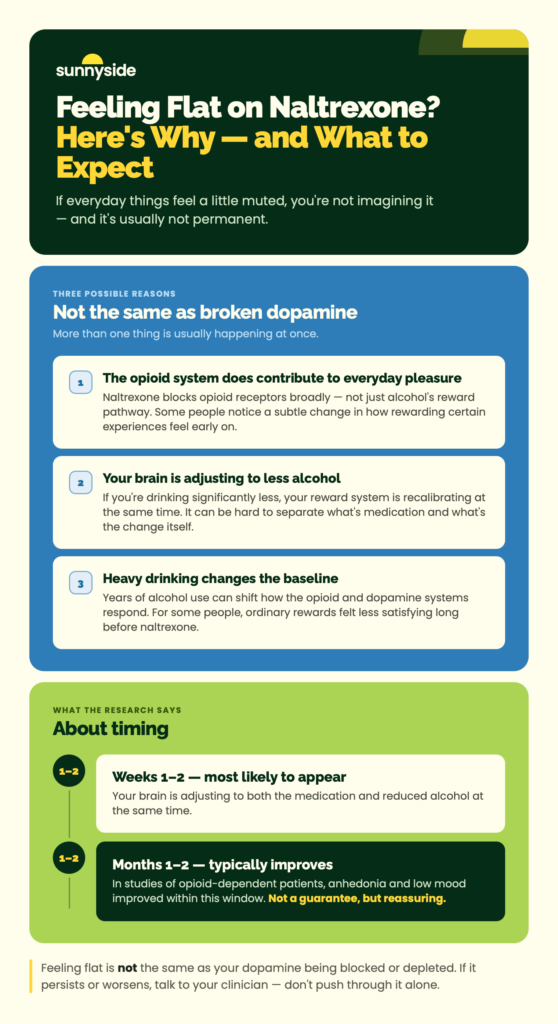
Some people do report feeling emotionally flat or less interested in normally enjoyable activities after starting naltrexone. That experience is worth taking seriously, even though it doesn’t mean naltrexone has “blocked” or depleted their dopamine.
There are a few possible reasons this can happen. Naltrexone blocks opioid receptors, and the endogenous opioid system plays a role in pleasure and reward, not just alcohol’s rewarding effects. Because of that, opioid blockade may subtly change how rewarding certain experiences feel for some people.
Another thing to consider: Alcohol itself affects the brain’s reward system, and repeated heavy drinking can change how the opioid and dopamine systems respond over time. If you start drinking significantly less on naltrexone, your brain is adjusting to that change at the same time you’re adjusting to the medication.
What we can’t say is that every case of early flatness has one simple cause. But feeling flat on naltrexone isn’t evidence that your dopamine system has been shut down. If the feeling is significant, persistent, or getting worse, it’s worth talking to your clinician.
Alcohol’s effects on reward involve several interconnected brain systems, including dopamine and endogenous opioids.
When you drink, alcohol can trigger the release of endogenous opioids such as beta-endorphin. Those opioids interact with the brain’s reward circuitry and can contribute to increased dopamine signaling. Over time, your brain can also learn to associate that reward with certain people, places, routines, or emotions. Research on alcohol and the reward system identifies both dopamine and opioid peptides as important contributors to alcohol’s reinforcing effects.
With repeated heavy drinking, the system adapts. Chronic alcohol exposure is associated with longer-term changes in several neurotransmitter systems, including dopamine and endogenous opioids. Research also suggests that chronic alcohol use and withdrawal can disrupt normal reward signaling, which may make alcohol increasingly important relative to other sources of reward.
One way to think about it is eating very sweet food every day for years and then suddenly cutting back. For a while, ripe fruit might taste surprisingly bland. The fruit hasn’t changed. Your point of comparison has.
That’s only an analogy, not a literal description of what happens in every brain. But it helps illustrate why changing a long-standing source of intense reward can sometimes make ordinary rewards feel different for a while.
Naltrexone intervenes at one specific point in this system. By blocking mu-opioid receptors, it can weaken part of the pathway connecting alcohol to dopamine signaling and reward. A meta-analysis of human laboratory studies describes evidence that mu-opioid receptor activation can indirectly promote dopamine release in the nucleus accumbens, while blocking those receptors can blunt alcohol-related dopamine release.
That doesn’t mean dopamine disappears. Naltrexone is changing one pathway through which alcohol activates the reward system, not shutting down the reward system itself.
If you do feel flat after starting naltrexone, there isn’t a universal timeline for when that feeling will go away. The research we have is limited, especially for people taking naltrexone to drink less.
One of the better studies comes from Krupitsky et al., 2016, which followed 306 people with opioid dependence for six months. Participants were randomly assigned to oral naltrexone, an extended-release naltrexone implant, or placebo, and researchers tracked depression, anxiety, and anhedonia, the clinical term for difficulty experiencing pleasure.
Those symptoms were elevated before treatment but declined to normal levels within the first one to two months among participants who stayed in treatment and did not relapse. Importantly, the researchers didn’t find evidence that naltrexone made depression or anhedonia worse compared with placebo.
There’s a big caveat: these participants were recovering from opioid dependence, not taking naltrexone to change their drinking. We can’t use the study to promise that any flatness you experience will disappear within a certain number of weeks.
Still, it’s reassuring evidence that blocking opioid receptors over time doesn’t necessarily mean losing your ability to experience pleasure. If low mood or emotional flatness sticks around or feels significant, talk to your clinician rather than assuming you just need to wait it out.
So what about the bigger fear: Could taking naltrexone long-term damage your dopamine system or permanently make life less enjoyable?
The evidence we have doesn’t point in that direction. In a small brain-imaging study, Zaaijer et al. (2015) measured striatal dopamine transporter availability in people with opioid dependence before and after starting extended-release naltrexone. The researchers found no significant change in dopamine transporter availability during treatment. In layman’s terms, alcohol may still affect you, but naltrexone can turn down some of the brain’s “this feels good, do it again” response to drinking. Depression scores also improved rather than worsened.
The study was tiny and involved people recovering from heroin dependence, so it shouldn’t be treated as definitive evidence about everyone who takes naltrexone. But it’s useful because researchers were looking directly at a component of the dopamine system rather than relying only on how participants said they felt.
Another study, Mysels et al. (2011), followed people with opioid dependence after they started extended-release naltrexone. Depression scores did not worsen during treatment, adding to the evidence that naltrexone does not generally cause depression simply because it blocks opioid receptors.
None of this means naltrexone is completely disconnected from everyday reward. The opioid system participates in many pleasurable experiences, so researchers are still studying whether blocking it can subtly change certain types of reward.
But there’s a big difference between a possible change in how rewarding something feels and “ruining your dopamine.” Current evidence does not suggest that naltrexone damages or shuts down the dopamine system, and longer-term studies have not shown a progressive loss of pleasure with continued treatment.
Feeling a little flat is different from experiencing a significant change in your mood. If you notice the latter, it’s important to tell your clinician.
Depression, suicidal thoughts, and suicide attempts have been reported among people taking naltrexone, but research has not established that naltrexone causes them. Still, the prescribing information recommends monitoring for depression or suicidal thinking during treatment. If your mood changes significantly after starting naltrexone, contact your clinician rather than assuming it’s a normal adjustment you need to push through.
That’s also why ongoing clinical support matters. Sunnyside Med members have access to the care team seven days a week, so you can check in if a side effect feels concerning or you’re unsure whether what you’re experiencing is normal.
If you’re experiencing thoughts of suicide or self-harm, seek immediate support by calling or texting the 988 Suicide & Crisis Lifeline at 988.
Starting naltrexone is one thing. Sticking with it long enough to see whether it works for you can be another.
A large pharmacy-claims study by Kranzler et al. (2008) followed 1,138 people who filled an oral naltrexone prescription. More than half filled only that first prescription, and just 14.2% had enough prescription coverage to meet the researchers’ definition of persistence over six months.
That’s one reason Sunnyside Med puts support around the medication rather than simply sending a prescription. Members have access to clinical care, drink tracking, coaching, and a private community as they figure out what naltrexone feels like for them and how it fits into their drinking goals. It can also help to know what to expect in the first weeks on naltrexone before you start.
Among active Sunnyside Med members, 78% achieve a meaningful reduction in drinking. Individual results vary.
If worries about dopamine or emotional flatness have made you hesitant to try naltrexone, the evidence is reassuring: naltrexone blocks opioid receptors, not dopamine itself. Its effects on alcohol reward are part of what makes the medication useful for people who want to drink less.
With Sunnyside Med, you can complete a very brief online assessment that’s reviewed by a licensed clinician and get ongoing support if you’re prescribed naltrexone. Learn more about Sunnyside Med—and see if you’re eligible.
Naltrexone is a prescription medication. This content is educational and should not be taken as medical advice. A licensed clinician reviews every Sunnyside Med application.
For most people, yes. Naltrexone blocks opioid receptors rather than dopamine receptors, and research doesn’t suggest that it shuts down your ability to experience pleasure. Some people notice changes in how rewarding certain experiences feel, particularly early in treatment, but that’s very different from losing your capacity for pleasure altogether.
Some people report feeling emotionally flat after starting naltrexone. Because the endogenous opioid system contributes to reward and pleasure, the medication itself may play a role. Changes in drinking can affect the reward system too, making it difficult to pin the feeling on one cause. Feeling flat does not mean your dopamine has been depleted or blocked.
There isn’t a well-established timeline. Research in people with opioid dependence found that anhedonia and low mood improved during the first one to two months of treatment, but we can’t assume the same timeline applies to people taking naltrexone to drink less. If emotional flatness is persistent or significant, talk to your clinician.
Current evidence has not established that naltrexone causes depression. Depression and suicidal thoughts have been reported during treatment, but clinical trials in people with alcohol dependence did not find higher rates of new-onset depression with naltrexone than with placebo. Significant mood changes should still be reported to your clinician.
For most people, everyday pleasures remain pleasurable on naltrexone. A small long-term study found that people receiving naltrexone continued to report substantial enjoyment from activities including eating, exercise, music, sex, and spending time with friends. Research is still exploring how opioid blockade affects different kinds of reward, so it’s more accurate to say that naltrexone doesn’t generally eliminate everyday pleasure than to say it can never affect it.
If emotional flatness persists, worsens, or starts interfering with your daily life, talk to your clinician. Don’t assume you need to push through it. Your clinician can help determine whether what you’re experiencing may be related to naltrexone, changes in your drinking, or something else.
Ian has a family deeply hurt by alcohol, and is on his own personal journey to drink less and live his healthiest life. He’s took naltrexone daily for two years and saw incredible results. As Sunnyside Med’s first customer, he’s deeply entrenched in alcohol health and naltrexone.
Naltrexone is not addictive or habit-forming. It blocks opioid receptors rather than activating them, so it doesn't produce...

Getting a prescription for naltrexone doesn't have to mean a long sit in a doctor's waiting room. With...
Naltrexone eligibility is determined through an individual clinical evaluation, not a single pass-or-fail test. You don't need to...
If you’re interested in trying naltrexone to help you drink less, the natural next question is where to...