
Last Updated on August 18, 2026

Feeling guilty after drinking doesn’t always mean you did something wrong. Alcohol changes brain chemistry, disrupts sleep, and can temporarily increase anxiety and self-criticism the next day. For many people, guilt also reflects a mismatch between how they drank and how they wanted to drink, rather than the events of the night itself.
Nothing dramatic happened last night. Three glasses of wine, good conversation, home by 10.
But that familiar low-grade dread is creeping in. If you’ve found yourself wondering, Why do I feel guilty after drinking when nothing went wrong?, you’re far from alone.
You wake up replaying the evening, searching for the moment that explains the feeling. Did I say too much? Was I annoying? Did I text someone? Nothing obvious comes to mind. The feeling arrived anyway.
One person on r/stopdrinking described it this way: “I feel so much guilt and shame after drinking, even when nothing bad happened.”
Research suggests that this experience is surprisingly common. Alcohol changes brain chemistry, disrupts sleep, and affects the way your brain processes emotions and memories once the alcohol wears off. Those shifts can leave you feeling remorseful, anxious, or deeply unsettled, even after an objectively uneventful night.
Understanding what’s happening won’t necessarily make the feeling disappear. But it can help explain why feeling guilty after drinking often has less to do with what happened the night before than with what alcohol is doing to your brain the morning after.
Your Brain the Morning After Drinking
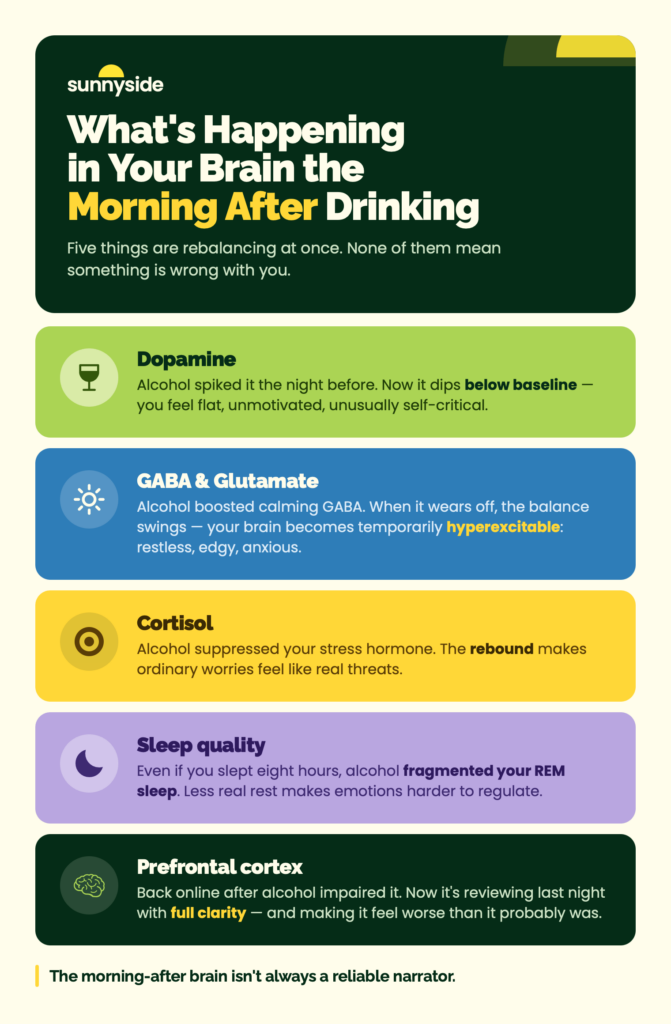
The morning after drinking isn’t a return to normal. Even after the alcohol has left your bloodstream, your brain is still recalibrating.
Dopamine
Alcohol temporarily increases dopamine activity in the brain’s reward system. As it wears off, dopamine activity dips back toward baseline, which can leave you feeling emotionally flat, sensitive, or unusually self-critical.
GABA and Glutamate
Alcohol also shifts the balance between calming GABA and stimulating glutamate. When alcohol wears off, that balance temporarily swings in the opposite direction. Researchers believe this rebound contributes to the anxious, unsettled feeling many people experience the next day, although it’s most strongly studied in alcohol withdrawal (Dharavath et al., 2023).
Stress Hormones
Stress hormones change, too. Alcohol initially suppresses cortisol, one of the body’s primary stress hormones. As that effect fades, cortisol can rebound, leaving your brain more likely to interpret uncertainty as something worth worrying about.
Sleep Quality
Sleep plays a role as well. Although alcohol can make you fall asleep more easily, it disrupts sleep quality later in the night. Waking up less rested makes it harder to regulate emotions, which can amplify feelings of guilt, anxiety, or regret.
Prefrontal Cortex
Finally, your prefrontal cortex, the part of the brain involved in judgment and self-reflection, regains the function alcohol temporarily impaired. Looking back on the previous evening with a clear mind can make ordinary conversations or small moments feel much bigger than they probably were at the time.
Watch the Related Podcast
Feeling Guilty After Drinking? You’re Not Alone
Taken together, the above changes help explain why you can wake up feeling guilty even after a perfectly uneventful night. Decades of hangover research describe the morning after as a whole-body rebound involving disrupted sleep, shifting hormones, and changes in brain chemistry that can affect mood and emotional regulation.
Research suggests the experience is common. In a large English study of increasing- and higher-risk drinkers, about one in eight people reported guilt or remorse after drinking (Cox et al., 2025). Women and younger adults reported these feelings more often, even after researchers accounted for how much participants drank. While the study wasn’t designed to represent everyone who drinks, it reinforces that post-drinking guilt is not an unusual experience.
Why Gray-Area Drinkers Often Feel Guilty
If you’re a gray-area drinker, your experience of guilt may be less about how much you drink than how your drinking fits with the person you believe yourself to be.
Gray-area drinkers typically don’t identify as having a drinking problem, but they also aren’t drinking the way they want to. That creates two kinds of friction.
The first is an identity gap. Your actions don’t match your self-image. If you see yourself as someone who values health, mindful drinking, or self-control, drinking more than you intended can feel like you’ve violated your own standards.
The second is an intention gap. Many gray-area drinkers set a limit before they start drinking, then wake up realizing they exceeded it. That broken promise to yourself often hurts more than the extra drink itself.
Temperament may shape the experience, too. In one study, socially anxious participants experienced a larger spike in next-day anxiety after drinking than more outgoing participants (Marsh et al., 2019). The study was small, but it suggests that personality influences how the morning after feels, not just how much you drank.
The Guilt Loop and the Difference Between Guilt and Shame
Here’s the difficult part: guilt and shame can become part of the cycle rather than the solution.
Guilt activates the brain’s stress response, and if alcohol has repeatedly become your fastest source of relief, your brain learns to reach for it again when uncomfortable emotions show up. That’s reinforcement learning, not a lack of willpower.
There’s also an important difference between guilt and shame. Guilt says, I did something I don’t feel good about. Shame says, There’s something wrong with me. Research consistently finds that shame is less likely to support lasting behavior change and more likely to fuel avoidance and self-defeating patterns.
As one person on r/stopdrinking wrote, “I drink to escape the guilt from drinking.”
Feeling guilty may be a sign that your drinking no longer matches your values, but beating yourself up rarely makes change easier. In fact, repeated cycles of drinking and hangovers have been linked to worsening mood over time, which may make the cycle even harder to break (Bagosi et al., 2025).
How to Combat Feeling Guilty After Drinking
If you’re already awake feeling guilty, you don’t have to stay there.
- Treat guilt as information. Ask, What can I learn from this? instead of replaying the night over and over.
- Look for patterns. Track when the guilt shows up and what happened beforehand. Over time, triggers become easier to spot.
- Practice self-compassion. Notice whether you’re speaking to yourself more harshly than you would to a friend.
- Make one change for next time. Set a drink limit, alternate with water, or plan an alcohol-free evening. Small changes are easier to repeat than perfect ones.
What Feeling Guilty After Drinking Might Be Telling You
When you ask, Why do I feel guilty after drinking?, the answer isn’t always that something terrible happened. More often, guilt is a signal that your drinking no longer matches what you actually want for yourself.
That’s worth paying attention to. It doesn’t mean you’re weak, that you have a drinking disorder, or that one night defines you. It means your actions and your intentions may have drifted apart.
Instead of asking, Why did I do that?, try asking, What was I hoping alcohol would do for me last night? Stress relief? Connection? Habit? The answer is often much more useful than the guilt itself.
And remember: the morning-after brain isn’t always a reliable narrator.
How Sunnyside Med Can Help With Guilt After Drinking
Self-compassion and planning are important, but they don’t change the brain processes that can make drinking feel hard to moderate in the first place.
In the short term, the neurochemical rebound after drinking settles on its own. Hydration, food, movement, and good sleep can help you feel better while your body recovers.
Over the longer term, many people find that tracking their drinking reveals clear patterns. Guilt often clusters around specific situations, emotions, or routines. Once you recognize those patterns, they’re much easier to change.
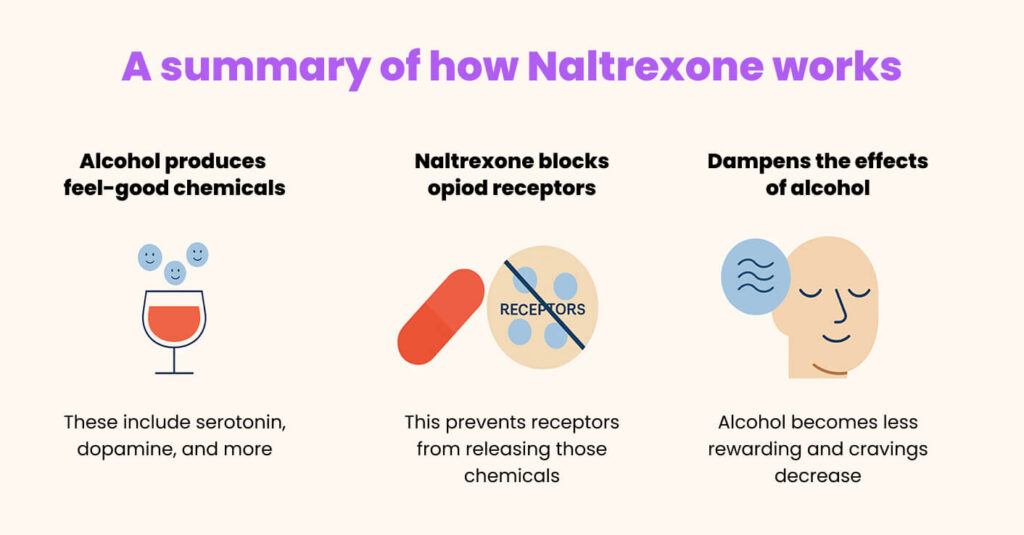
For people who find that the pull to drink repeatedly overrides their intentions, one option is medication. Sunnyside Med offers compounded naltrexone, which reduces the brain’s reward response to alcohol. Over time, many people find the gap between what they planned to drink and what they actually drink becomes smaller.
Among active Sunnyside Med members with at least 50% app engagement, 78% report a meaningful reduction in drinking. Individual results vary.
The whole process happens discreetly online, and you don’t have to quit drinking before getting started. A licensed clinician reviews every application to determine whether treatment is appropriate. Take a three-minute quiz to see if Sunnyside Med is right for you.
Frequently Asked Questions (FAQ): Feeling Guilty After Drinking
Is it normal to feel guilty after drinking even if nothing bad happened?
Yes. Many people experience guilt or remorse after drinking even when nothing objectively went wrong. Alcohol changes brain chemistry, disrupts sleep, and affects emotional processing the next day, making you more likely to feel anxious, self-critical, or unsettled.
Why do I feel anxious and guilty the morning after drinking?
As alcohol wears off, your brain and body go through a temporary rebound. Changes in neurotransmitters, stress hormones like cortisol, and poor sleep can all contribute to next-day anxiety and make ordinary interactions feel more significant than they really were.
Why do gray-area drinkers feel more guilt than heavy drinkers?
Research hasn’t shown that gray-area drinkers feel more guilt than heavy drinkers. The difference is often psychological rather than biological: gray-area drinkers are more likely to feel that their drinking doesn’t match their intentions or personal values. This can make guilt feel especially intense.
Does feeling guilty after drinking mean I have a drinking problem?
No. Feeling guilty after drinking isn’t a diagnosis. It may simply be a sign that your drinking no longer aligns with what you want for yourself. If the feeling keeps coming back, it’s worth paying attention to—not because guilt is always accurate, but because it can point to a pattern you want to change.
How do I stop feeling guilty after drinking?
Start by treating guilt as information rather than proof that something is wrong with you. Focus on recovery with food, hydration, and sleep, then look for patterns in when and why you drink. If you repeatedly find that the first drink leads to more than you intended, talk with a healthcare professional about treatment options such as naltrexone, which can help reduce alcohol’s rewarding effects for some people.
Naltrexone is a prescription medication. This content is educational and is not medical advice. A licensed clinician reviews every Sunnyside Med application.
Sunnyside Is the Perfect Companion for Your Mindful Drinking Journey
Sunnyside is the #1 mindful drinking app. Since 2020, we’ve been honing our harm-reduction approach and have helped over 400,000 people cut out 22 million drinks from their baseline habits. 96.7% of our members report success in drinking less, and in a third-party study, our approach was demonstrated to reduce weekly drinking by 33% after 12 weeks.
Think of Sunnyside as the front door for anyone who wants to change their relationship with alcohol. If you want to drink less, we can help you get there. If you want to eventually quit, but want to take a gradual approach, we can make that happen.
When you sign up for Sunnyside, you’ll take a quick 3-minute quiz, then hop into the app. It’s as simple and quick as that. We’ll give you weekly plans to gradually reach your drinking goals, and we’ll provide nudges, coaching, exercises, and advice to help you get there.
We have daily tracking and journaling tools, including the option to chat with a real human coach at any time. And our state-of-the-art analytics help you track your progress over time.
If you choose to stop taking naltrexone, the Sunnyside app remains a tool you can keep using to maintain your healthy habits.
Everyone who signs up for Sunnyside gets a free 15-day trial. After that, the subscription is $8.25/month.
Whether you’re currently taking naltrexone or just doing some research on alcohol moderation, we’d love to have you sign up for our 15-day free trial today.