
How Long Does Naltrexone Stay in Your System?
How long naltrexone stays in your system depends partly on which form of naltrexone you're taking. Oral naltrexone,...

Naltrexone and AA (Alcoholics Anonymous) are different approaches to changing your drinking. AA offers peer support centered on abstinence, while naltrexone is a prescription medication that can help reduce heavy drinking. Neither is inherently better, and some people use both. The right approach depends on your goals and the kind of support that works for you.
If you’re weighing naltrexone vs. AA (Alcoholics Anonymous), you may be trying to figure out what kind of help actually fits your particular situation.
Maybe you want to stop drinking. Maybe you want to drink less. Or maybe you’ve considered AA but aren’t sure its approach is right for you.
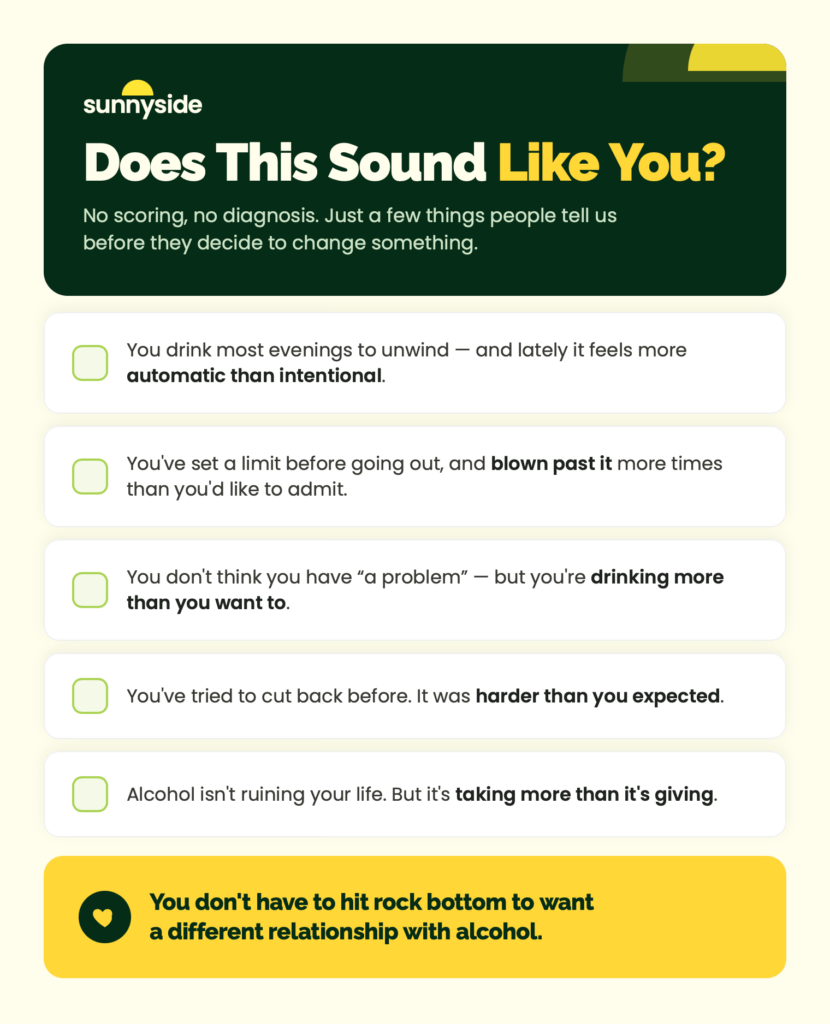
AA and naltrexone aren’t two versions of the same treatment. One is a peer-support program built around abstinence. The other is a prescription medication that can help reduce heavy drinking. Understanding that difference makes comparing them much more clarifying.
AA is a great program. It has saved the lives of several people in my family and my co-founder’s family, and I won’t say a word against it.
For someone who wants what AA offers, including community and support for abstinence, it can be exactly the right home.
But it isn’t the only way to change your relationship with alcohol. Nearly 29 million American adults have alcohol use disorder, according to the NIAAA, and AUD itself ranges from mild to severe. Treatment goals can differ, too.
That’s why we believe in adding options, not replacing them. Sunnyside Med pairs medication with behavior-change tools for people who want help changing their drinking, whether their goal is to cut back or quit.
Naltrexone and AA can also be used together. They aren’t replacements for each other, and we’d never claim otherwise.
AA and naltrexone approach drinking from quite different directions.
Alcoholics Anonymous is a peer-support program based on the 12 Steps. Meetings, sponsorship, and connection with other members provide an ongoing support system for people who want to stop drinking.
Naltrexone is a prescription medication. It blocks opioid receptors involved in alcohol’s rewarding effects, which can reduce heavy drinking and make it easier for some people to stop after fewer drinks. (If you want the mechanism in more detail, our guide to how naltrexone works breaks it down.)
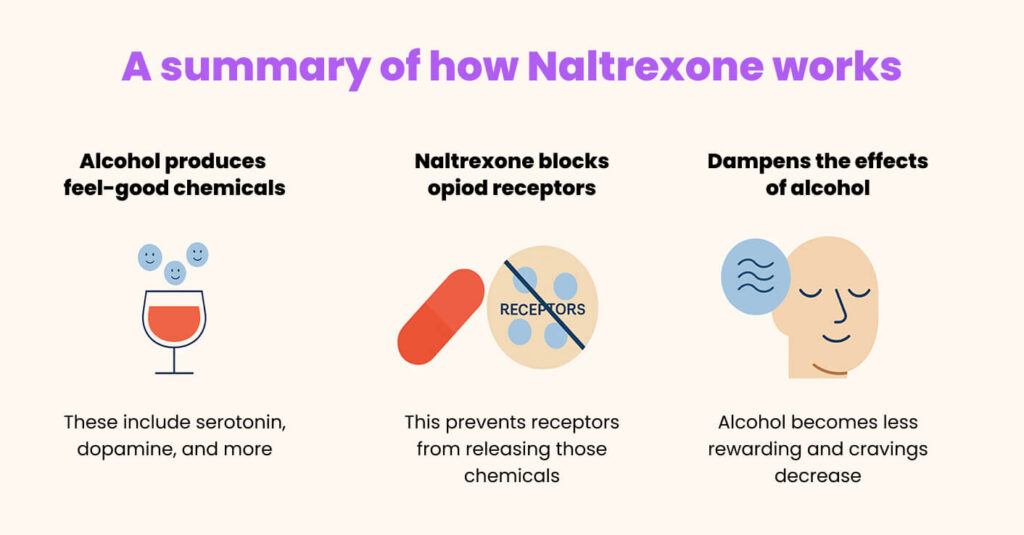
Unlike AA, taking naltrexone doesn’t require abstinence. You can continue drinking while taking it, and treatment can support either cutting back or quitting.
Brian Noonan, a psychiatric nurse practitioner quoted in The Stranger, described his standard for success this way: “The only marker for success I have is that the patient feels in control. They can drink or not drink in a manner that is appropriate to them. Sometimes that’s abstinence, or sometimes that’s just drinking on the weekends.”
That’s one of the practical differences between the two approaches. AA is organized around abstinence. Naltrexone can be used with either an abstinence or moderation goal.
There hasn’t been a randomized trial directly comparing AA with naltrexone, so we can’t use the research to “declare” one more effective than the other. Each has its own evidence base, and the studies tend to measure different outcomes.
One of the strongest pieces of research around AA is a 2020 Cochrane review that included 27 studies and 10,565 participants. It found that manualized AA and Twelve-Step Facilitation programs generally performed as well as other established treatments on most outcomes and often produced higher rates of continuous abstinence. They also appeared to reduce healthcare costs.
There’s an important limitation for this comparison: the review focused on people with alcohol use disorder, and abstinence was a major outcome. It doesn’t tell us how well AA works for someone whose goal is to drink less.
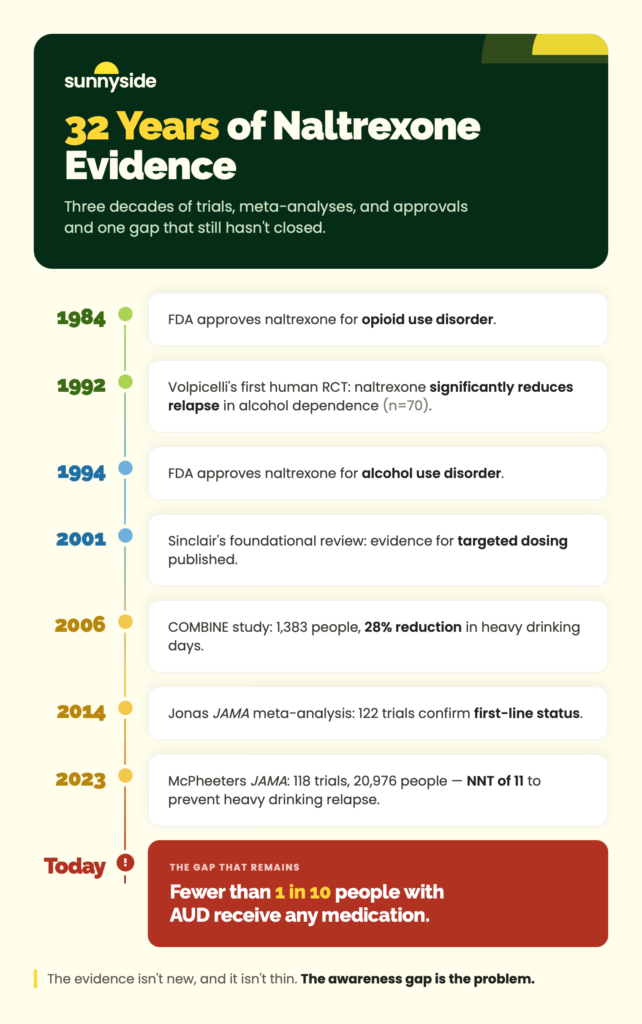
Naltrexone also has a large evidence base. A 2023 systematic review and meta-analysis examined 118 clinical trials involving more than 20,000 participants. Oral naltrexone was one of the medications with the strongest evidence for improving alcohol-related outcomes.
The researchers calculated a number needed to treat of 11 to prevent one additional person from returning to heavy drinking. In other words, for about every 11 people treated with oral naltrexone rather than a control condition, one additional person avoided a return to heavy drinking.
That doesn’t make naltrexone “better” than AA. The evidence answers different questions. AA research is particularly strong for abstinence, while naltrexone trials show that medication can reduce heavy drinking.
AA can be a strong fit for someone who wants to stop drinking and finds it helpful to have regular contact with other people working toward the same goal. Meetings are widely available, participation is free, and some people find the community and structure valuable over the long term.
That approach isn’t for everyone. You may want to drink less without committing to abstinence. You may not like group meetings or the 12-Step framework. Or you may prefer to approach your drinking through medical care.
Naltrexone offers a different starting point. It’s a prescription medication rather than a peer-support program, and you don’t have to identify with a particular label or participate in meetings to take it. It can also be used when your goal is moderation.
That doesn’t mean you have to choose one camp. Someone may prefer AA, naltrexone, another form of treatment, or a combination of approaches. The useful question is what kind of support matches your goals and what you’re actually willing to stick with.
For people who don’t identify with an abstinence-first approach, medication can make treatment feel more accessible. That’s also part of the thinking behind naltrexone for gray-area drinkers, who may want help changing their drinking without feeling that traditional recovery language describes them.
One concern people sometimes have about medication for alcohol use disorder is whether taking naltrexone simply replaces one substance with another.
But naltrexone’s actual mechanism doesn’t really support that idea. Naltrexone is an opioid antagonist, meaning it blocks opioid receptors rather than activating them. It doesn’t produce a high, isn’t addictive, and doesn’t cause physical dependence or withdrawal when you stop taking it.
Naltrexone has been FDA-approved to treat alcohol use disorder since 1994. Rather than replacing alcohol with another rewarding substance, it reduces some of alcohol’s reinforcing effects.
It’s also worth separating individual opinions about medication from AA’s official position. AA does not give medical advice, and its own literature acknowledges that some members need prescribed medication. Decisions about naltrexone should be made with a qualified clinician.
Yes. Choosing naltrexone doesn’t rule out AA, and participating in AA doesn’t medically prevent you from taking naltrexone.
The two can address different parts of changing your drinking. Naltrexone targets biological pathways involved in alcohol’s rewarding effects. AA provides peer support, structure, and connection with other people who want to stop drinking.
There has even been some research combining the two approaches. A small 2019 study paired naltrexone with Alcoholics Anonymous Facilitation, a behavioral intervention designed to encourage AA involvement. Participants increased their percentage of abstinent days during treatment. However, the study included only 20 people and had no comparison group, so it can’t tell us how much benefit came from the combination itself.
You don’t need to combine the two, either. If AA helps you, medication doesn’t have to replace it. If AA isn’t a fit, taking naltrexone doesn’t require you to start attending meetings. Treatment can be built around the kind of support you’re actually comfortable using.
For someone who wants to explore medication without making meetings or abstinence the starting point, Sunnyside Med offers another option.
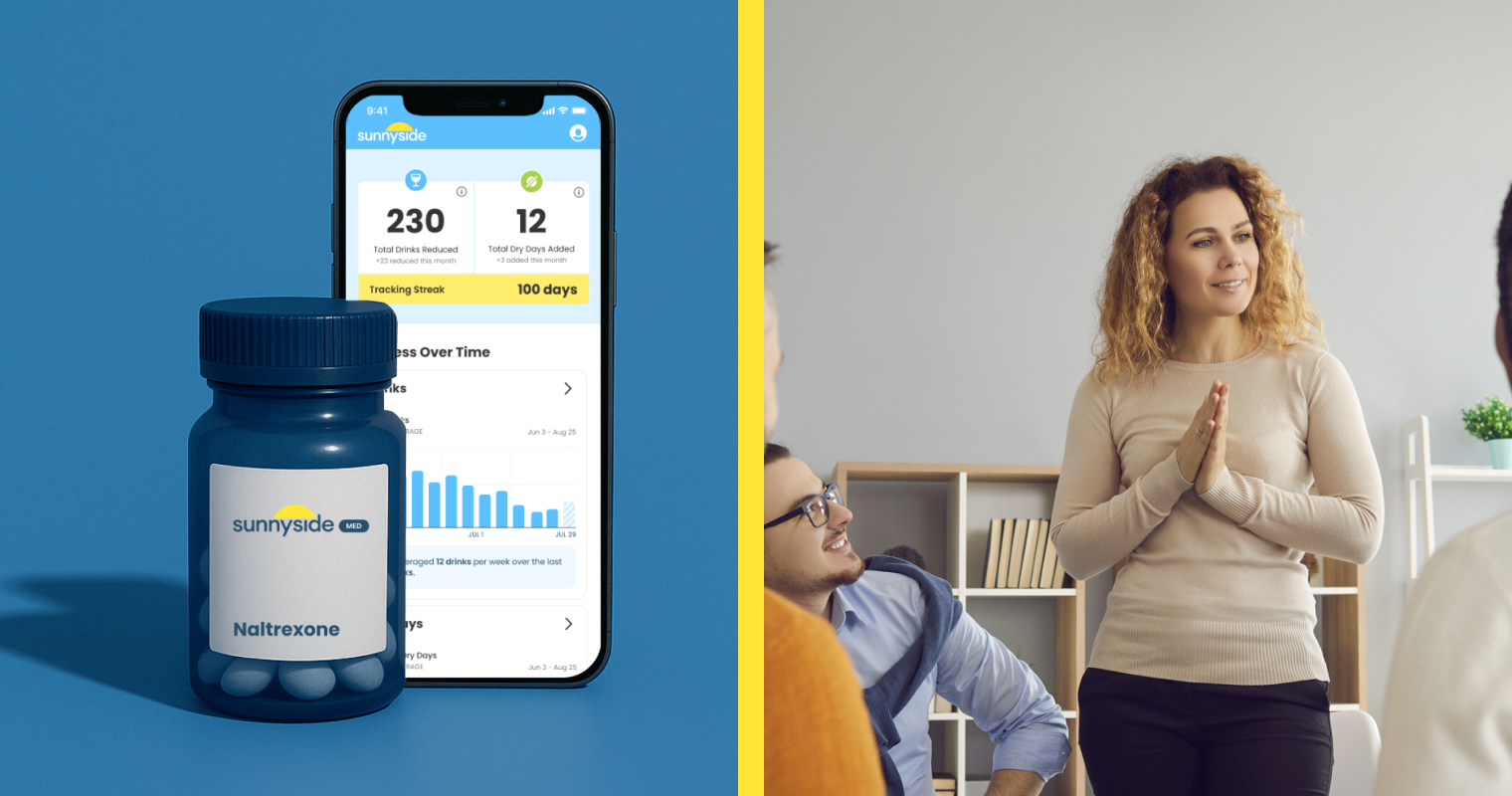
Sunnyside Med is a 100% online alcohol health program. A licensed clinician reviews your assessment and determines whether naltrexone is appropriate for you. If prescribed, medication is shipped discreetly to your door where available. No insurance is required.
The program includes more than medication. Members also get drink tracking and weekly goal-setting, text coaching seven days a week, group calls, a private community, and ongoing clinical support.
That support matters because staying on naltrexone can be difficult in real-world use. In a large pharmacy claims study, most people who filled an initial naltrexone prescription didn’t continue to fill it consistently over the following months. Among active Sunnyside Med members, those who engage with the program’s behavior-change support are 2.5x more likely to stay on their medication at month four. (Individual results vary.)
“[Sunnyside Med] isn’t only for people at or approaching rock bottom,” says Sunnyside co-founder Nick Allen. “We’re building Sunnyside Med to provide proactive and preventive access to medication before alcohol becomes a massive negative part of your story.”
One Sunnyside Med member who found success with naltrexone described their current reality this way: “One glass of wine, without major self-recrimination, without the pull to keep drinking. I was drinking 1.5 bottles of white wine every evening before I started naltrexone. I am not going back there.”
According to Sunnyside Med’s member data, 78% of active members achieved a meaningful reduction in drinking over 12 weeks. Individual results vary.
Sunnyside Med starts at $99 a month, is HSA/FSA eligible, and doesn’t require insurance. If naltrexone sounds closer to what you’re looking for than an abstinence-first program, you can learn more about Sunnyside Med and take a short assessment reviewed by a licensed clinician.
Naltrexone is a prescription medication. This content is educational and should not be taken as medical advice. A licensed clinician reviews every Sunnyside Med application.
Not necessarily. They're different kinds of support. Naltrexone is a prescription medication that can reduce heavy drinking, while AA is a peer-support program centered on abstinence. Some people use one or the other, and some use both.
Yes. Taking naltrexone doesn't prevent you from participating in AA. AA's official literature also says that medical advice and treatment should come from qualified physicians and acknowledges that some members need prescribed medication.
AA doesn't provide medical advice or prohibit members from taking prescribed medication. Individual members may have their own opinions, but AA's official guidance says that decisions about medical treatment should be made with a qualified physician.
Both have substantial but separate evidence bases, and there hasn't been a randomized trial directly comparing them. Research supports AA and Twelve-Step Facilitation for abstinence, while large systematic reviews support naltrexone for reducing heavy drinking.
No. Unlike medications that cause an unpleasant reaction with alcohol, naltrexone can be taken while someone is still drinking. Depending on your goals, it can be used as part of a plan to cut back or quit.
Possibly, but one treatment not working doesn't predict whether another will. A clinician can help determine whether it's appropriate for you.
Yes. Naltrexone has been studied for reducing heavy drinking, so complete abstinence doesn't have to be your goal. Whether it's appropriate for you depends on your drinking, health history, and other factors.
Ian has a family deeply hurt by alcohol, and is on his own personal journey to drink less and live his healthiest life. He’s took naltrexone daily for two years and saw incredible results. As Sunnyside Med’s first customer, he’s deeply entrenched in alcohol health and naltrexone.
How long naltrexone stays in your system depends partly on which form of naltrexone you're taking. Oral naltrexone,...

Research on naltrexone use during pregnancy is limited, particularly among people taking it for alcohol use disorder. What...
Although naltrexone eventually became an established treatment for alcohol use disorder (AUD), getting it into routine clinical practice...

Naltrexone and Antabuse differ in how they work, what taking them is like, their safety considerations, and the...