
Last Updated on September 8, 2026

Naltrexone for gray-area drinkers may help reduce the urge to keep drinking by making alcohol feel less rewarding. Research suggests it can be effective for people who want to moderate their drinking. Unlike medications that require abstinence, naltrexone can be taken while you’re still drinking as part of a plan to cut back. When combined with behavioral support, such as coaching, tracking, and habit-building strategies, it may help people make lasting changes to their drinking habits.
You tend to pour a glass of wine most evenings, as a way to unwind after work. Lately, though, you’ve started wondering whether that pour has become a little too automatic.
The situation is nuanced. You go to work, pay your bills, and keep your commitments. You just drink more often than you’d like—or, when you do drink, you have more than you intended.
Many people describe this as gray-area drinking. It’s the space between “I drink socially” and “I think I need treatment.”
Drinking habits exist on a spectrum, and most people don’t fit neatly into one category. You don’t need to decide, for example, that you have alcohol use disorder or are in severe crisis before deciding to drink less. That choice can be a proactive health decision, much like improving your sleep or treating high blood pressure before it causes complications.
That’s where naltrexone comes in. Despite FDA approval and the backing of decades of research, many people don’t hear about naltrexone until they stumble across a Reddit thread or hear about it from a friend. But naltrexone is a genuinely useful, evidence-based option that can help people reduce how much they drink.
What Is Gray-Area Drinking?
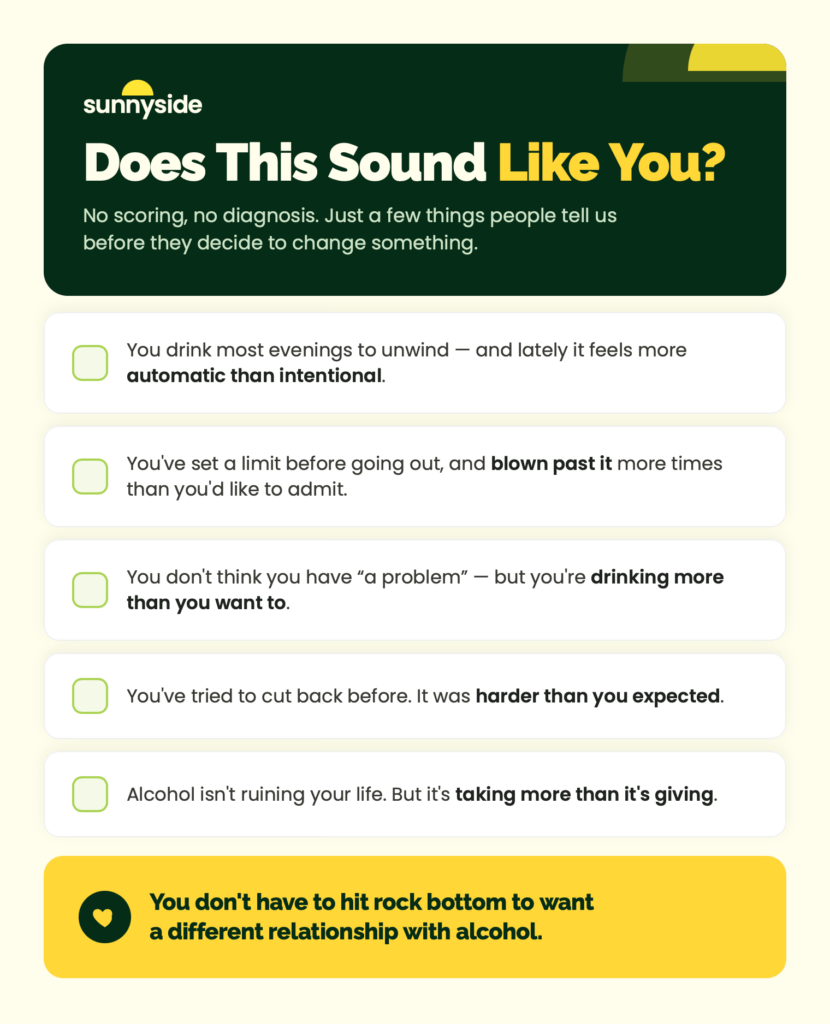
Gray-area drinking a term used to describe an “in-between” space—between drinking that feels completely unproblematic and drinking that clearly calls for intensive treatment.
For some people, that means a couple of drinks most nights that gradually become three or four. For others, it’s repeatedly breaking promises to cut back, thinking about alcohol more than they’d like, or noticing that drinking has become a default way to unwind.
Alcohol use exists on a spectrum. Clinicians diagnose alcohol use disorder using 11 criteria in the DSM-5, with severity based on how many criteria a person meets. Some people who identify with gray-area drinking meet the criteria for mild alcohol use disorder. Others don’t meet the threshold for a diagnosis at all.
What matters is whether your current drinking matches the life you want to be living. “You’re not here because you hate alcohol,” said Sunnyside co-founder Ian Andersen. “You’re here because it’s been taking more than it’s been giving.”
Why We Think “Gray-Area Drinking” Is a Useful Description
The phrase “gray-area drinking” isn’t perfect, but it captures something that feels recognizable to a lot of people. Many people know alcohol is taking up more space in their lives long before they’d describe themselves as having a drinking problem.
That’s why, at Sunnyside Med, we focus less on labels and more on goals. Whether your goal is to have more alcohol-free nights, stop drinking every weekday, feel comfortable stopping after one drink, or simply feel more in control, you can feel empowered to make a change.
For us, “gray-area drinking” is less of a capital-I Identity and more of a shorthand for a common experience: realizing your drinking doesn’t feel as intentional as you’d like.
Why Naltrexone Works for Gray-Area Drinkers
When you drink, alcohol triggers the release of endorphins, which contribute to the sense of pleasure or relief many people experience. Naltrexone blocks opioid receptors, blunting that reward signal.
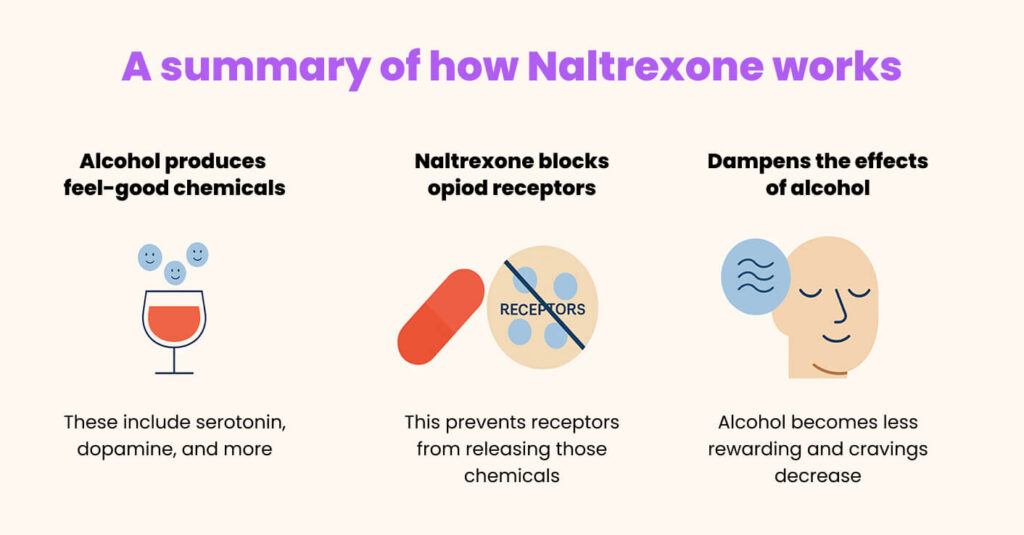
For many people, that means drinking simply becomes less appealing over time. The first drink may feel less exciting. The urge to keep going may be weaker. Instead of relying on willpower alone, the medication changes the experience of drinking itself.
Naltrexone has been FDA-approved to treat alcohol use disorder since 1994. It isn’t addictive, and decades of research have established a well-characterized safety profile when it’s prescribed appropriately.
Unlike medications that require complete abstinence, you can continue drinking while taking naltrexone. That may be particularly relevant for many gray-area drinkers. Rather than drinking to avoid withdrawal, they’re often drinking because alcohol feels rewarding: it helps them relax, socialize, or unwind after a long day.
Research suggests naltrexone may be especially helpful for people who drink for those reward-related reasons. Importantly, the evidence doesn’t suggest naltrexone is only useful for people with severe alcohol use disorder. Instead, it appears to reduce drinking across a range of severities, including among people whose goal is moderation rather than abstinence.
“I’m really enjoying having the ‘Noise’ quieted,” said one Sunnyside Med member. “It’s been about 40 days on [naltrexone], and I don’t even think of drinking during the week.”
The Research on Naltrexone for Gray-Area Drinkers
Much of what we know about naltrexone comes from studies of people with alcohol use disorder. But several randomized trials have also examined people whose drinking resembles gray-area drinking.
In a randomized trial of 128 young-adult heavy drinkers, many of whom did not have alcohol use disorder, naltrexone reduced drinks per drinking day and lowered the likelihood of reaching intoxication compared with placebo (O’Malley et al., 2015). The authors concluded that its benefits were modest but meaningful, with a favorable risk-benefit profile for young adults trying to reduce heavy drinking.
Another randomized trial by Kranzler and colleagues (2009) found that naltrexone reduced drinks per drinking day among people whose goal was moderation rather than abstinence. Although the study used targeted dosing, it adds to the broader evidence that naltrexone can help people reduce their alcohol consumption, not just stop drinking altogether.
Why Taking Early Action Matters
One advantage of addressing your drinking early is that you don’t have to wait for alcohol to cause major problems before doing something about it.
Clinical trials (like the Kranzler study) have shown that naltrexone can help people whose goal is to drink less, not necessarily to quit entirely. That’s important because many people assume medication is only appropriate after years of escalating alcohol use. In reality, you don’t need to wait until drinking has caused serious health, relationship, or work problems before exploring options.
Addressing your drinking earlier doesn’t mean anything about your situation’s severity. It just means you’re responding to something that’s no longer working for you before it grows into a larger problem.
“For the first time in years I’ve been waking up clear-headed and feeling good,” said a Sunnyside Med member. “I still plan to drink some, but I don’t miss feeling like I have to drink.”
What Does Drinking Actually Feel Like on Naltrexone?
Naltrexone doesn’t make alcohol taste different, and it doesn’t stop you from feeling the effects of drinking. What many people notice instead is that the urge to keep drinking becomes less intense.
Sometimes that change is surprisingly ordinary. As one Sunnyside Med member put it: “I had a cocktail last night, and for the first time ever, I didn’t drink the whole thing. I dumped half down the drain.”
For others, the biggest change is what happens after that first drink. As another member shared: “One glass of wine, without the pull to keep drinking — that is a place I aim to dig in and stay. I was drinking 1.5 bottles of white wine every evening before [I started naltrexone]. I am not going back there.”
The timeline matters, too. While some people notice changes within the first few weeks, many report more meaningful improvements after one to three months of consistent use. That’s why clinicians often recommend giving naltrexone enough time to work before deciding whether it’s helping.
If you’re wondering what those first few months typically look like, our guide to the naltrexone timeline walks through the process week by week. Just keep in mind that everyone’s experience is different.
Why You May Not Have Heard of Naltrexone Before
If naltrexone has been available for decades, why is it still unfamiliar to so many people?
One reason is that medications for alcohol use disorder remain underused. According to the National Institute on Alcohol Abuse and Alcoholism, fewer than 10% of people with alcohol use disorder receive treatment in a given year, and only a small percentage receive medication.
Research suggests this gap extends across healthcare settings. In a 2025 review of more than 52,000 treatment-eligible emergency department encounters across 12 hospitals, only 0.5% resulted in a naltrexone prescription at discharge (Lebin et al., 2025). The study can’t explain every reason prescribing was uncommon, but it illustrates how infrequently medication is started, even when patients come into contact with the healthcare system.
There’s also the matter of doctor familiarity. Many clinicians receive limited training in treating alcohol use disorder. In addition, outdated concerns about naltrexone and liver safety persist despite decades of clinical use, and some healthcare settings continue to focus primarily on abstinence rather than medication-supported reduction.
Is Naltrexone Too Serious for Gray-Area Drinkers?
If you’re a gray-area drinker, it’s understandable to feel apprehensive about naltrexone. Medication can feel like a step reserved for someone whose drinking is in a much more extreme place.
But in reality, naltrexone isn’t prescribed based on whether someone has reached a crisis point. It’s one evidence-based option that may help people who want to drink less, whether their goal is moderation or abstinence.
At Sunnyside Med, eligibility isn’t based on the number of drinks you have per week. Instead, the evaluation focuses on whether alcohol is creating problems in your life, whether you’ve found it difficult to control your drinking, and whether naltrexone is medically appropriate for you.
From there, a licensed clinician reviews your health history, drinking patterns, and goals to determine whether treatment is a good fit. The entire evaluation takes place online and can be completed from home.
Why Medication Alone Isn’t Enough
Naltrexone can make it easier to drink less, but it doesn’t automatically change the routines, habits, and situations that have become tied to drinking. For many people, that’s where behavioral support makes a difference.
The evidence points in the same direction. The landmark COMBINE study, one of the largest clinical trials of medications for alcohol use disorder, found that both naltrexone and behavioral interventions improved drinking outcomes. Rather than competing approaches, they work best as complementary tools.
That’s the idea behind Sunnyside Med. The medication addresses alcohol’s rewarding effects, while the program helps you build new habits around it through tracking, reminders, coaching, and community support.
That combination may also help people stay on treatment. Within the Sunnyside Med program, members who actively engage with the app are 2.5 times more likely to remain on their medication than less engaged members. Individual results vary.
“The medication alone has been shown to reduce bounce-back behavior, but especially when coupled with behavior change; that’s when you get the most effective results for the long term,” said Sunnyside co-founder and CEO Nick Allen.
See if you might be eligible for naltrexone with a two-minute quiz.
Frequently Asked Questions (FAQ): Naltrexone for Gray Area Drinkers
Is naltrexone only for people with alcohol use disorder?
No. Naltrexone has been studied in a range of populations, including people with heavy drinking patterns who did not have a formal alcohol use disorder diagnosis. If your goal is to drink less rather than quit completely, it may still be an appropriate option.
Can you still drink while taking naltrexone?
Yes. Unlike medications that require complete abstinence, naltrexone can be started while you’re still drinking, and many people take it specifically to help them cut back.
What does drinking feel like on naltrexone?
Naltrexone doesn’t make alcohol taste different, and it doesn’t prevent you from feeling the effects of drinking. What many people notice instead is that the urge to keep drinking becomes less intense.
Naltrexone is a prescription medication. This content is educational and should not be taken as medical advice. A licensed clinician reviews every Sunnyside Med application.
Sunnyside Med Is the Perfect Companion for Your Naltrexone Journey
Sunnyside is the #1 mindful drinking app. Since 2020, we’ve been honing our harm-reduction approach and have helped over 400,000 people cut out 22 million drinks from their baseline habits. 96.7% of our members report success in drinking less, and in a third-party study, our approach reduced weekly drinking by 33% after 12 weeks.
Think of Sunnyside as the front door for anyone who wants to change their relationship with alcohol. If you want to drink less, we can help you get there. If you want to eventually quit, but want to take a gradual approach, we can make that happen.
When you sign up for Sunnyside, you’ll take a quick 3-minute quiz, then hop into the app. It’s as simple and quick as that.
We’ll give you weekly plans to gradually reach your drinking goals, and we’ll provide nudges, coaching, exercises, and advice to help you get there.
We have daily tracking and journaling tools, including the option to chat with a real human coach at any time. And our state-of-the-art analytics help you track your progress over time.
If you choose to stop taking naltrexone, the Sunnyside app remains a tool you can keep using to maintain your healthy habits.
Everyone who signs up for Sunnyside gets a free 15-day trial. After that, the subscription is $8.25/month.
Whether you’re currently taking naltrexone or just doing some research on alcohol moderation, we’d love to have you sign up for our 15-day free trial today.