

Last Updated on September 18, 2026
There is no single naltrexone success rate because studies define success differently. In a large 2023 JAMA review, oral naltrexone had a number needed to treat of 11 for preventing a return to heavy drinking. That doesn’t mean it works for only 1 in 11 people. It measures the added benefit of naltrexone compared with a control group.
If you’ve been researching naltrexone, you’ve probably encountered numbers that may have been a little confusing. One source might give you a tidy percentage. Another talks about a “number needed to treat,” or NNT. Meanwhile, clinical trials measure everything from abstinence to heavy drinking days and changes in cravings.
So which number tells you whether naltrexone will work for you?
Unfortunately, none of them can do that, at least not precisely. The research can tell us how naltrexone performs across groups of people, but individual response varies. Understanding the numbers starts with understanding what researchers mean by “success.” Then, you’ll be more empowered to make the decision that works best for you.
Why Naltrexone Doesn’t Have One “Success Rate”
A medication’s success rate depends on what we’re defining as “success.”
Naltrexone studies have measured return to heavy drinking, return to any drinking, percentage of heavy drinking days, total alcohol consumption, abstinence, and craving. A study measuring complete abstinence will naturally produce a different number from one measuring whether someone drank less.
That’s why a claim like, for example, “naltrexone is 80% effective,” doesn’t mean much on its own. To evaluate a percentage, you need to know where it came from, what population was studied, what outcome researchers measured, and what they compared it with.
A more useful question is: Which drinking outcomes has naltrexone been shown to improve, and how much additional benefit does it provide?
That’s where the number needed to treat (NNT) can help.
The NNT, And What the Best Evidence Says About Naltrexone
One of the most comprehensive recent analyses comes from McPheeters et al. (2023), a systematic review and meta-analysis published in JAMA. The researchers analyzed 118 clinical trials involving 20,976 participants across the medications evaluated in the review.
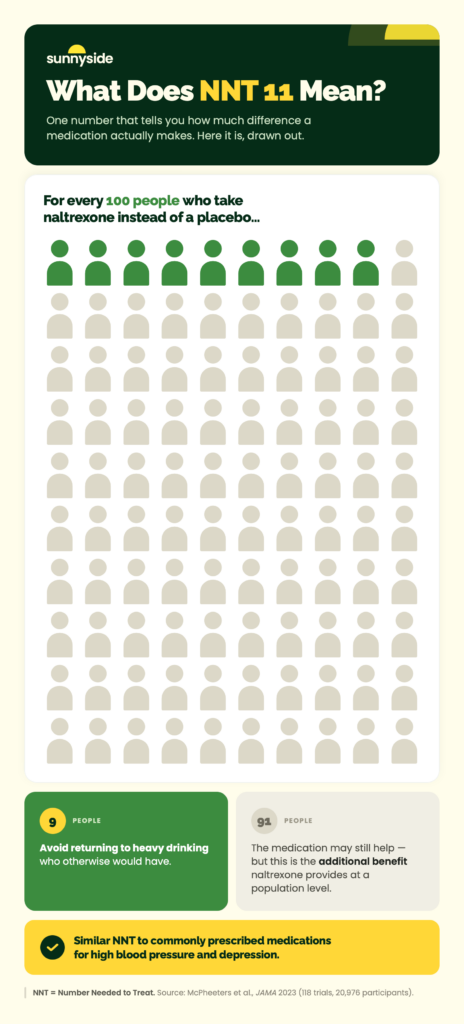
For oral naltrexone, the number needed to treat (NNT) was 11 for preventing a return to heavy drinking and 18 for preventing a return to any drinking.
Now, what does that mean? An NNT of 11 means that for every 11 people treated with oral naltrexone rather than a control intervention, one additional person avoids returning to heavy drinking because of the treatment.
It does not mean naltrexone works for one person and fails for the other 10. People in both the naltrexone and control groups may improve. NNT measures the difference in outcomes between those groups.
Limits of the NNT
NNT describes an average treatment benefit across a population. It can’t tell you your individual odds of responding. There are also limits to how precisely we can interpret the number. The estimate for return to heavy drinking had a fairly wide confidence interval, and the evidence in this review primarily applies to adults with alcohol use disorder.
Still, the overall finding is useful: oral naltrexone provides a measurable benefit for reducing heavy drinking compared with control treatment. The size of that benefit is better represented by measures like NNT than by a single universal success percentage.
Sunnyside Med: Why Sticking With Treatment Matters
Clinical trials tell us whether naltrexone can improve drinking outcomes. Real-world results also depend on whether people continue taking the medication.
A large U.S. insurance-claims study, Kranzler et al. (2008), found that 85.8% of people who filled an initial naltrexone prescription did not persist with it over the following six months. The data came from 2000 to 2004, so prescribing patterns may look different today. Claims data also can’t tell us why someone stopped filling a prescription or whether they took every dose.
Still, the study highlights a practical issue: getting a prescription and staying on treatment are two different things.
Sunnyside Med pairs clinician-supervised naltrexone, when medically appropriate, with tools designed to support the broader process of changing your drinking. In Sunnyside’s internal observational data, members who engaged with the full program were 2.5 times more likely to still be taking their medication at month four than less-engaged members.
What the COMBINE Study Found
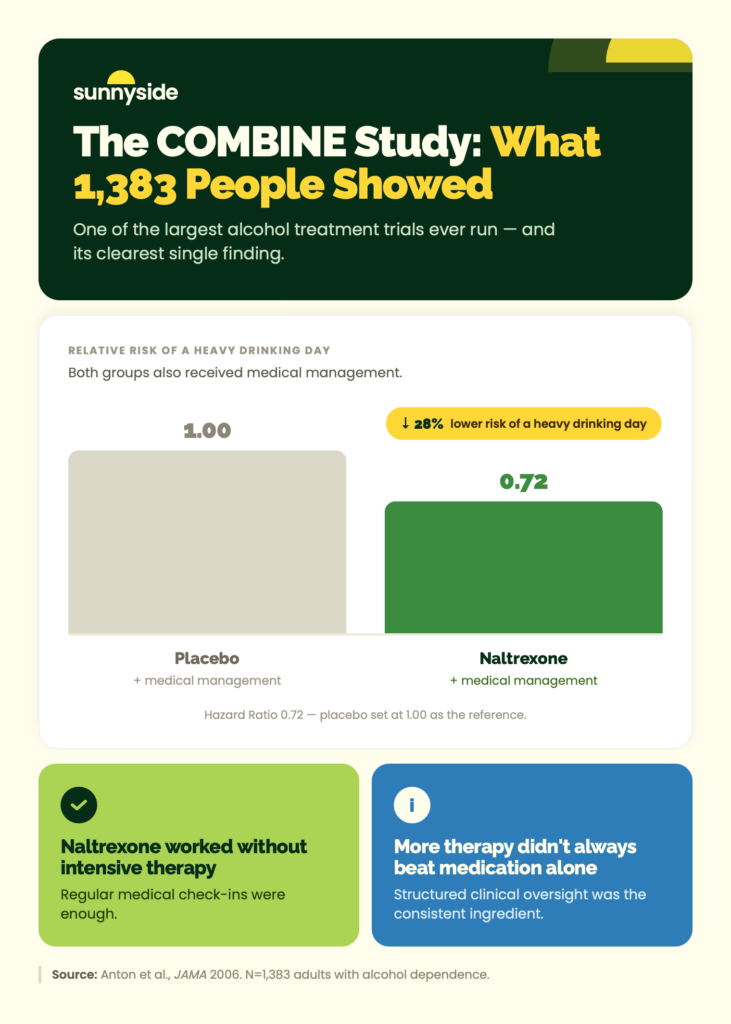
Another useful piece of evidence comes from COMBINE, a large U.S. trial involving 1,383 recently abstinent adults with alcohol dependence. Researchers tested naltrexone, acamprosate, behavioral intervention, and structured medical management in different combinations.
Participants receiving naltrexone with medical management had 80.6% days abstinent, compared with 75.1% among those receiving placebo with medical management. Naltrexone also reduced the risk of a heavy drinking day compared with placebo.
Medical management included regular appointments, monitoring, adherence support, and guidance around drinking. One caveat: Adding the study’s more intensive behavioral intervention didn’t clearly improve outcomes further, so COMBINE supports naltrexone as part of structured clinical care but doesn’t establish that any particular form of behavioral support is superior.
Why Naltrexone Might Not Work for Everyone
People don’t all respond to naltrexone the same way. Some notice substantial changes in craving or drinking, while others experience a smaller effect or little noticeable change.
Expectations can also shape how people judge whether the medication is working. Naltrexone doesn’t necessarily eliminate cravings or make alcohol immediately unappealing. Its pharmacologic effects begin relatively quickly, but changes in your drinking may take longer to notice.
Consistency matters, too. If you stop taking naltrexone early or take it inconsistently, it’s harder to evaluate how well it’s working for you. If you’re taking naltrexone and aren’t noticing the changes you expected, talk and set expectations with your clinician rather than changing your dose or stopping on your own.
What Success Can Look Like if Your Goal Is to Drink Less
Success with naltrexone doesn’t have to mean never drinking again. Many clinical trials measure outcomes such as return to heavy drinking or the number of heavy drinking days, rather than abstinence alone.
If your goal is moderation, success might mean drinking less overall, having fewer heavy drinking days, or finding it easier to stay within the limits you’ve set for yourself.
Sunnyside Med uses that same moderation-friendly approach. When naltrexone is medically appropriate, the program pairs it with drink tracking, goal setting, medication tracking, coaching seven days a week, group support, a private community, and ongoing clinical care.
“Now that I have medication to help, I feel even more confident in implementing the coping skills that I’ve learned,” said one member.
Sunnyside’s internal observational data offer another way of measuring outcomes. Among active Sunnyside Med members, 78% achieved a meaningful reduction in drinking, and active members averaged a 45.6% reduction in daily drinks. (Individual results vary.)
Sunnyside Med is 100% online and costs $99 per month plus a one-time intake fee. No insurance is required, and the program is HSA/FSA eligible and available in all 50 states.
If you’d like to find out whether naltrexone and Sunnyside Med could be appropriate for you, take a short online assessment. A licensed clinician reviews each application.
Frequently Asked Questions (FAQ): Naltrexone Success Rate
What is naltrexone’s success rate for alcohol?
There isn’t one universal percentage. Studies measure different outcomes, including heavy drinking, abstinence, overall consumption, and cravings. In a 2023 JAMA review, oral naltrexone had a number needed to treat of 11 for preventing a return to heavy drinking.
What does an NNT of 11 mean for naltrexone?
It means that for every 11 people treated with oral naltrexone rather than a control intervention, one additional person avoided returning to heavy drinking. It does not mean naltrexone works for only 1 in 11 people.
Why do some people say naltrexone didn’t work for them?
Individual response varies. Some people experience substantial changes in cravings or drinking, while others notice less of an effect. Taking the medication consistently and having realistic expectations can also affect how well you’re able to evaluate your response.
How long does it take to know whether naltrexone is working?
Naltrexone begins acting pharmacologically relatively quickly, but changes in cravings or drinking may take longer to notice. Your clinician can help you evaluate your response over time and set realistic expectations around the timeline.
Does naltrexone work if your goal is moderation?
It can. Clinical research on naltrexone includes outcomes such as reduced heavy drinking, not just abstinence. A licensed clinician can help determine whether naltrexone is appropriate for your drinking goals.
Naltrexone is a prescription medication. This content is educational and should not be taken as medical advice. A licensed clinician reviews every Sunnyside Med application.