Last Updated on July 7, 2026
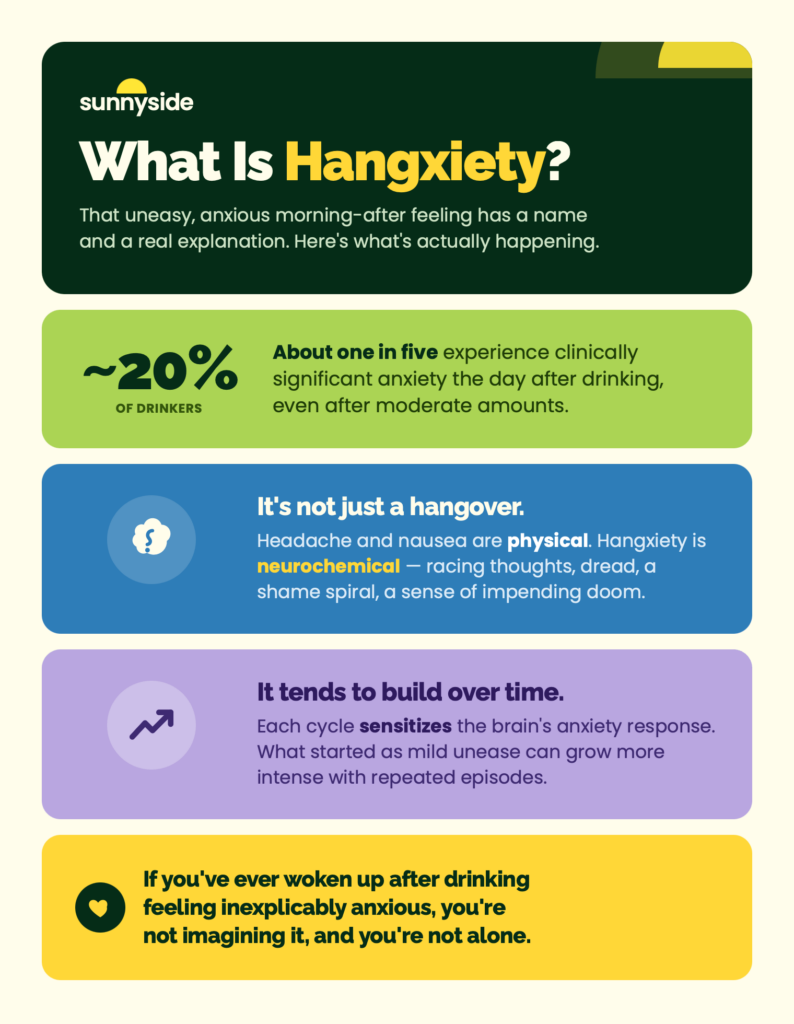
About 1 in 5 social drinkers experience significant anxiety as part of their hangovers, according to survey research published in the Journal of Clinical Medicine. Not just a headache and fatigue. Real anxiety, dread, racing thoughts, a sense that something bad is about to happen. If that sounds familiar, this article is for you. And the first thing you should know is that it is not a character flaw. It is brain chemistry. This article explains exactly what hangxiety is, why it happens, why it tends to get worse over time if nothing changes, and what you can actually do about it at the neurological level.
Most content about hangxiety ends with “drink water and rest.” That advice is not wrong. It is just wildly incomplete. What you will not find in the standard top-ten articles is an explanation of why the anxiety can feel worse every year, why it can last two or three days in severe cases, and why willpower is not a credible solution when your own brain chemistry is working against you.
That is the gap this article fills.
What is hangxiety?
“Hangxiety” is a portmanteau of hangover and anxiety that entered common use in the mid-2010s, first in UK and Australian media, then everywhere. The word stuck because it captured something real that clinical language had not named cleanly. Doctors call it “hangover-related anxiety” or “post-alcohol anxiety.” But anyone who has felt it knows it is more than a category in a textbook.
The term gained traction because millions of people recognized themselves in it. Sunday-morning dread. Heart racing when you check your phone. Replaying conversations from the night before and filling in the blanks with worst-case assumptions. A low, persistent sense that something is wrong, even when nothing specifically is.
What is notable about that 22% prevalence figure is the population it describes: social drinkers. Not people with a diagnosed disorder. Not people who identify as having a serious problem. People who drink in social settings and wake up the next day feeling like their nervous system caught fire.
What hangxiety actually feels like?
The experience is not one thing. It ranges from mildly uncomfortable to genuinely disabling, and where you land on that spectrum on any given morning depends on how much you drank, your personal neurobiology, your baseline anxiety, and how long this pattern has been repeating.
Light hangxiety
- Feeling down or emotionally flat
- Low motivation, difficulty starting tasks
- Brain fog, hard to focus on anything requiring real thought
- A low hum of anxiety that feels bad but tends to clear up within a few hours after you hydrate, eat, and move your body
Medium hangxiety
- Everything above, plus more obvious physical symptoms
- Increased heart rate, restlessness, a physical edge to the anxiety
- The anxiety sticks with you through most of the day
- Irritable with people around you, counting the hours until you can go home and sleep it off
Debilitating hangxiety
- Thoughts of impending doom that feel real, not abstract
- Shame and regret dominate your thinking, often about things that probably were not even a big deal
- A fear that the anxiety will never lift
- Near-impossible to focus at work, which compounds the anxiety further
- Thoughts of having a drink to take the edge off
- Can last 2 to 3 days in some cases
- Calling in sick, canceling plans, withdrawing
- At this level, these symptoms overlap with what doctors see at the mild end of alcohol withdrawal, particularly after heavier or repeated drinking. You can experience some of this without physical dependence, but your body is registering the absence of alcohol.
These are also hangover symptoms, yes. But when the anxiety component takes over, it creates a feedback loop that can carry through the entire day and beyond.
What causes hangxiety?
The experience is real and the biology behind it is well understood. This is not you being dramatic. This is your brain chemistry in a temporary but genuinely unpleasant state of imbalance. Understanding the mechanism matters because it changes how you think about the problem and what you can do about it.
Why do some people get hangxiety and others don’t?
You have probably noticed that some people bounce back from a night of drinking without a trace of anxiety while others are mentally ruined for a full day. This is not about mental toughness.
A few factors consistently predict who lands on the hangxiety end of the spectrum:
Baseline anxiety or shyness. People with existing anxiety disorders or shy, neurotic personality traits are significantly more likely to experience hangover-related anxiety. Research by Gunn and colleagues in 2020 found that shyness and drinking to cope with negative emotions predicted stronger next-day mood disruption. If alcohol is already functioning as a social lubricant or a way to quiet an anxious mind, the rebound when it leaves is felt harder.
Genetics. Some people have genetic differences in GABA-A receptor subunits, glutamate receptors, and stress-reactivity genes that make them more sensitive to the shift in brain chemistry when alcohol clears. This is still an emerging area of research, but individual variability in hangover severity is substantially explained by genetics and metabolism, not just how much someone drank.
Drinking pattern. Higher quantities, drinking to intoxication, and binge patterns predict more severe hangovers and more pronounced next-day anxiety. It is not just about the total number of drinks but how quickly they were consumed and how high blood alcohol climbed.
The GABA rebound
This is the core mechanism, and it is worth understanding properly because almost every article stops halfway through the explanation.
GABA (gamma-aminobutyric acid) is your brain’s main inhibitory neurotransmitter. Think of it as the calming signal. Glutamate is the main excitatory neurotransmitter. These two systems are normally in balance.
Alcohol enhances GABA-A receptor activity and simultaneously suppresses NMDA-type glutamate receptors. The result is the familiar relaxed, loose, socially-eased feeling that alcohol produces acutely.
But the brain is always trying to maintain balance. As alcohol keeps those GABA receptors artificially stimulated, the brain compensates by making those receptors less sensitive and ramping up the glutamate system. By the time you go to bed, your brain has partially adjusted to alcohol being present.
When alcohol clears your system, both of those compensatory adaptations are still in place. Suddenly there is too little inhibition and too much excitation. The result is a hyper-aroused brain state: anxiety, irritability, racing thoughts, physical restlessness.
This mechanism is why benzodiazepines (medications like diazepam or alprazolam) and alcohol produce similar withdrawal experiences. Both work primarily on GABA-A receptors. When either is removed after the brain has adapted to their presence, the rebound is excitation in the same circuits. Alcohol’s version is less severe than benzo withdrawal in most cases, but it is the same direction, driven by the same receptor system.
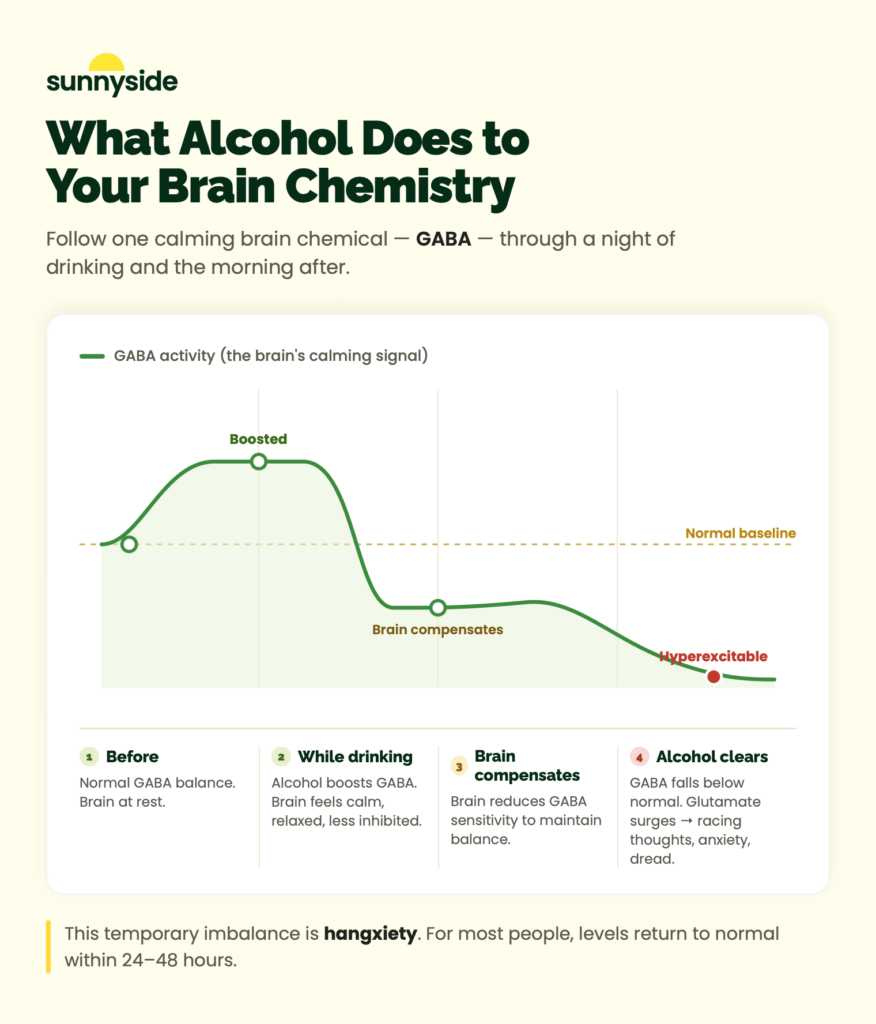
The research supporting this mechanism comes from multiple lines of evidence, including Littleton J., 1998 on neurochemical mechanisms underlying alcohol withdrawal and Koob & Volkow, 2016 in The Lancet Psychiatry.
The cortisol spike
GABA and glutamate explain the brain’s excitability. But there is a second system running in parallel that most hangxiety articles skip entirely.
Alcohol also activates the hypothalamic-pituitary-adrenal axis, the body’s central stress response system. This triggers the release of cortisol, the primary stress hormone.
Research by Stephens and Wand in 2012 in Alcohol Research documents how repeated alcohol exposure sensitizes the HPA axis, leading to elevated stress hormone activity during withdrawal states. Even a single heavy night can produce a cortisol pattern the next day that amplifies the subjective experience of anxiety. The result is the physical signature of stress without anything in your environment specifically causing it: elevated heart rate, sweating, hypervigilance, a sense of dread that does not connect to any specific threat.
When the brain is already in a GABA-depleted, glutamate-elevated state and cortisol is simultaneously elevated, the cumulative effect is what many people describe as a feeling that something terrible is about to happen. Nothing is actually about to happen. But the chemistry is producing an accurate signal of a real physiological state.
Why you wake up anxious at 3am
If you drink in the evening, alcohol takes roughly six to eight hours to metabolize fully for most adults. That often aligns with the window between 2am and 4am.
The first half of the night, alcohol actually acts as a sedative, shortening the time it takes to fall asleep and deepening early sleep. But as it clears your system in the second half of the night, the sedative effect evaporates while the compensatory excitatory changes remain. REM sleep becomes fragmented. Autonomic nervous system activity, including heart rate and body temperature, climbs. Cortisol begins its normal pre-dawn rise earlier than it should.
The result is a bolt-awake experience at 3am with a racing heart, sweating, and thoughts that immediately spiral into catastrophe. This is one of the most commonly reported hangxiety experiences in online communities and one of the least discussed in clinical content. Only one of the ten highest-ranking articles about hangxiety specifically addresses it. It deserves more than a footnote.
Roehrs et al., 1991 and subsequent work by Chakravorty et al. in 2016 document this second-half-of-night sleep fragmentation after alcohol and the role it plays in next-day mood and anxiety.
Why hangxiety gets worse over time
This is the section most articles skip entirely. And it is the one that matters most for anyone who has noticed that what used to be a rough morning is now a rough two days.
The brain is adaptive. Each time you drink heavily and then clear alcohol from your system, the compensatory changes described above occur. With repeated cycles of this over months and years, the neurological adaptations can become more pronounced. The brain learns to expect alcohol and adjusts accordingly. When alcohol is absent, the excitatory rebound starts to come faster and feel more intense.
In research on heavier drinkers, this is called kindling. Repeated withdrawal episodes sensitize certain neural circuits, making each subsequent withdrawal more pronounced. The formal research on kindling has largely been conducted in people with significant alcohol dependence, as documented by Becker, 1998 in Alcohol Health and Research World. But the principle at the receptor level extends in direction, if not in severity, to people who drink heavily without meeting diagnostic criteria.
What this means practically is that the person who had hangovers in their twenties that were mostly physical, headache and fatigue, and now in their mid-thirties finds the anxiety component has become the dominant feature, is not imagining things. The brain has had more cycles. The compensatory adaptations have become more entrenched.
There is also a psychological dimension to the escalation. When hangxiety starts to become predictable, the anticipatory anxiety begins before you even wake up. You go to sleep already dreading how you will feel. The stress response activates before the hangover fully arrives. The thinking about drinking starts to weigh as heavily as the drinking itself.
One way members who have gone through this pattern describe the shift: “The thinking about drinking is as bad as the drinking. Now I barely think about it.” That is someone describing what it feels like when the cycle finally breaks.
You don’t need a label to want this to stop
The current conversation about alcohol tends to offer two framings. Either drinking is normal and hangxiety is just something you manage, or you have a disorder and need to seek treatment. Neither of those speaks to the person in the middle.
Gray area drinking is real. You do not need to identify as anything, carry a diagnosis, or reach any kind of low point to decide that this pattern is taking more than it is giving.
The person who is waking up with hangxiety every weekend and noticing it is getting worse over time is not broken. But the pattern they are in is neurologically self-reinforcing in the ways described above. Wanting it to change is not an admission of anything. It is a health decision, the same category as deciding to exercise more consistently or change the way you eat.
Sunnyside Med was built specifically for this space. Not for crisis intervention, not for people who have decided to quit forever. For people who drink more than they want to and are ready to try something that works at the level of the actual mechanism.
What helps with hangxiety: How to manage when it hits
When you are in it, the goal is stabilization. These approaches help, though they will not eliminate the underlying chemistry, they make it more manageable.
- Hydrate. Alcohol is a diuretic and dehydration worsens every physical hangover symptom, including the stress response.
- Eat. Blood sugar fluctuations compound anxiety. A real meal stabilizes the physical substrate.
- Move gently. Light exercise can help discharge some of the sympathetic nervous system activation. Not a punishing workout. A walk.
- Avoid more alcohol. The urge to have a drink to “fix” hangxiety is real and understandable given the mechanism. It provides brief relief and extends the cycle.
- Sleep if you can. The sleep you got was fragmented. More rest helps the brain reset.
- Limit stimulants. Caffeine on an already-aroused nervous system can push anxiety higher.
These steps are not meaningless. They help. But they also do not address why the pattern keeps repeating or why it tends to get worse over time. For that, you need to work at the neurological level, not just the morning-after level.
How to prevent hangxiety in the future
Hangxiety is driven by the brain’s reward-withdrawal cycle. The most direct way to interrupt that cycle is not behavioral willpower, it is changing the neurochemical signal that drives the whole loop.
Naltrexone is a medication that has been studied for decades for its effects on alcohol use. It works by reducing the brain’s reward response to alcohol. The mechanism: alcohol’s pleasurable effects are substantially mediated by opioid receptors. Naltrexone occupies those receptors, so the dopamine surge that normally follows drinking is blunted. Alcohol still enters the system, but the brain’s “that was great, do it again” signal is quieter.
Over time, with that reward signal reduced, many people find the drive to keep drinking after the first or second drink simply fades. One member described it as “the chase is gone.” Another said “alcohol just isn’t as interesting anymore.” Those are not marketing lines. They reflect what happens when the opioid receptor pathway is no longer amplifying the reward signal.
Dr. Joseph Volpicelli, M.D., Ph.D., who conducted the first clinical trial of naltrexone for this purpose, described the mechanism directly: “Naltrexone works by blocking the receptors in the brain that register the feelings of reward and pleasure that many feel from alcohol consumption.”
The COMBINE study, the largest NIH-funded trial of its kind with 1,383 participants published in JAMA in 2006, found that naltrexone combined with behavioral support significantly outperformed either approach alone. Medication quiets the neurological pull. Behavior change builds the new habits. Together, they attack both sides of the pattern.
Among active Sunnyside Med members with 50% or more app engagement, 78% achieved meaningful reduction in drinking over 12 weeks and members averaged 45.6% fewer drinks per week. Individual results vary.
Fewer heavy drinking episodes means fewer significant GABA rebounds. Fewer severe rebounds means the kindling cycle does not keep compounding. This is not hangxiety treated directly. It is the neurological pattern that creates hangxiety interrupted at the root. Naltrexone is a prescription medication. Any content here is educational and should not be taken as medical advice. A licensed clinician reviews every Sunnyside Med application.
You can read more about how naltrexone works and what to expect in our naltrexone guide, and if you are concerned about side effects, this article covers naltrexone nausea specifically.
Use modern tools to avoid hangxiety
Hangxiety is not a willpower problem. It is a neuroscience problem. And the people who make the most lasting change are the ones who stop trying to out-discipline their own brain chemistry and start using tools that work at the level of the mechanism.
Harm reduction is a real and evidence-based approach. Drinking less, even if not quitting entirely, meaningfully reduces the frequency and severity of hangxiety by reducing how often your brain goes through the reward-rebound cycle. Every episode you avoid is a cycle that does not compound.
Sunnyside Med combines compounded naltrexone with a behavior change app, daily tracking, weekly goal-setting, and human coaching seven days a week. It is 100% online. Nobody has to know. No waiting rooms, no awkward conversations with your primary care doctor, no label required.
If this article describes a pattern you recognize and you are ready to try something that addresses it at the neurological level, the natural next step is a short intake quiz at joinsunnysidemed.com/quiz. A licensed clinician reviews every application and, if appropriate, medication ships discreetly to your door in all 50 states. Hangxiety does not have to be a permanent fixture of your weekends.
Frequently asked questions
How long does hangxiety last?
For most people, hangxiety peaks in the first 12 to 24 hours after blood alcohol returns to zero and gradually fades as the brain’s GABA and glutamate systems restabilize. However, many people report that anxiety and low mood can linger for one to three days, especially after particularly heavy drinking or in those who already live with baseline anxiety. Sleep disruption can extend the recovery window, since fragmented sleep affects mood and stress regulation for more than a single night.
Why does hangxiety get worse over time?
Repeated cycles of heavy drinking followed by clearance train the brain’s compensatory mechanisms to kick in faster and more strongly. The GABA system downregulates, the glutamate system becomes more sensitive, and the HPA stress axis becomes more reactive. In research on heavier drinkers, this escalation is called kindling. Even for people who do not meet clinical criteria for alcohol dependence, repeated heavy drinking over years can make the brain more responsive to the absence of alcohol, which translates to more pronounced next-day anxiety. The pattern is neurologically self-reinforcing, which is why “just trying harder” rarely changes the trajectory.
Is there a medication for hangxiety?
There is no medication approved specifically for hangxiety. For managing acute symptoms in the moment, rest, hydration, food, and gentle movement are the primary tools. But if hangxiety is a recurring pattern rather than a one-time experience, the more meaningful question is whether medication can interrupt the underlying cycle that creates it. Naltrexone, which has been FDA-approved since 1994 and studied in over 50 randomized controlled trials, reduces the brain’s reward response to alcohol. By making alcohol less rewarding at the neurological level, many people find they drink less, have fewer heavy episodes, and consequently experience hangxiety less often. It is a tool for changing the pattern, not a morning-after remedy.
What is hangxiety?
Hangxiety is the combination of hangover and anxiety that occurs when alcohol clears your system. It reflects real neurochemical changes: primarily a rebound in the brain’s excitatory systems after alcohol’s suppressive effects wear off, combined with a cortisol spike from activation of the body’s stress response. It is not a sign of weakness or a sign that something is fundamentally wrong with you. It affects roughly 1 in 5 social drinkers to a meaningful degree.
Does alcohol help with hangxiety?
Acutely, a drink does quiet the GABA rebound because it temporarily re-suppresses the excitatory activity. This is why the thought occurs. But it delays recovery, extends the overall withdrawal cycle, and over time contributes to the escalation pattern described above. The short-term relief comes at a real neurological cost.
If I get hangxiety, does that mean something is wrong with me?
No. Hangxiety is a physiological response driven by brain chemistry, not a reflection of your character or mental health status. Having it does not mean you have a disorder. It does mean your brain is sensitive to the withdrawal of alcohol’s neurochemical effects, which is more common than most people realize.
What can I do to avoid hangxiety?
The most reliable prevention is reducing the frequency and severity of heavy drinking episodes, which reduces how often your brain cycles through the reward-rebound pattern. Behavioral strategies like pacing drinks, eating before drinking, and having dry days help. For people who have found that willpower alone is not enough to change the pattern, naltrexone can reduce the brain’s reward response to alcohol, making it easier to stop earlier in an evening and drink less overall.
Does hangxiety mean I’m in withdrawal?
Not necessarily. Hangxiety and mild alcohol withdrawal share some symptoms because they involve the same neurological mechanism, the rebound of excitatory activity after alcohol is removed. But withdrawal in the clinical sense implies physical dependence, typically from prolonged heavy daily drinking. You can experience genuine hangxiety, including a racing heart, dread, and anxiety, without being physically dependent on alcohol. If you find you need a drink in the morning to feel functional, or if symptoms are severe and include tremor or confusion, those are signals to speak with a doctor directly.