
Why Naltrexone Is Not Addictive
Naltrexone is not addictive or habit-forming. It blocks opioid receptors rather than activating them, so it doesn't produce...


President, Assisted Recovery Centers of America (ARCA)

Naltrexone causes nausea in roughly 10–30% of patients, making it the most commonly reported side effect. The good news: it’s almost always mild to moderate, and for most people it fades within one to two weeks as the body adjusts. Here’s what’s actually happening in your body, how long it lasts, and what you can do about it today.
If you’re reading this, you probably recently started taking naltrexone to help with alcohol cravings, and you’re experiencing some nausea. Or your bottle of naltrexone is sitting on the counter and you’re hesitant to start because you’ve read about the side effects.
We can help. We’ve worked with thousands of Sunnyside Med customers taking naltrexone daily, and nausea is one of the first things we prepare people for. It’s a documented, biologically explainable response to a medication that’s been helping people drink less since the FDA approved it in 1994.
If you’ve spent any time reading online forums about naltrexone, your impression of nausea is probably worse than the data warrants.
That’s not an accident.
Online drug reviews tend to over-represent negative experiences. People who feel sick are more motivated to post than people who feel fine, and the side effects most visible to the reviewer get reported far more often than less visible ones. This pattern shows up across multiple medication classes (Goh & Tok, 2024; Hughes et al., 2016).
In one analysis of online SSRI discussions, adverse events appeared disproportionately more often in online drug reviews than in US and UK regulatory adverse event reporting data (Vaghefi & Lapointe, 2023).
For naltrexone, nausea fits that pattern almost perfectly. It’s real, it’s the most commonly reported side effect, and it’s also one of the most over-represented experiences in the online conversation. That gap matters, because it can push people to abandon a medication that would otherwise have worked for them.
In the FDA-label safety data, drawn from an open-label study of roughly 570 patients with alcohol dependence on 50 mg/day, nausea occurred in 10% of patients (Naltrexone GH Product Information, NPS MedicineWise). A primary care review of naltrexone for AUD reports that the most common adverse event is nausea, reported in 10% to 33% of patients (Winslow et al., U.S. Pharmacist, 2018).
A clinical review in Patient Preference and Adherence notes that early adverse events with naltrexone in AUD are mostly gastrointestinal, including nausea, vomiting, and abdominal discomfort, and usually mild in intensity, occurred in up to 30% of patients (Pettinati et al., 2006).
A separate multicenter open-label trial of 3,000 patients with alcohol dependence found the most frequent adverse clinical events were nausea (13.6%), headache (2.2%), dizziness (1.6%), insomnia (1.4%), fatigue (1.2%) and vomiting (1.1%) (Lynch, reported in Psychiatric Times). That lands squarely inside the 10-30% range.
The most rigorous quantification comes from a 2023 JAMA meta-analysis by McPheeters and colleagues, a pharmacotherapy review for alcohol use disorder that pooled data from 118 clinical trials and 20,976 participants. Compared with placebo, oral naltrexone was associated with a risk ratio for nausea of 1.73 (95% CI, 1.51-1.98).
That means patients on naltrexone were about 73% more likely to report nausea than those on placebo. Vomiting carried a similar but smaller increase (risk ratio 1.53) (McPheeters et al., JAMA, 2023).
The other thing worth knowing: nausea tends to be transient. In a recent randomized trial of targeted oral naltrexone for AUD, all nausea events were mild or moderate and resolved as participants adjusted to naltrexone treatment (Santos et al., American Journal of Psychiatry, 2023).
Standard-dose AUD treatment guidance consistently reports that most gastrointestinal symptoms, nausea, decreased appetite, abdominal discomfort, tend to resolve within two to four weeks as the body adjusts (Appa, Boulder Care, 2025).
Your stomach is off. That’s real, and it’s worth taking seriously. It’s not an allergic reaction, it’s not a sign the medication is wrong for you, and it’s not a warning to stop. Clinicians who prescribe naltrexone regularly know this and are ready for it. Setting expectations is one of the best things they do, because patients who know that nausea, fatigue, or low mood may occur in the first one to two weeks are much less likely to discontinue prematurely (Appa, Boulder Care, 2025).
Most people know naltrexone blocks opioid receptors in the brain, the ones responsible for the reward signal alcohol delivers. What few people know is that opioid receptors exist throughout the gastrointestinal tract as well. When naltrexone blocks those receptors, the gut slows down slightly. Food sits longer. That weighty, unsettled feeling is the result.
To understand how naltrexone works at a deeper level, the key word is “adjustment.” Your gut is noticing a new signal, not rejecting the medication wholesale. And the more recently there’s been alcohol stimulating those same receptors, the more the gut registers the change.
Again, this is usually temporary. As the body adjusts over the first one to two weeks, that signal quiets down.
One of the most informative clinical findings on this topic comes from a study by O’Malley et al. (2000) published in the Journal of Clinical Psychopharmacology. Among the predictors of naltrexone-induced nausea, the researchers found that at shorter durations of abstinence, lighter drinkers taking naltrexone were actually more likely to experience nausea as a side effect than heavier drinkers. That risk declined for longer periods of abstinence, particularly for lighter drinkers.
In plain language: if you’re a gray area drinker who is still drinking, or who recently cut back without stopping entirely, your gut’s opioid receptors may be more reactive at first.
Research was conducted in populations with alcohol use disorder, so the findings should be understood as directionally relevant rather than definitive for gray area drinkers specifically. Still, it’s the closest evidence we have.
Nausea from naltrexone is a side effect that tends to appear early in treatment and improve within days to weeks. Of course, every case is different.
In a pooled analysis of phase 3 clinical trials involving the naltrexone/bupropion combination used for obesity treatment, the highest rate of nausea occurred during the first week, and more than 95% of cases were rated mild to moderate in severity. Median nausea duration ranged from about 9 to 14 days. The researchers also found that only a small minority of participants reported ongoing nausea beyond four weeks.
Because this research was conducted in an obesity-treatment population using a combination medication rather than naltrexone alone for alcohol use disorder, the exact numbers shouldn’t be treated as directly transferable. Still, the findings line up with broader clinical experience that gastrointestinal side effects from naltrexone are usually temporary and tend to improve as the body adjusts.
If nausea is severe, persists for several weeks, or is accompanied by symptoms such as upper-right abdominal pain, dark urine, or yellowing of the skin or eyes, contact a medical provider promptly. Those symptoms can signal something more serious.
When you sign up for Sunnyside Med, we arm you with information and best practices to make sure you know what to expect and stick with the program.
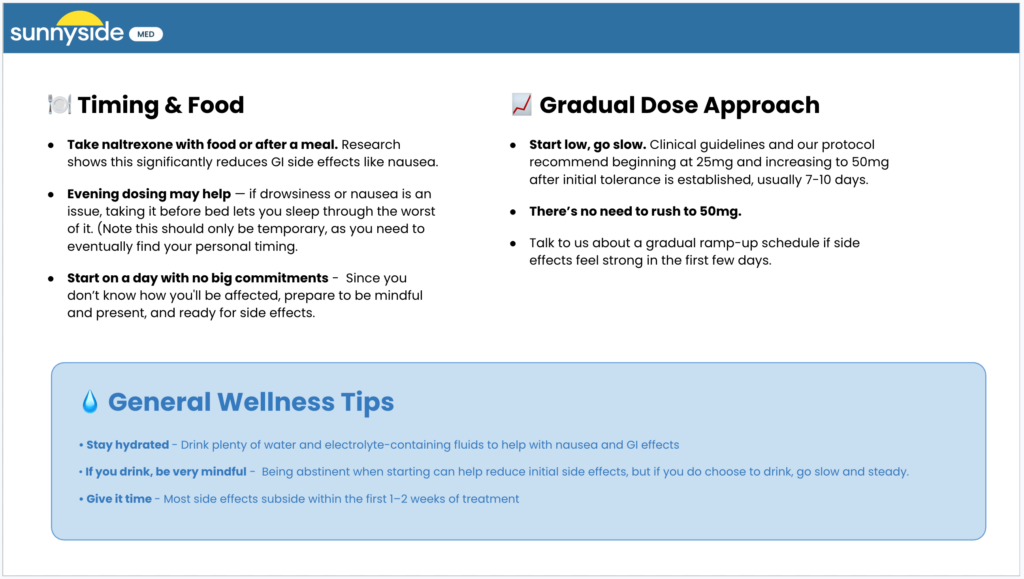
Here are some straightforward tips to help prevent and manage naltrexone nausea:
This is one of the most common questions Sunnyside Med members ask: “I took my naltrexone and then had a couple drinks, and the nausea was way worse. Is that normal?”
Yes. And there’s a straightforward biological reason.
Naltrexone blocks the opioid receptors in your gut. Alcohol, meanwhile, is already a gastrointestinal irritant on its own. It increases stomach acid production, relaxes the valve between your stomach and esophagus, and slows gastric motility. When you combine those two forces (a medication dampening one signaling system while alcohol agitates the tissue directly) the nausea can compound.
There’s also a timing factor. Naltrexone reaches peak blood concentration about one hour after you take it. If you’re drinking in that same window, your gut is processing both at once. Members who space their dose and their first drink by at least an hour tend to report less stomach trouble.
The O’Malley et al. (2000) research we mentioned earlier supports this too. People who were still actively drinking when they started naltrexone had more GI side effects than those who’d had a period of abstinence first. Your gut is adjusting to the medication and processing alcohol at the same time, and it lets you know.
This doesn’t mean you need to stop drinking before starting naltrexone. The whole point of the medication is to change your relationship with alcohol while you’re still in it. But it does mean the first few drinking occasions on naltrexone might feel rougher than expected. That’s the adjustment period doing its thing, not a sign something is wrong.
If your nausea is uncomfortable but manageable, we strongly recommend pushing through. Most people find it fades within a few days to two weeks, and the benefits on the other side are worth it. You’ll start noticing naltrexone’s positive effects on your drinking habits and your daily life.
Our Sunnyside Med care team recommends a few over-the-counter options that can help take the edge off. Please check with your care team or doctor before starting any of these:
Sunnyside Med also now offers a 30-day prescription for Zofran (ondansetron), a medication that’s proven effective for nausea. Qualifying members can get it alongside their naltrexone. If you’re interested and you’re a Sunnyside Med customer, reach out to us at med@sunnyside.co to learn more.
If your nausea is debilitating (meaning it’s seriously impacting your day-to-day life or making you feel very sick) please take that seriously. It’s rare, but it happens.
Stop taking the medication and contact your care team, your doctor, or 911.
This article isn’t medical advice. If you’re concerned, err on the side of caution and talk to your care team before continuing naltrexone. As mentioned above, Sunnyside Med does offer a 30-day Zofran prescription for qualifying members, which can sometimes be paired with naltrexone to help with onboarding and alleviate the more serious nausea side effects.
If you’re reading this article, you’re probably in one of two places: dealing with nausea and wondering if it’s worth pushing through, or staring at a bottle of naltrexone and wondering if you should start at all.
Either way, you’re doing the hard part. You’re taking your health seriously.
Naltrexone works best when it’s paired with behavioral support. That’s not just our opinion. The COMBINE study, one of the largest naltrexone trials ever conducted, found that medication combined with a behavioral program outperformed either approach alone. That’s the model Sunnyside Med is built on: compounded naltrexone, a behavior change app, human coaching, and a care team available seven days a week.
Among active Sunnyside Med members with 50% or more app engagement, 78% achieved a meaningful reduction in drinking over 12 weeks. (Individual results vary. This is observational data from our member population, not a randomized trial.)
Sunnyside is the #1 mindful drinking app. Since 2020, we’ve helped over 600,000 people cut out 22 million drinks from their baseline habits. 96.7% of our members report success drinking less, and a third-party study demonstrated a 33% reduction in weekly drinking after 12 weeks.
When you sign up, you’ll take a quick 3-minute personalization quiz and hop into the app. You’ll get weekly plans, daily tracking and journaling tools, nudges, coaching, and the option to chat with a real human coach at any time.
Naltrexone reduces the cravings. Sunnyside helps you understand the triggers and patterns behind them. Together, they give you a system that actually sticks. And if you eventually stop taking naltrexone, Sunnyside is a tool you can keep using to maintain your progress.
Ian has a family deeply hurt by alcohol, and is on his own personal journey to drink less and live his healthiest life. He’s took naltrexone daily for two years and saw incredible results. As Sunnyside Med’s first customer, he’s deeply entrenched in alcohol health and naltrexone.
Naltrexone is not addictive or habit-forming. It blocks opioid receptors rather than activating them, so it doesn't produce...

Getting a prescription for naltrexone doesn't have to mean a long sit in a doctor's waiting room. With...

Naltrexone eligibility is determined through an individual clinical evaluation, not a single pass-or-fail test. You don't need to...
If you’re interested in trying naltrexone to help you drink less, the natural next question is where to...