

How to Drink Less Alcohol in 2026: 10 Practical Ways to Cut Back
Whatever your reason, drinking less doesn't have to mean giving up alcohol entirely. You can set your own...


For a long time, the conversation around alcohol has been pretty binary. You either drink… or you don’t. You either have control… or you don’t.
And if something starts to feel off, the default assumption has often been that the solution is to stop completely.
But that framing doesn’t work for everyone. And honestly, it probably never did—it just went mostly unchallenged for a long time.
Now there’s more space opening up in the middle.
Sometimes people call it gray area drinking. That in-between place where nothing is technically “out of control,” but it’s also not quite working the way it used to.
That’s where moderation-based approaches tend to resonate.
Moderation Management is one of the earlier organizations built around the idea that changing your relationship with alcohol doesn’t have to mean going all the way to zero.
As Executive Director Andrea Pain explains: “Moderation Management is a nonprofit organization that was established to provide mutual support to people who want to develop a healthier relationship with alcohol.”
Instead of pushing one outcome, the focus is more on giving people tools, structure, and some kind of support system while they figure things out. As she puts it, “it’s really designed to… provide a space for the gray area between the black and white.”
That gray area is bigger than most people think.
For a lot of people, the traditional model of alcohol care just doesn’t click right away. Not because it’s wrong, but because it doesn’t feel like it fits yet.
Andrea describes that tension pretty clearly: “I really need to make a change in my drinking habits. But I really—I knew I wasn’t prepared to stop altogether.”
Something needs to shift, but the idea of quitting entirely feels like too big a jump—or maybe just not the right one.
There’s also the identity piece, which can get sticky, too. Andrea says, “I mostly… was coming to terms with whether or not I could call myself an alcoholic… I just really wasn’t sure if that was a word that defined my relationship with alcohol.”
And if that label doesn’t feel right, it can create this weird kind of pause. Like you don’t quite know where you belong or what to do next.
Moderation gives people somewhere to start without forcing that decision upfront.
A big part of what’s changing right now is how people define recovery in the first place.
It’s not as rigid as it used to be.
Andrea points out that “back in 1993… there was no such thing as harm reduction in alcohol recovery… if you had a drinking problem, you had to stop drinking.”
Now there’s at least some movement away from that. Slowly, but it’s happening.
“We know now that recovery can mean a lot of things, and can be very different for everybody.”
That shift opens things up in a meaningful way. Why? Because people don’t all want the same outcome—and forcing a single path tends to leave a lot of people out.
One thing that stands out in moderation-based approaches is how success gets defined.
That success doesn’t always equate to hitting a “perfect” number or sticking to a rigid plan. It’s more directional than that. As Andrea puts it, “if I’m doing better today than I was yesterday or last week or last month, then it’s working.”
That could mean a lot of things! Drinking less, sure. But also fewer negative side effects. Better sleep. Less tension in relationships. Feeling a little steadier day-to-day.
The numbers back that up, too. Andrea shares that “ninety-five percent of the people who join reduce their drinking by some measure… seventy-five percent reduced their drinking by forty percent or more.”
Not everyone stops drinking, but that’s not really the point here. The point is change.
There’s always that temptation to flip a switch and just be different overnight. But that rarely (if ever) holds.
Andrea says it pretty directly: “Don’t try to go from where you are today to there overnight.”
Instead, the focus shifts to smaller adjustments that are actually doable in real life.
Things like delaying your first drink, or alternating with something non-alcoholic. Cutting out those extra drinks that sneak in before going out or after coming home.
One example she shared sticks because it’s so simple: “Why do I need those before and after drinks? Why can’t I just focus on the number of drinks I’m gonna have when I’m out?”
It’s not dramatic. But it changes the structure of the night.
And those kinds of changes tend to stick because they’re manageable.
Community can be a tough sell, especially if you’re more on the introverted side. But it shows up as important again and again.
Andrea mentions that “even if you just go—you don’t turn on your video, and you don’t share—but you listen… there’s so much value in just participating.”
Just being around other people who are thinking about this stuff—even passively—can shift how you see your own habits. It makes it feel less like a solo project.
If you’re in that middle space—where something feels off, but quitting entirely doesn’t feel like the move—moderation can be a place to start.
It doesn’t require a big announcement or a hard line. Usually, it starts with something much smaller: awareness.
Tracking what’s actually happening. Noticing patterns. Seeing where things might be able to shift.
Andrea recommends starting there: “Before you even make any changes, just start tracking where you’re at.”
From there, things tend to build naturally over time.
Get started on your mindful drinking journey with a 15-day free trial of Sunnyside.
Sunnyside is a mindful drinking and alcohol moderation app that can help change your habits around alcohol using a proven, science-backed method. Whether you want to become a more mindful drinker, drink less, or eventually quit drinking, Sunnyside can help you reach your goals. We take a positive, friendly approach to habit change, so you never feel judged or pressured to quit.
When you join Sunnyside, you’ll start by completing a 3-minute private assessment so we can learn a bit about you. Once that’s done, you’ll get a 15-day free trial to test out everything, including our daily habit change tools, tracking and analytics, community and coaching, and education and resources. It’s a full package designed specifically to adapt to your goals and help you reach them gradually, so you can make a huge impact on your health and well-being.
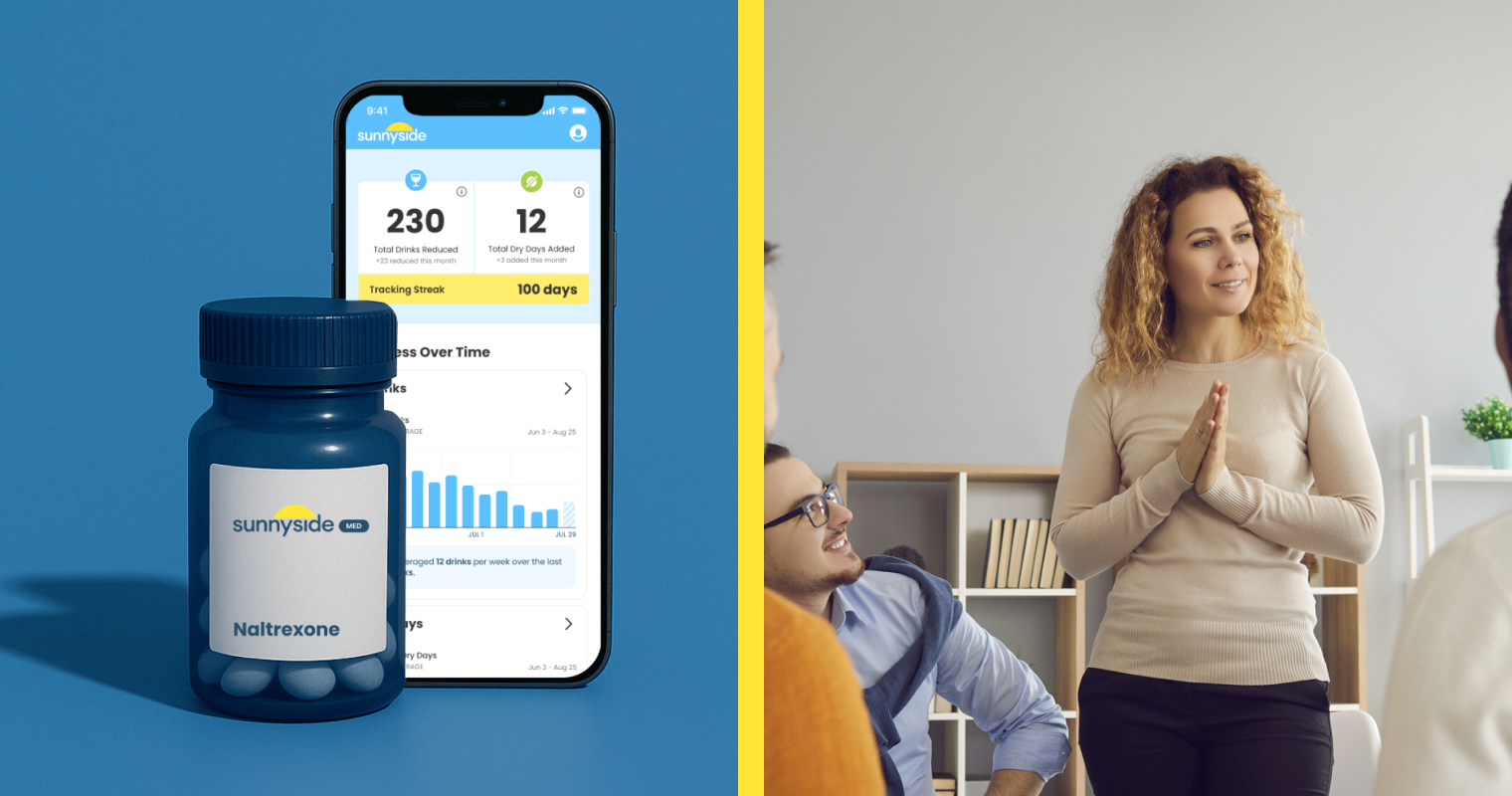
Sunnyside is a digital habit and behavior-change program that is incredibly effective on its own, but can also be the perfect complement to other work you’re doing to cut down on drinking, whether that includes talk therapy or medication such as Naltrexone.
Get your 15-day free trial of Sunnyside today, and start living your healthiest life.
Ian has a family deeply hurt by alcohol, and is on his own personal journey to drink less and live his healthiest life. He’s took naltrexone daily for two years and saw incredible results. As Sunnyside Med’s first customer, he’s deeply entrenched in alcohol health and naltrexone.
Whatever your reason, drinking less doesn't have to mean giving up alcohol entirely. You can set your own...
AA and naltrexone aren't two versions of the same treatment. One is a peer-support program built around abstinence....

Most people trying to drink less already know what alcohol does. You don’t need another explanation about sleep...
You make a plan, maybe even feel good about it, and then a few days later, you’re right...