

Does Naltrexone Cause Sexual Side Effects?
Naltrexone does not appear to consistently lower sex drive. Sexual changes have been reported, but research hasn't established...

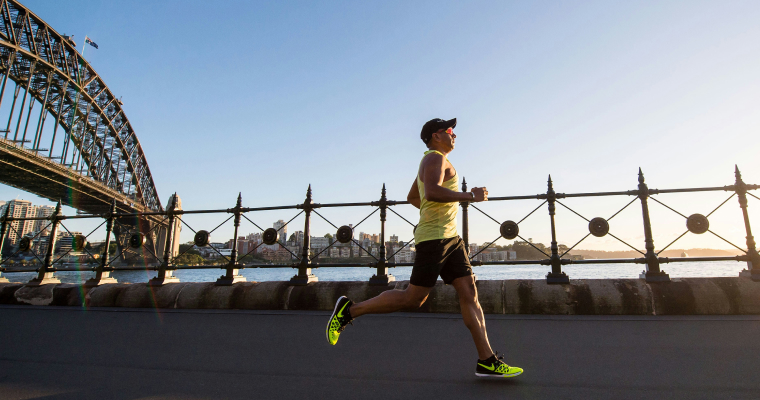
Available research does not show that naltrexone significantly affects exercise performance, including strength, endurance, or aerobic fitness. Studies also suggest that blocking opioid receptors does not eliminate the runner’s high, although naltrexone may change some aspects of how exercise feels. If side effects interfere with your workouts, talk with your clinician rather than changing your medication schedule on your own.
You’ve found something that might help you drink less. Then you read that naltrexone blocks endorphins and start wondering what that means for your workouts. You like running. You like going to the gym. Is naltrexone going to make either of those things harder or less enjoyable?
Your concern isn’t far-fetched. Naltrexone reduces the brain’s reward response to alcohol by blocking opioid receptors. Endorphins are the body’s own opioids, and exercise can activate the opioid system.
But available research does not show that naltrexone reduces strength, endurance, or overall physical performance. And when researchers have blocked opioid receptors during running, participants still experienced the euphoria and reduced anxiety associated with a runner’s high.
Understanding why means looking beyond the familiar “exercise releases endorphins” concept, which is a little reductive.
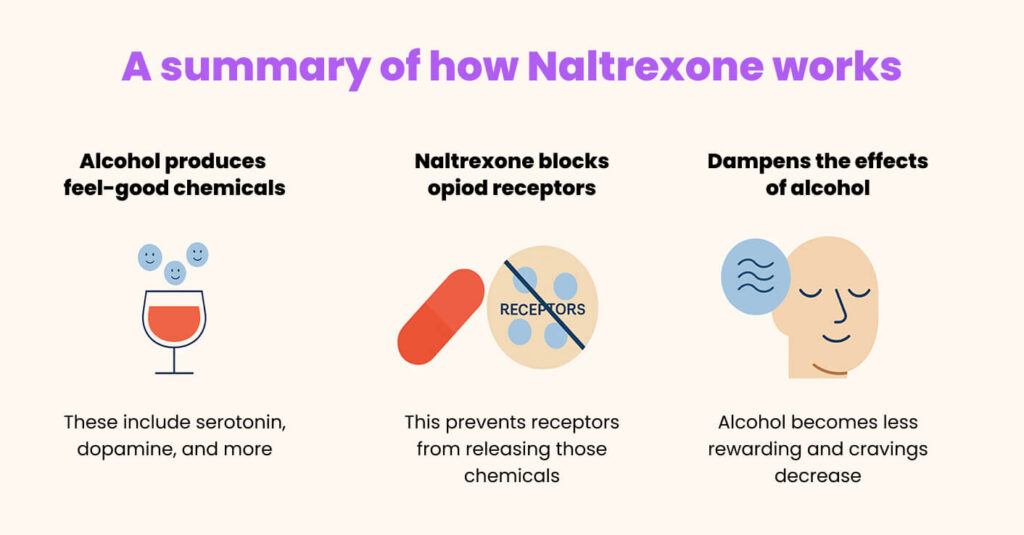
Naltrexone is an opioid receptor antagonist, which means it blocks the receptors that endorphins act on. Exercise can activate this opioid system, so it’s easy to assume naltrexone must also block the good feelings you get from working out.
The reality is more complicated.
Exercise really does activate the brain’s opioid system. In a small brain-imaging study of 10 endurance athletes, researchers found increased opioid activity after a two-hour run, and greater activity in certain brain regions was associated with greater feelings of euphoria, according to Boecker et al., 2008.
But endorphins aren’t the whole story. Exercise also activates the endocannabinoid system, including molecules such as anandamide and 2-AG. These work through cannabinoid receptors rather than opioid receptors, so naltrexone doesn’t directly block them.
That distinction helps explain something that might otherwise seem contradictory: exercise can activate the opioid system, but blocking opioid receptors doesn’t necessarily take away the good feelings associated with a run. We’ll get to the research on that next.
Naltrexone works best with support around it, and that’s the idea behind Sunnyside Med. Thousands of members use the program with access to a clinical team that can answer questions about side effects, help you avoid impacts to your exercise, and explain what to expect as you adjust.
Hands-on onboarding and evidence-based guidance help set clear expectations from the start. If something about your workouts does feel different, you’ll have a clinical team to help you figure out what’s going on rather than navigating it alone.
The best evidence we have suggests that you can.
In a randomized, placebo-controlled trial of 63 healthy runners, participants completed a moderate-intensity run and a walk after receiving either naltrexone or placebo. Running increased euphoria, reduced anxiety, and raised levels of the endocannabinoids anandamide and 2-AG. The proportion of participants who reported a runner’s high was comparable between the naltrexone and placebo groups.
In other words, blocking opioid receptors did not take away the runner’s high. The researchers concluded that endocannabinoids are strong candidates for explaining why running can produce euphoria and reduce anxiety.
That doesn’t mean endorphins have nothing to do with exercise. As the brain-imaging research above shows, exercise does activate the opioid system. But this trial suggests that opioid signaling isn’t necessary for two key features of a runner’s high: increased euphoria and reduced anxiety.
So if you’re worried that naltrexone will automatically take away the good feelings you get from a run, the available evidence is reassuring.
Possibly. While naltrexone doesn’t appear to eliminate the runner’s high, some research suggests opioid blockade can affect other aspects of post-exercise mood.
In a small randomized crossover study from 1992, 19 adults completed the same high-intensity aerobics class twice, once after naltrexone and once after placebo. After the placebo session, participants tended to feel calmer, more relaxed, and more pleasant. Those positive mood shifts did not occur after naltrexone, according to Daniel, Martin & Carter.
That finding is worth considering alongside the newer runner’s-high research (rather than assuming one study cancels out the other). The studies involved different types and intensities of exercise and measured somewhat different aspects of mood. The 2021 study found that running still increased euphoria and reduced anxiety during opioid blockade, while the older study found differences across several measures of mood after a high-intensity aerobics class.
A 2025 narrative review raised the possibility that naltrexone could affect some of the positive reinforcement associated with healthy activities, including exercise. But the authors emphasized that the evidence is preliminary and that more research is needed.
For now, there’s evidence that naltrexone can affect some aspects of the mood response to exercise, but not enough to conclude that workouts generally become less enjoyable. If you notice a meaningful or persistent change in your motivation or enjoyment, bring it up with your clinician.
For someone using naltrexone to cut back on drinking, it’s also worth looking beyond the medication itself. Drinking less can remove some of alcohol’s effects on exercise and recovery.
Alcohol can interfere with post-workout muscle repair. In a small controlled crossover study, consuming a large amount of alcohol after exercise reduced muscle protein synthesis, even when participants also consumed protein.
The study involved a small sample and a high amount of alcohol, so it doesn’t tell us what happens after every drinking occasion. But it does show that heavy alcohol consumption can interfere with the muscle-rebuilding process after exercise.
Exercise may have benefits for people who are cutting back, too. A meta-analysis of seven randomized trials involving people with alcohol use disorder found that exercise interventions were associated with lower alcohol consumption and improved cardiorespiratory fitness, although they did not significantly reduce binge drinking.
For Sunnyside Med members, cutting back can be part of that bigger health picture. Among active members with 50% or more app engagement, average daily drinks fell 45.6%, or roughly 10 fewer drinks per week. Individual results vary.
Cutting back doesn’t guarantee faster runs or heavier lifts. But reducing alcohol can mean less exposure to something that can interfere with post-workout recovery, while exercise itself can remain part of your routine as you change your relationship with alcohol.
In general, taking naltrexone doesn’t mean you need to stop exercising or change your normal workout schedule. There’s also no established requirement to time your medication around training.
The most direct performance research we have is reassuring. In a study of healthy U.S. Army soldiers, researchers measured performance before, during, and after a week of daily naltrexone. Participants completed the Army Combat Fitness Test, which included deadlifts, push-ups, a sprint-drag-carry, abdominal strength testing, and a two-mile run.
Researchers found no significant decline in overall physical performance or in any of the individual fitness tests while participants were taking naltrexone. The study was small, with 16 participants, and only looked at short-term use, so it can’t tell us everything about long-term athletic performance. But it provides direct evidence that opioid blockade doesn’t automatically translate into poorer strength, endurance, or exercise capacity.
There’s also no evidence that taking naltrexone before versus after a workout changes physical performance or the runner’s high. Rather than building your medication schedule around your workouts, follow the plan you and your clinician have established.
If you’re new to naltrexone and something does make exercise uncomfortable, let your clinician know. A temporary change in how you feel during a workout isn’t necessarily the same thing as a change in your actual physical capacity.
The research above is reassuring about physical performance, but that doesn’t mean every workout will feel exactly the same after you start naltrexone.
Naltrexone can cause side effects such as nausea, headache, dizziness, fatigue, and sleep changes—though not everyone experiences side effects. If you’re dealing with nausea or fatigue, for example, you may not feel eager to head to the gym that day. That’s different from naltrexone directly reducing your strength or endurance.
It’s also worth keeping the bigger goal in view. If you’re taking naltrexone to drink less, reducing alcohol can have benefits that extend well beyond your drinking habits. As we covered above, heavy alcohol consumption after exercise can interfere with muscle protein synthesis and recovery. Drinking can also affect sleep, hydration, and how ready you feel to exercise the next day.
So there are two separate questions here. Does naltrexone directly impair exercise performance? The limited evidence we have doesn’t suggest that it does. Can starting a medication sometimes change how you feel during a workout? Yes, particularly if you’re experiencing side effects.
For many people, those short-term tradeoffs exist alongside the longer-term goal of drinking less. You don’t have to choose between caring about your fitness and caring about your relationship with alcohol.
If side effects are making it difficult to exercise or aren’t improving, talk with your clinician rather than changing your medication schedule on your own. The goal is to find an approach that supports your health as a whole, including the parts of your routine that already make you feel good.
Naltrexone is one part of changing your relationship with alcohol. Sunnyside Med pairs medication with tools and support that help you understand your drinking patterns, build new habits, and get answers when questions come up.
It’s a 100% online program that combines compounded naltrexone with a habit-change plan, human coaching seven days a week, weekly group calls, and access to a licensed care team.
That support can be especially useful when you’re trying to figure out whether something you’re experiencing is related to naltrexone. If your energy changes, a side effect is interfering with a workout, or exercise simply feels different, you can bring those questions to the clinical team instead of guessing.
For some members, drinking less comes with noticeable changes in how they feel day to day. As one Sunnyside member put it, “Really enjoying the lack of booze and increased energy.”
Engaged members are 2.5x more likely to stay on their medication at month four than less-engaged members. And 78% of active Sunnyside Med members achieved a meaningful reduction in drinking. Individual results vary.
Sunnyside Med is $99 a month, HSA- and FSA-eligible, with no insurance required. If you’re wondering whether naltrexone can fit into an active lifestyle, see if you’re eligible with a short assessment reviewed by a licensed clinician.
Naltrexone is a prescription medication. This content is educational and should not be taken as medical advice. A licensed clinician reviews every Sunnyside Med application.
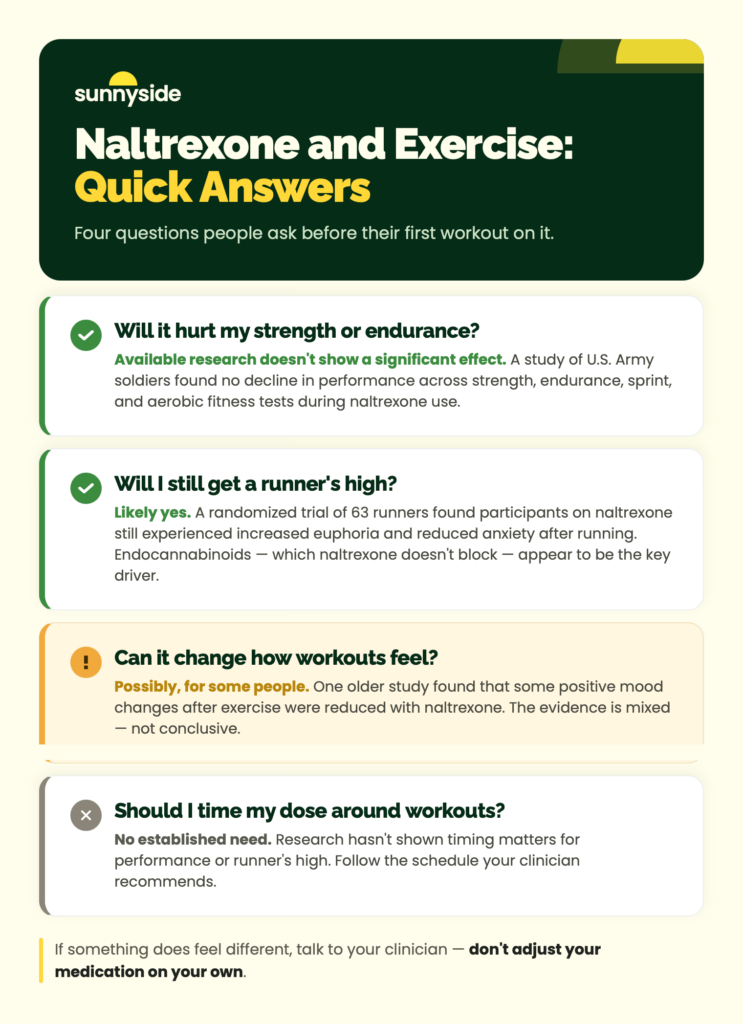
The best human evidence suggests it doesn't. In a randomized trial of 63 runners, participants taking naltrexone still experienced increased euphoria and reduced anxiety after running. Endocannabinoids, which naltrexone doesn't block, appear to play an important role in the runner's high.
Not necessarily. One small study found that naltrexone reduced some positive mood changes after exercise, while a larger, newer study found that running still increased euphoria and reduced anxiety. Some aspects of exercise may feel different, but the evidence doesn't show that workouts generally become less enjoyable.
Available research doesn't show a significant effect. A 2024 study of healthy soldiers found that short-term naltrexone use did not significantly reduce performance on tests of strength, endurance, power, or aerobic fitness. The study was small and short-term, so more research is needed.
It can. Heavy alcohol consumption after exercise has been shown to interfere with muscle protein synthesis, which is part of the body's recovery process. Cutting back removes one factor that can work against post-workout recovery.
There's no established need to time naltrexone around your workouts. Research hasn't shown that taking it before versus after exercise improves performance or preserves the runner's high. Follow the medication schedule recommended by your clinician, and reach out if side effects are interfering with exercise.
Ian has a family deeply hurt by alcohol, and is on his own personal journey to drink less and live his healthiest life. He’s took naltrexone daily for two years and saw incredible results. As Sunnyside Med’s first customer, he’s deeply entrenched in alcohol health and naltrexone.
Naltrexone does not appear to consistently lower sex drive. Sexual changes have been reported, but research hasn't established...

Many worries about naltrexone and the liver originate from older research, which used much higher doses than doctors...
The best vitamin after drinking is somewhat of a myth. For preventing hangovers, the evidence is strongest for...
You had a drink or two last night. You didn't expect much of a hangover, but your stomach...