
Hangxiety 101: The Real Science (And Why It Feels So Bad)
While not everyone experiences anxiety after drinking, many people report feeling more emotionally vulnerable or on edge during...
You pour a drink to take the edge off, and it works. The shoulders drop, the mental chatter quiets, and the evening feels manageable again.
The problem shows up the next morning, or sometimes at 3 am, when the anxiety is back, and it’s worse than it was before you started.
You wake up too early. Your heart is pounding for no obvious reason. Tiny worries suddenly feel enormous. You replay text messages. Conversations. For some people, it feels almost chemical. Because it is.
The relationship between anxiety and alcohol is complex. Alcohol can absolutely calm anxiety in the short term. But over time, it often pushes anxiety in the opposite direction.
That doesn’t mean you’ve “lost control.” It means your nervous system has adapted to a substance that changes the brain’s stress and reward systems.
When you drink, alcohol changes the balance of certain neurotransmitters in the brain, especially GABA and glutamate.
GABA helps slow brain activity down. It’s associated with relaxation and reduced nervous-system arousal. Glutamate is more stimulating.
Alcohol increases GABA activity while suppressing glutamate, which is part of why drinking can temporarily make you feel calmer, less guarded, or less anxious.
The National Institute on Alcohol Abuse and Alcoholism (NIAAA) describes alcohol as “dually reinforcing” because it both activates reward pathways and reduces stress responses. That combination is powerful. It teaches the brain very quickly that alcohol equals relief.
Which is why drinking for anxiety can start to feel incredibly effective….at first.
Your brain is always trying to maintain balance. So when alcohol repeatedly pushes the nervous system in one direction — more sedation, more calm — the brain starts compensating behind the scenes.
Over time, it reduces some of its own calming activity and becomes more sensitive to stimulation.
Then the alcohol wears off. And suddenly the nervous system swings hard the other direction. That’s where a lot of post-drinking anxiety comes from.
People experience the “anxiety” part of the alcohol and anxiety loop differently, but it can look like:
(A lot of people call this “hangxiety.”)
Then there’s sleep. Alcohol can make you fall asleep faster, but the quality of your sleep tends to suffer later in the night. REM sleep — the stage linked to emotional processing and mood regulation — gets disrupted.
Poor sleep increases anxiety. Alcohol disrupts sleep. Anxiety increases the urge to drink again. And the loop keeps feeding itself.
One reason this pattern gets confusing is that the relief alcohol provides is genuine.
If drinking reliably lowers anxiety for a few hours, your brain starts remembering alcohol as a solution.
Over time, though, something shifts. For many people, drinking slowly stops being about feeling good and starts becoming more about not wanting to feel bad.
Researchers from the University of Minnesota Medical School found that people with anxiety and mood disorders tend to experience more alcohol-related symptoms than people without those conditions, even at similar levels of drinking.
Other research has found that anxiety disorders often come before problematic alcohol use, especially social anxiety.
In other words, anxiety is frequently the starting point. Alcohol becomes the coping mechanism, then the coping mechanism slowly raises the anxiety baseline.
That’s why people often say things like:
The target keeps moving!
Sometimes anxiety gets a little worse before it gets better. If your nervous system has adapted to regular alcohol exposure, removing alcohol can temporarily leave the brain feeling overstimulated while it recalibrates.
People often notice temporary increases in:
Then, gradually, things start leveling out. The timeline varies from person to person, but many people notice meaningful improvement after several weeks of drinking less consistently.
Sunnyside co-founder Ian Andersen puts it this way: “Alcohol patterns formed over years won’t disappear in weeks. Commit to at least 90 days if a year feels too long.”
That’s probably the hardest part of changing your drinking habits, and something you should give yourself grace about: The nervous system needs time.
Tracking your drinking patterns with an app like Sunnyside can reveal a lot. Not just how much you drink — but why. When you start recognizing the emotional pattern underneath the drinking, the habit becomes easier to interrupt.
Even a couple of dry days each week can help your nervous system recover. The point is giving your brain periods where it is not constantly recalibrating around alcohol.
The combination of poor sleep, elevated stress hormones, and caffeine can make next-day anxiety feel dramatically worse. Sometimes what feels like an anxiety spiral is partly exhaustion plus an overstimulated nervous system.
Exercise helps regulate stress physiology and is consistently associated with lower anxiety levels. And no, it doesn’t need to be intense. A walk still counts!
The urge to drink for anxiety relief can feel immediate and convincing. But cravings are temporary states. Sometimes simply naming what’s happening — “I’m anxious, and I want relief right now” — creates enough separation to interrupt that autopilot-esque response.
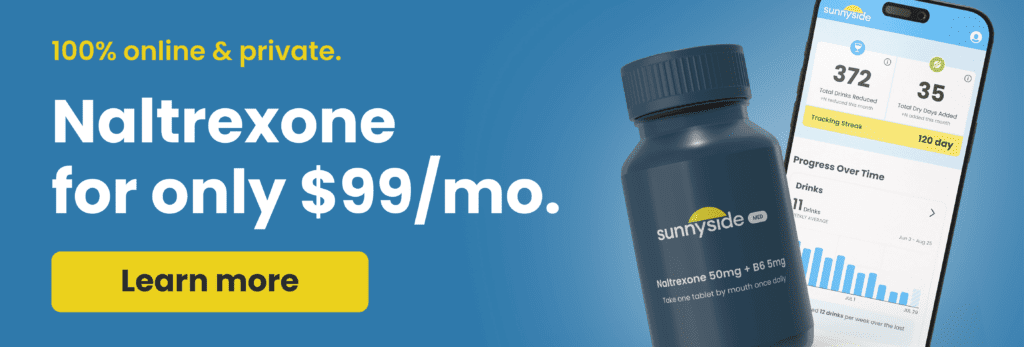
Some people who struggle with the alcohol-and-anxiety loop explore medication support. One option is compounded naltrexone through Sunnyside Med.
Naltrexone has been studied for decades as a treatment for alcohol use disorder. It works by reducing alcohol’s rewarding effects in the brain, which may help people gradually drink less.
Naltrexone 101: A Pill To Drink Less or Quit – Your Complete Guide
It is not an anxiety medication. But some people find that as their drinking decreases, their baseline anxiety improves too because the nervous system is no longer repeatedly cycling through intoxication and rebound.
One Sunnyside member described it this way: “The chase is just gone. I’d pour a glass out of habit and realize halfway through that I didn’t actually want it.”
(This is not medical advice. A licensed clinician can help determine whether naltrexone is appropriate for your situation.)
Among active Sunnyside members with 50%+ app engagement, 78% achieved meaningful drinking reduction, and members averaged 45.6% fewer drinks per week.
The brain learns patterns that reduce discomfort. Alcohol reduces anxiety temporarily, so the brain learns to reach for it. But learned patterns can change. And noticing the connection between alcohol and anxiety in the first place is often where that change begins.
If you want to explore whether medication support could help you drink less, take Sunnyside Med’s free quiz to discover whether naltrexone may be right for you.
Sunnyside is the #1 mindful drinking app. Since 2020, we’ve been honing our harm-reduction approach, and have helped over 400,000 people cut out 22 million drinks from their baseline habits. 96.7% of our members report success drinking less, and in a third-party study, our approach was demonstrated to reduce weekly drinking by 33% after 12 weeks.
Think of Sunnyside as the front-door for anyone who wants to change their relationship with alcohol. If you want to drink less, we can help you get there. If you want to eventually quit, but want to take a gradual approach, we can make that happen.
When you sign up for Sunnyside, you’ll take a quick 3-minute personalization quiz, then hop into the app. It’s as simple and quick as that.
We’ll give you weekly plans to gradually reach your drinking goals, and we’ll provide nudges, coaching, exercises, and advice to help you get there.
We have daily tracking and journaling tools, including the option to chat with a real human coach at any time. And of course we have great analytics so you can track your progress over time.
Sunnyside is a full-featured mindful drinking app, and thus the perfect companion for your Naltrexone journey. Naltrexone will actively help you reduce cravings around alcohol, and Sunnyside will help you understand your triggers and patterns, giving you a healthy system for habit change.
If and when you see success drinking less, and you choose to stop taking Naltrexone, Sunnyside is a tool you can keep using to maintain your healthy habits.
Everyone who signs up for Sunnyside gets a free 15-day trial, then the subscription is $8.25/month, less than the cost of a fancy drink. And the best part is our members save an average of $50 per month, easily paying for the cost of the subscription.
Whether you’re currently taking naltrexone, or just doing some research on alcohol moderation, we’d love to have you sign up for our 15-day free trial today.
Ian has a family deeply hurt by alcohol, and is on his own personal journey to drink less and live his healthiest life. He’s took naltrexone daily for two years and saw incredible results. As Sunnyside Med’s first customer, he’s deeply entrenched in alcohol health and naltrexone.
While not everyone experiences anxiety after drinking, many people report feeling more emotionally vulnerable or on edge during...
Why do so many people swear off drinking in the morning, only to find themselves drinking while hungover,...
Shake off the replays and second-guessing.
Understanding these patterns can help you change them.