

How to Drink Less Alcohol in 2026: 10 Practical Ways to Cut Back
Whatever your reason, drinking less doesn't have to mean giving up alcohol entirely. You can set your own...


Making a big change—drinking less, stopping altogether, or simply trying to live with more intention—often comes with an early rush of relief. Sleep improves. Mornings feel clearer. What happens after you stop drinking? There’s a sense that things are finally clicking.
Then, for many people, that feeling starts to fade.
This is the part that doesn’t get talked about as much: what happens after the initial high wears off. When the excitement levels out. When you realize the change didn’t magically fix everything.
For Marci Hopkins, host of Wake Up With Marci and author of Wake Up, You’re Not Broken, that phase marked the real work.
“Rediscovering yourself is a path,” Marci says. “It’s not something that’s a one-shot thing.”
Early change can feel urgent. There’s pressure to quickly become a new version of yourself, to prove that the decision was worth it. Marci’s experience didn’t work that way.
“I had to do a lot of rediscovery of myself,” she says. “I had to meditate. I had to take a lot of long walks. I had to get curious. I had to experiment with different things to find what really lit me up because I had just been going through the motions of life.”
From the outside, her life already looked successful. She had a strong career and was doing visible, creative work. Internally, though, she knew something was missing.
“My passion has always been media and content and creation,” she says. “But like what was deeper inside of me?”
That question didn’t get answered in one moment. It showed up slowly—through quiet, trial and error, and learning how to sit with herself without distraction.
As Marci began paying attention to what was happening beneath the surface, she started reconnecting with a part of herself she remembered from early life.
“When I was very young, I was like, all I wanted to do was love others and for others to feel that love because I had so much love inside of me,” she says. “Then, as life progressed, I became empty. I didn’t know how to really love. I didn’t know how to accept love.”
That sense of emptiness didn’t disappear overnight. Healing, for her, was about rebuilding trust with herself and reconnecting to something larger.
“As I was healing, as I was doing this self exploration, that’s where I reunited with the love and the passion within me and my connection to God, my higher power, my higher source, the divine, whatever you want to call it,” she says.
That reconnection changed how she moved through the world and gave her the confidence to pursue work that felt aligned, not just impressive on paper.
Marci grew up with organized religion, but her early understanding of God didn’t feel comforting.
“God was the big scary guy in the sky,” she says. “I always believed in God and Jesus in the story. I did believe that.”
As an adult, spirituality wasn’t central to her life until she stopped drinking and started questioning how much control she was really able to hold.
“When I got sober, and I started my spiritual journey and my connection to God and turning myself over to a higher power, first of all, that I wasn’t in control,” she says. “I mean, a relief that something bigger than me does actually have my back at all times.”
That shift changed how she interpreted setbacks and uncertainty.
“Just that trust that each thing that happens in my life is happening for a reason,” she says. “If a door closes, it’s not for me. If a door opens, where is that door going to lead me?”
Instead of needing proof before believing, she learned to move forward without knowing exactly how things would turn out.
“I didn’t believe even like I had to see it,” she says. “I had to see it to make it real.”
One practice that helped ground Marci during this period was gratitude—approached simply and without pressure.
“For me, one of the other very life-changing ways I got to that is the practice of gratitude,” she says.
Rather than treating it as another task, she kept it small and internal.
“Just before you get out of bed, say those three things that you’re grateful for,” she says. “I always say keep it really small.”
Over time, that shift affected how she moved through her days.
“The more you do it, the easier it becomes,” she says. “And then you just like believe good things are going to happen and good things happen.”
In Wake Up, You’re Not Broken, Marci focuses heavily on the first 30 days of sobriety—a stretch of time she believes is often misunderstood.
“It’s scary,” she says. “It’s so scary, and it sucks. It’s not fun, but it gets fun.”
Many people experience what’s commonly called the “pink cloud”—a period of elevated mood and optimism early on.
“You stop drinking, and you just feel like you’re so elated and so happy and everything’s so light,” Marci explains. “You feel like these little spurts of joy for the first time.”
That feeling doesn’t last forever.
“It doesn’t remain,” she says. “So then when you have that … let down when that pink cloud dissipates, you’re like, what do I do with this?”
There’s nothing wrong with that shift. In fact, it’s often a sign that bigger change is starting to happen.
“There are a lot of things that are happening chemically within your body and spiritually and physically,” she says. “So learn about what happens and what to do with that.”
Once the early momentum fades, many people assume they’re failing. Marci sees it differently.
“Once that pink cloud dissipates, the work starts,” she says. That work includes learning how to forgive yourself.
“You can’t live in the shame or the guilt,” she says. “You can’t move forward.”
Changing behavior also means changing how you talk to yourself. “If you’ve told yourself that you suck for years and years and years, you’ve got to retrain the way that you think about yourself,” Marci explains.
Even tools like affirmations can feel awkward at first. “They don’t feel real in the beginning,” she says. “So these are all the things like once that pink cloud dissipates, the work starts, and then you will get to a place where it’s a more leveled, happiness cloud.”
Support plays a bigger role than many people expect.
“Community is so important,” Marci says. “Being with people who are going through the same or just having people who uplift you.”
Connection helps normalize setbacks and reminds people they’re not uniquely failing.
“There are always people to support you,” she says. “You just gotta put yourself out there.”
Slips and stalled progress don’t erase growth. Marci emphasizes compassion over self-punishment.
“Have compassion for yourself and realize that your human mistakes are going to happen, and you just start over,” she says.
Starting over doesn’t mean you’re back at zero. “As long as you start over, you’re giving yourself another chance,” she adds.
Each attempt brings more awareness, more experience, and more understanding than the last. For Marci, change is about uncovering the potential self that’s already there.
“I don’t believe that I would be where I am today if I didn’t find that higher power within myself,” she says.
Get started on your mindful drinking journey with a 15-day free trial of Sunnyside.
Sunnyside is a mindful drinking and alcohol moderation app that can help change your habits around alcohol using a proven, science-backed method. Whether you want to become a more mindful drinker, drink less, or eventually quit drinking, Sunnyside can help you reach your goals. We take a positive, friendly approach to habit change, so you never feel judged or pressured to quit.
When you join Sunnyside, you’ll start by completing a 3-minute private assessment so we can learn a bit about you. Once that’s done, you’ll get a 15-day free trial to test out everything, including our daily habit change tools, tracking and analytics, community and coaching, and education and resources. It’s a full package designed specifically to adapt to your goals and help you reach them gradually, so you can make a huge impact on your health and well-being.
Sunnyside is a digital habit and behavior-change program that is incredibly effective on its own, but can also be the perfect complement to other work you’re doing to cut down on drinking, whether that includes talk therapy or medication such as Naltrexone.
Get your 15-day free trial of Sunnyside today, and start living your healthiest life.
Ian has a family deeply hurt by alcohol, and is on his own personal journey to drink less and live his healthiest life. He’s took naltrexone daily for two years and saw incredible results. As Sunnyside Med’s first customer, he’s deeply entrenched in alcohol health and naltrexone.
Whatever your reason, drinking less doesn't have to mean giving up alcohol entirely. You can set your own...
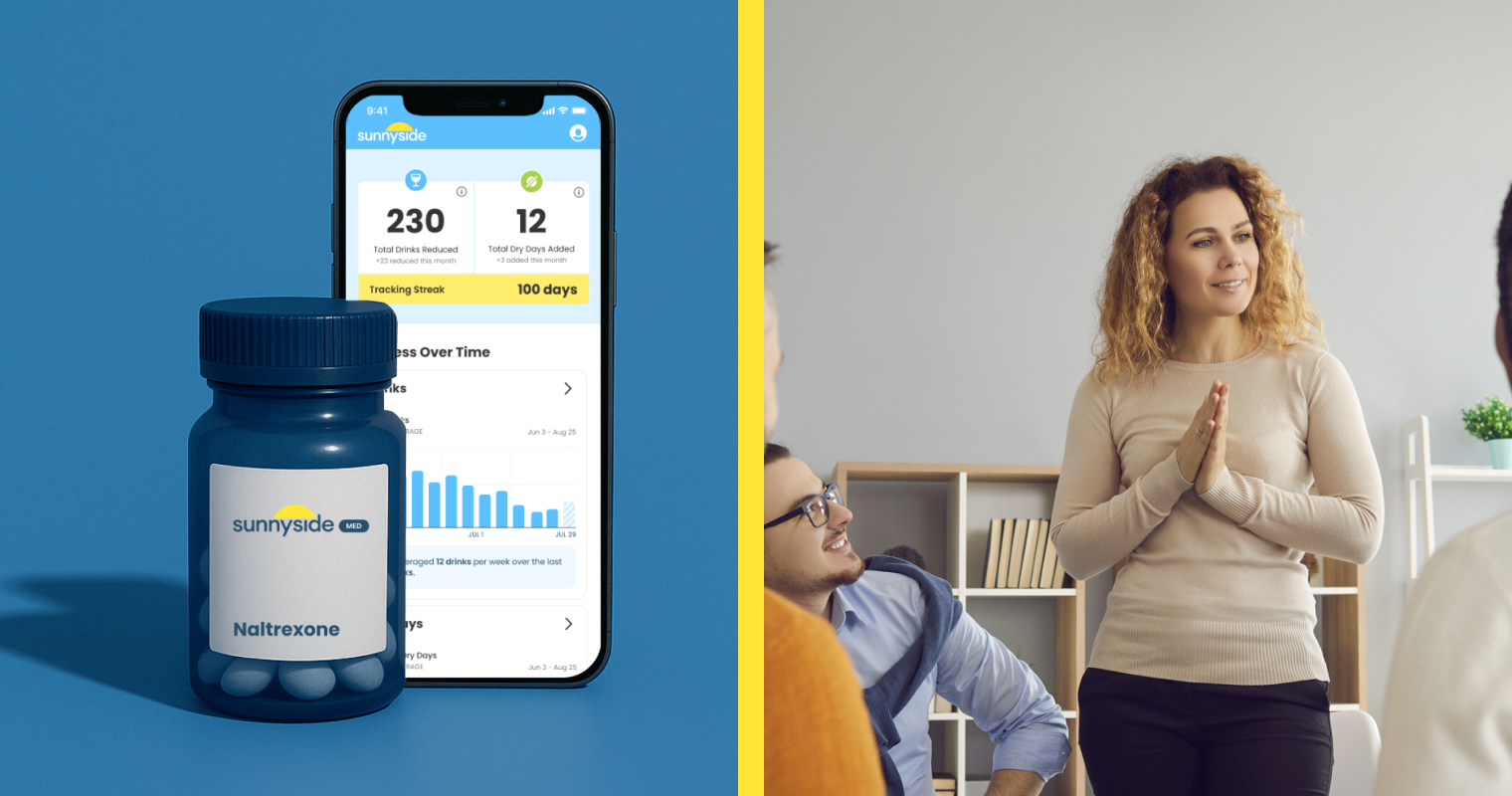
AA and naltrexone aren't two versions of the same treatment. One is a peer-support program built around abstinence....

Most people trying to drink less already know what alcohol does. You don’t need another explanation about sleep...
You make a plan, maybe even feel good about it, and then a few days later, you’re right...