

Why Naltrexone Is Not Addictive
Naltrexone is not addictive or habit-forming. It blocks opioid receptors rather than activating them, so it doesn't produce...
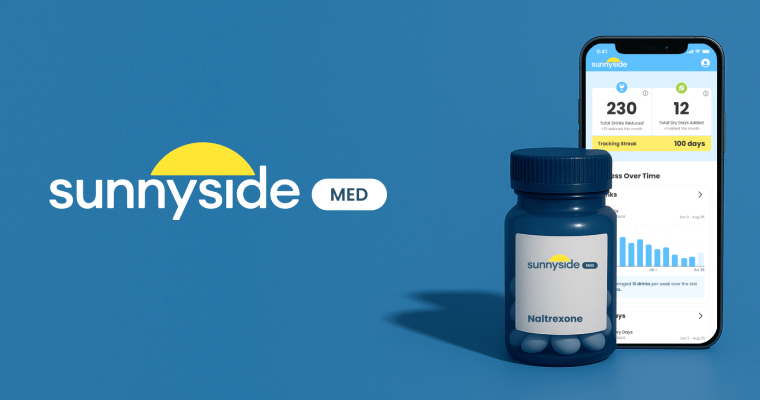
The best telehealth alcohol program depends on the kind of care you want. Sunnyside Med is our top overall pick for people who want medication, coaching, drink tracking, and ongoing clinical support in one moderation-friendly program. Ria Health, Workit Health, Oar Health, Choose Your Horizon, and Reframe each suit narrower needs, whether that’s intensive clinical care or app-first habit change.
Maybe you’re tending to drink more than you planned on weeknights, or the pull toward another drink has gotten harder to ignore. No matter how your life looks from the outside, you’d just like alcohol to take up less space in it.
Telehealth has made it possible to get help without going to an addiction clinic or rearranging your life around in-person appointments. Depending on the program, you may be able to meet with a licensed clinician, access medication when appropriate, and get coaching or other behavioral support entirely online.
But telehealth alcohol programs aren’t interchangeable. The right fit depends on your goals, the level of support you want, cost, insurance, and what’s available in your state. Below, we’ll compare several telehealth alcohol programs, what each one provides, and who each model may work best for.
Telehealth alcohol treatment brings professional care online. Depending on the provider, you may complete an alcohol use assessment, meet with a licensed clinician, receive medication like naltrexone, and get ongoing coaching, therapy, or other support without regular trips to an office.
That’s different from simply using a tracking app or joining an online support group. Some telehealth programs combine medical care with digital tools such as tracking, goal-setting, educational content, or peer communities. Others focus mainly on evaluation, prescribing, and medication management.
Despite the number of evidence-based options available, alcohol treatment remains surprisingly uncommon. According to NIAAA’s national survey data, just 7.5% of U.S. adults with alcohol use disorder received alcohol treatment in 2024. Only 2.4% received medication-assisted treatment.
Telehealth can’t eliminate every barrier to treatment, but it can make professional care easier to fit into everyday life. It can also offer more privacy and make specialized alcohol care accessible to people who don’t have appropriate providers nearby.
Telehealth alcohol programs vary considerably in what they provide. Before signing up, look at the medical care itself as well as the support surrounding it.
Some programs are built primarily around abstinence. Others support moderation too, allowing you to work toward drinking less rather than quitting completely.
If moderation is your goal, make sure the program explicitly supports it. You shouldn’t have to adopt a goal that doesn’t fit what you’re trying to accomplish.
Look at who conducts the medical evaluation, which medications the program offers, and how much access you’ll have to a clinician after treatment begins. Medication for alcohol use disorder should only be prescribed when a licensed clinician determines it’s appropriate.
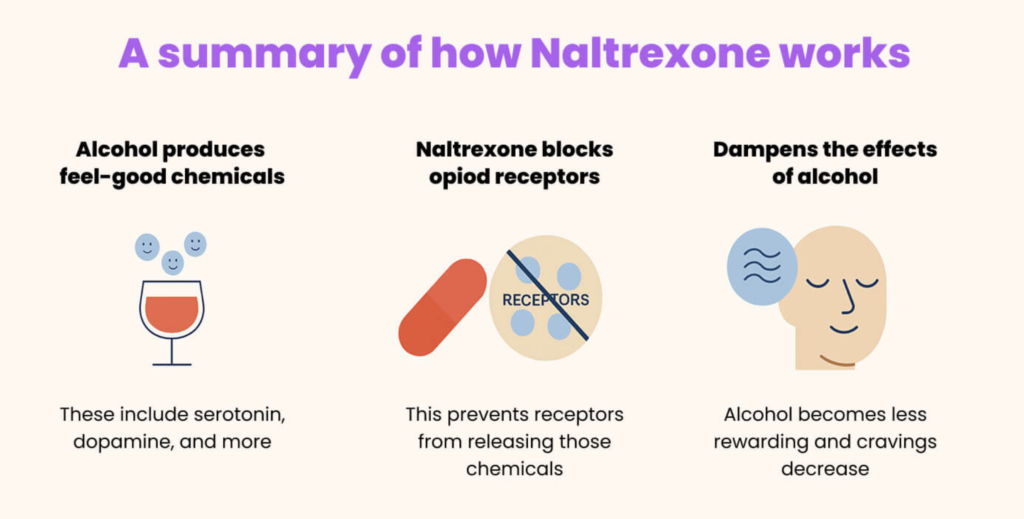
Some programs offer several medications for alcohol use disorder. Others specialize primarily in naltrexone, which can reduce alcohol’s reinforcing effects and help some people reduce heavy drinking.
A prescription isn’t the only consideration. Coaching, therapy, drink tracking, goal setting, group support, and other behavioral tools can provide additional structure while you’re changing your drinking.
How much of that structure you want is personal. Someone who already has a therapist or support system may be happy with medication-focused care. Someone who wants more day-to-day accountability may prefer a program that builds behavioral support into treatment.
Compare the full cost of care, including membership fees, medication, clinical appointments, and any additional coaching or therapy. If you plan to use insurance or HSA/FSA funds, check those details too.
Availability also varies by state. Before committing, confirm that the program currently treats patients where you live and check how appointments, follow-up care, and medication delivery work.
Best overall for: people who want to cut back or quit with medication, when appropriate, plus ongoing support to make changes stick.
Sunnyside Med is a 100% online alcohol health program for people who want to change their drinking without committing to an abstinence-only model. A licensed clinician reviews each application and determines whether naltrexone is medically appropriate.
The program pairs that medical care with a larger behavior-change system, including human coaching seven days a week, drink tracking and weekly goal setting, weekly group calls, a private member community, and ongoing clinical support. Your goal can be drinking less, taking an extended break, or quitting.
That added structure matters because getting a prescription doesn’t guarantee that someone will continue taking it. In a study of naltrexone persistence, Kranzler and colleagues found that many patients who filled an initial prescription didn’t remain on the medication consistently. Sunnyside is designed to provide support around the prescription rather than treating medication access as the endpoint.
Membership costs $99 per month, billed quarterly, plus a one-time $50 intake fee. Medication, unlimited 1:1 clinical care, and the behavioral program are included. No insurance is required, and the program is HSA/FSA eligible. You can see how Sunnyside Med works before you apply.
Naltrexone addresses one part of changing your drinking. Behavioral support can help with another: identifying patterns, setting goals, navigating triggers, and staying engaged with treatment.
A major 2023 JAMA systematic review found strong evidence supporting oral naltrexone as a first-line medication for alcohol use disorder. Medication is also commonly used alongside psychosocial treatment, although the right combination of care varies from person to person.
The landmark COMBINE study helps illustrate that nuance. Participants who received naltrexone with medical management had better outcomes on some drinking measures than those receiving placebo with medical management. A specialized behavioral intervention also produced good outcomes, but adding it to naltrexone and medical management did not clearly improve outcomes further.
In other words, COMBINE supports both medication and behavioral treatment for alcohol use disorder, but it doesn’t prove that adding any particular coaching program or app to naltrexone will make the medication work better.
As Nick Allen, CEO of Sunnyside, says: “Sunnyside provides scaffolding around the medication to allow folks to be as successful as possible.”
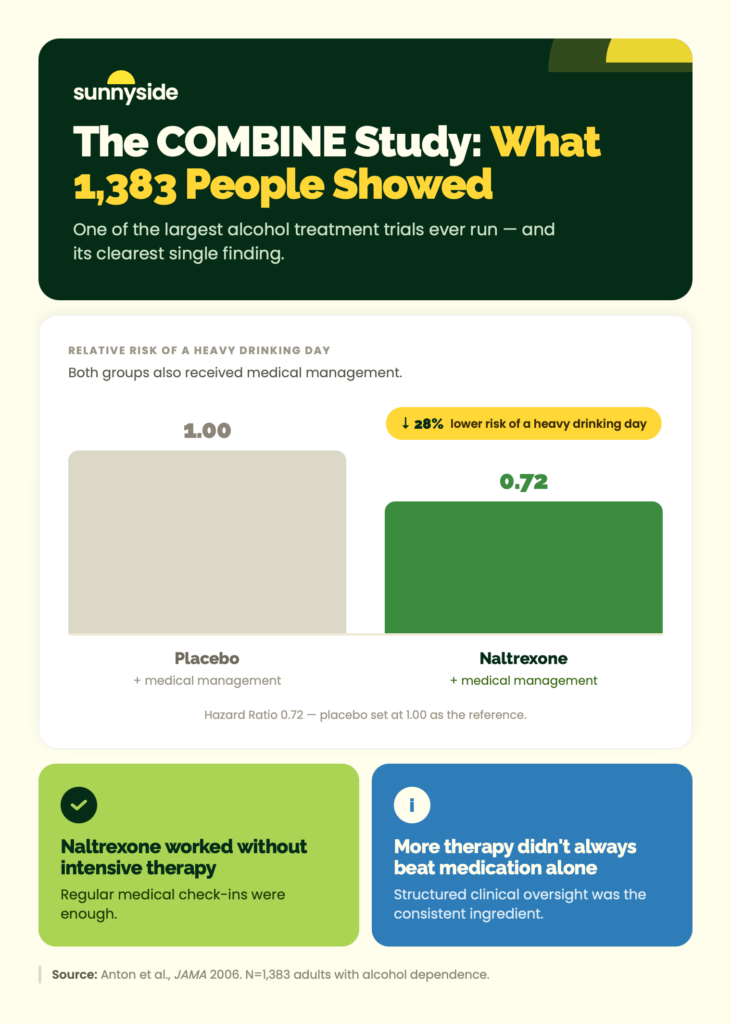
Sunnyside’s internal data provides some early evidence of how members fare when they engage with the program. Among active members with at least 50% app engagement, 78% achieved a meaningful reduction in drinking over 12 weeks. (These are observational results from Sunnyside members, not findings from a randomized clinical trial, and individual results vary.)
One member described the combination this way: “With the structure and support of the app, combined with Sunnyside Med (Naltrexone), I’ve been able to experience my first truly healthy, balanced relationship with alcohol in my adult life.”
Sunnyside Med is designed to make medication and support available before drinking reaches a crisis, including for gray-area drinkers who simply want more control over alcohol.
Best for: people who want a more intensive clinical alcohol-treatment model, particularly those hoping to use insurance.
Ria Health offers fully virtual alcohol treatment that combines medical care, medication when appropriate, 1:1 coaching, and progress tracking. Members can work toward either moderation or abstinence.
Compared with more streamlined medication providers, Ria operates more like a traditional treatment program delivered remotely. Members work with a care team and typically have regular coaching alongside follow-up from the medical team. Treatment plans may include medication as well as behavioral strategies based on the member’s goals.
Ria is in-network with several major insurers, although coverage depends on the specific plan and location. It’s also HSA/FSA eligible.
That makes Ria especially worth considering if you want a higher-touch clinical model and have insurance that covers the program. For people looking primarily for straightforward medication access, the additional clinical structure may differ from their needs.
Best for: people who want insurance-based medical care alongside a more recovery-oriented support model.
Workit Health provides virtual treatment for alcohol use disorder through licensed clinicians and supports both drinking reduction and abstinence. Unlike providers centered almost exclusively on naltrexone, Workit can prescribe several medications when appropriate, including naltrexone and acamprosate.
The program also includes video visits with prescribing clinicians, care-team messaging, guided recovery groups, and peer support. Workit treats some other conditions as well, which may make it a good fit for people who want broader addiction and behavioral health care within the same system.
Workit’s language and support structure lean more toward recovery than Sunnyside’s habit-change model, but abstinence isn’t required.
With insurance, Workit’s website says most members pay about $25 to $35 per month, although exact costs depend on the plan and medication is billed separately. For alcohol treatment without insurance, self-pay currently costs $250 for the first month and $150 per month after that.
Best for: people mainly looking for convenient medication access without a larger built-in behavioral program.
If you already have support elsewhere, or simply want a lighter-touch approach, a medication-focused telehealth provider may be the right fit.
Oar Health focuses on straightforward, online access to naltrexone.
First, you complete an online assessment, which is reviewed by a licensed healthcare professional. If naltrexone is appropriate, the medication is prescribed and shipped to your home.
Oar supports both moderation and abstinence. Its model centers medication rather than a larger behavior-change program, although members do receive support resources like human coaching and analytics. It also partners with outside organizations including Moderation Management and SMART Recovery, giving members options if they want additional peer or behavioral support.
Treatment currently costs $297 for three months. If medication access is your main priority, you can compare online naltrexone providers in more detail.
Choose Your Horizon also provides online access to naltrexone for people who want to cut back or quit. Its plans include a clinical evaluation, medication, shipping, and follow-up clinician visits.
Plans range from about $66 to $89 per month, with an additional evaluation fee. Coaching is available separately for people who want more support.
As with Oar, Choose Your Horizon may be a good fit if your main priority is convenient medication access rather than a more extensive behavior-change program.
Best for: people who want medication paired with Reframe’s established app-based behavior-change program.
Reframe began as an alcohol habit-change app, and that digital program remains at the center of Reframe Med+. The app includes daily lessons, drink tracking, progress insights, craving-management tools, and community support.
Med+ adds telehealth medical care and compounded naltrexone + B6 when prescribed by a licensed clinician. After an online assessment, a provider reviews your information and may approve treatment asynchronously or schedule a video visit. Members can also message their care team through the app.
That puts Reframe Med+ in a similar broad category to Sunnyside Med: both pair medication with an established alcohol behavior-change program rather than treating prescription access as the entire service. The difference is largely in the support experience. Reframe Med+ builds its medical offering around Reframe’s app-first model, while Sunnyside Med places greater emphasis on ongoing human coaching, group calls, and community support.
Reframe Med+ supports moderation, taking a break, or quitting and is available to eligible adults in all 50 states and Washington, D.C.
| Program | Best for | Medication | Behavioral support |
| Sunnyside Med | Medication plus ongoing human and behavioral support | Naltrexone when appropriate | App, 7-day coaching, tracking, weekly groups, community |
| Ria Health | Higher-touch clinical care | AUD medications when appropriate | 1:1 coaching, progress monitoring |
| Workit Health | Recovery-oriented medical care | Multiple AUD medications when appropriate | Groups, peer support, care-team messaging |
| Oar Health | Streamlined medication access | Naltrexone when appropriate | Limited support resources |
| Choose Your Horizon | Medication-focused care | Naltrexone when appropriate | Coaching available separately |
| Reframe Med+ | App-first behavior change plus medication | Compounded naltrexone + B6 when appropriate | App lessons, tracking, community, care-team messaging |
Pricing, services, and availability can change. Check each provider for current details and availability in your state.
Telehealth describes how care reaches you, not a single type of treatment. Its effectiveness depends on the treatment you’re receiving, whether it’s appropriate for your needs, and whether you’re able to stick with it.
Naltrexone is one of the best-studied medications for alcohol use disorder. A 2023 JAMA systematic review found that oral naltrexone and acamprosate had the strongest evidence among the medications it evaluated.
Consistency matters too. A COMBINE secondary analysis found an association between better medication adherence and better drinking outcomes.
Research also suggests that alcohol care can feasibly be delivered remotely. But telehealth isn’t appropriate for everyone. People at risk for severe alcohol withdrawal or those who need a higher level of care may require in-person medical treatment.
Sunnyside Med is our top overall pick because of the particular support it builds around medication. Members get an online clinical evaluation, naltrexone when medically appropriate, ongoing clinical care, seven-day human coaching, drink tracking and weekly goal setting, group calls, and a private member community.
It’s also built around flexible goals. You can work toward drinking less, taking an extended break, or quitting entirely.
For someone who wants medication but also wants regular human support and accountability around it, that combination makes Sunnyside Med our top overall telehealth pick.
“For the first time in years I’ve been waking up clear-headed and feeling good,” said one Sunnyside Med member. “I still plan to drink some, but I don’t miss feeling like I have to drink.”
Does it sound like Sunnyside Med might be a good fit? If so, get started with a quick three-minute online assessment.
Our top overall pick is Sunnyside Med for people who want medication paired with ongoing coaching and behavioral support.
Yes. Several telehealth programs support moderation as well as abstinence, allowing you to work toward drinking less without committing to quitting entirely.
Yes, in many cases. A licensed clinician can evaluate you remotely and prescribe medication such as naltrexone when medically appropriate. The process and medications available vary by provider and state.
An online naltrexone provider primarily offers medical evaluation and medication access. A broader telehealth alcohol program may also include ongoing clinical care, coaching, tracking, therapy, or peer support.
Naltrexone is a prescription medication. This content is educational and should not be taken as medical advice. A licensed clinician reviews every Sunnyside Med application. Individual results vary.
Ian has a family deeply hurt by alcohol, and is on his own personal journey to drink less and live his healthiest life. He’s took naltrexone daily for two years and saw incredible results. As Sunnyside Med’s first customer, he’s deeply entrenched in alcohol health and naltrexone.
Naltrexone is not addictive or habit-forming. It blocks opioid receptors rather than activating them, so it doesn't produce...

Getting a prescription for naltrexone doesn't have to mean a long sit in a doctor's waiting room. With...

Naltrexone eligibility is determined through an individual clinical evaluation, not a single pass-or-fail test. You don't need to...
If you’re interested in trying naltrexone to help you drink less, the natural next question is where to...