
Last Updated on June 18, 2026
The Sinclair Method is a naltrexone protocol (specifically for alcohol use disorder) in which the medication is taken 1-2 hours before drinking, rather than daily. By blocking opioid receptors during alcohol consumption, naltrexone interrupts the brain’s reward response to drinking, and over time, cravings become less urgent through a process called “pharmacological extinction.”
Once you’ve decided to take naltrexone to change your relationship with alcohol, there are two main protocols you can choose from in terms of timing: daily dosing and targeted dosing. Targeted dosing, or taking naltrexone specifically before you drink, is most commonly known as The Sinclair Method.
Here, we’ll cover how The Sinclair Method works at a brain level, what the research actually says, how The Sinclair Method compares to daily naltrexone, and why Sunnyside Med recommends starting with daily dosing before considering targeted use.
The Sinclair Method: An Overview
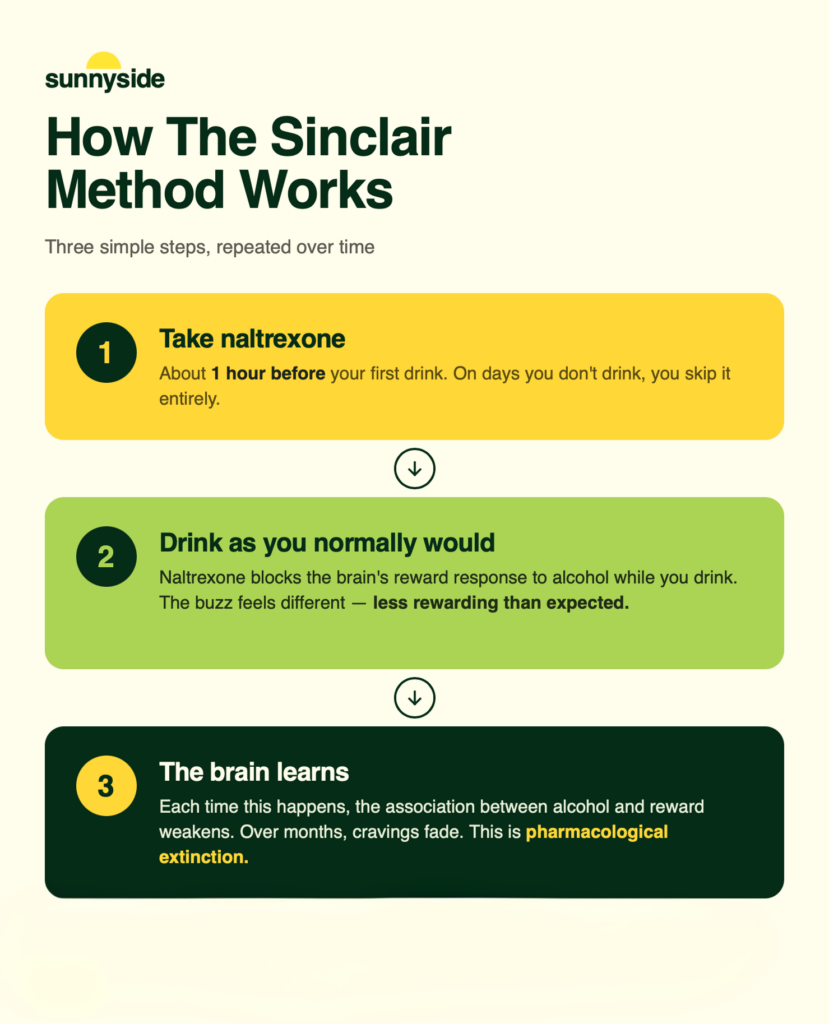
The Sinclair Method (TSM) is a protocol for using naltrexone before drinking occasions rather than taking it every day at the same time. You take your pill about one hour before your first drink, and on days you don’t drink, you skip the medication entirely.
The method was developed by Dr. John David Sinclair, a neuroscientist who spent decades researching behavioral conditioning at the National Public Health Institute in Finland. Sinclair’s work with rats helped support a key insight: The brain learns to crave alcohol because drinking triggers a reward signal. If you block that signal often enough while drinking continues, the learned craving weakens over time.
The Sinclair Method’s primary distinction from daily naltrexone is timing. Daily naltrexone provides consistent opioid receptor blockade, whether or not you drink on a particular day. Contrastingly, TSM engages the blockade for drinking events specifically. The theory is that extinction learning—the process of changing a learned behavior—happens best when you drink with the reward signal blocked.
The Science Behind “Pharmacological Extinction”
Every time you drink (without naltrexone), alcohol triggers the release of endorphins. Those endorphins bind to opioid receptors in your brain. That binding triggers a dopamine surge— basically a “this feels good, let’s do it again” signal.
Your brain records the association: alcohol equals reward. And with each repetition, that association gets stronger. The craving isn’t a character flaw. It’s a conditioned response your brain built over hundreds or thousands of drinking occasions.
Naltrexone is an opioid receptor antagonist. It sits on those same receptors and blocks endorphins from binding. Researchers believe this dampens part of the dopamine signaling involved in reinforcement learning. In practical terms, the brain expects the familiar reward associated with drinking, but the reinforcement is weaker than before.
This process is known in the TSM community as pharmacological extinction. The concept is based on classical extinction learning: the idea that conditioned responses weaken over time when the expected reinforcement no longer arrives. (One famous example: why Pavlov’s dogs eventually stopped salivating when the bell rang without food.)
And this is why the Sinclair Method specifically requires drinking on the medication. Extinction learning may require exposure to the cue (alcohol) while the reinforcement (the opioid-mediated reward) is blocked. Without the action of drinking, there’s nothing to unlearn.
What The Evidence Shows
In Sinclair’s 2001 review published in Alcohol and Alcoholism, he reported a 78% response rate using targeted naltrexone protocols designed around pharmacological extinction.
The 78% figure deserves some context because it is often repeated online without qualification. Sinclair’s paper was a narrative review written by a researcher summarizing his own line of work and related studies, not a modern systematic review or independent meta-analysis with predefined inclusion criteria. That does not invalidate the findings, but it does mean the number should not be treated as a universally established benchmark.
Targeted naltrexone has also been studied outside the Sinclair framework. In 2009, for example, Henry R. Kranzler et al. found that targeted naltrexone reduced heavy drinking among participants trying to moderate their alcohol intake.
Then, in 2022, Guilherme-Marcelo Santos et al. reported that targeted naltrexone was associated with fewer binge-drinking days among sexual and gender minority men in a randomized controlled trial.
At the same time, daily naltrexone remains the most extensively studied protocol overall. It is the FDA-approved prescribing approach and has been evaluated across substantially larger clinical trial populations. A major 2014 meta-analysis published in JAMA by Daniel E. Jonas et al. reviewed 122 randomized controlled trials involving more than 22,000 participants and found that naltrexone significantly reduced the risk of returning to heavy drinking.
Daily naltrexone has a broader and deeper evidence base than targeted dosing, particularly within large U.S. clinical trials and FDA-reviewed research.
The Sinclair Method and Daily Naltrexone: 2 Valid Approaches
Both protocols use the same medication. The difference is when and how you take it, and the right protocol for you depends on your drinking patterns and your life.
TSM may be a better fit for people who drink on predictable occasions and can reliably take a pill 1-2 hours before every drinking occasion. It suits people who want to keep drinking intentionally while they change their relationship with alcohol.
Daily naltrexone tends to work better for people who drink unpredictably or out of habit. It’s also likely a stronger fit for anyone who wants consistent craving reduction throughout the day or finds the pre-drinking planning ritual hard to maintain.
Starting with daily naltrexone has practical advantages. It takes adherence out of the equation since you take it every morning regardless of whether you plan to drink. It fast-tracks side effect management, because you’ll know within the first week or two how your body responds. And it helps you figure out whether naltrexone works for you before you add the complexity of timing it around drinking events.
Sunnyside Med recommends starting on daily naltrexone for at least 90 days. That gives you time to build the habit, stabilize on the medication, and see real changes before considering a switch to targeted dosing.
Neither approach is wrong. Many people try one and switch to the other. Some people start on daily naltrexone, then eventually move to targeted use as their drinking becomes more predictable and less frequent.
The Importance of Consistency in the Sinclair Method
As one person put it in an online forum: “[Naltrexone] works, but you have to take the pill.”
As with many medications—and goals in general—consistency is key here. And the Sinclair Method does present a specific consistency challenge compared to daily naltrexone. The very moment you most need to take the pill is the moment you’re least likely to remember or want to.
Let’s say you’re heading to dinner. Or you’re at a friend’s house. Or you make spontaneous plans after work on a Friday night. In each of these situations, your naltrexone might not be readily available, or you might be tempted to skip it in favor of a heavy-drinking night. To avoid this, you must plan your drinking in advance, every single time, without exception—and that’s not always how life works.
Daily naltrexone has a different compliance pattern. It’s easier to build as a daily habit that you’re more likely to stick with. But you do need to take it even on days you don’t drink.
How Behavioral Support Enhances Naltrexone’s Effects
Both protocols need behavioral support to be sustainable. The medication is a tool, not a magic pill. Research from the landmark COMBINE trial found that naltrexone worked best alongside behavioral support, suggesting that the medication is more effective when paired with tools that help people actively reshape their drinking habits.
And Sunnyside Med comprehensive data shows that members who engage with the full program (coaching, daily habit tools, community, meetings, and more) are 3x more likely to refill their prescription compared to less engaged members. The support makes the medication do its best work.
Why Doctors Don’t Prescribe The Sinclair Method
TSM is much more visible online than in clinical practice. If you’ve been researching naltrexone, you’ve probably encountered it on Reddit, in online forums, or in Claudia Christian’s TEDx talk (which has been viewed over 5 million times). Books, documentaries, and grassroots communities have helped the TSM build a passionate following.
But when you visit a doctor, they’ll almost certainly recommend daily dosing. That’s because daily naltrexone is the FDA on-label protocol.
This gap between online visibility and clinical adoption isn’t unique to TSM. Advocates like Percy Menzies have spent decades trying to get programs to adopt naltrexone in any form, including daily dosing.
Even the best-studied protocol is dramatically underprescribed. According to data from the National Institute on Alcohol Abuse and Alcoholism (NIAAA), only about 2.5% of people with alcohol use disorder (AUD) received medication treatment in the past year.
The issue isn’t really “TSM versus daily.” The bigger problem is that a lot of people aren’t accessing naltrexone at all. Institutional adoption is decades behind the science.
What Changes When Naltrexone Works
Regardless of whether someone uses targeted or daily dosing, the experience Sunnyside members describe follows a recognizable pattern.
- “I feel as though the Naltrexone is a Godsend! I’m really enjoying having the
‘Noise’ quieted.” —Sunnyside member
- “Not having that constant ‘itch’ is an unbelievable feeling!” —Sunnyside member
- “I had a cocktail last night, and for the first time ever, I didn’t drink the whole thing. In fact, I dumped half of it down the drain.” —Sunnyside member
These reports have a lot in common. For example, for each person, the “noise” around drinking got quieter. The automatic pull toward another drink lessened considerably. For a lot of Sunnyside members, alcohol just becomes way less interesting.
Most of the people who describe this shift didn’t identify as having a “problem” in the traditional sense. They just wanted alcohol to play a smaller role in their lives.
As Sunnyside co-founder Ian Andersen puts it: “You’re not here because you hate alcohol. You’re here because it’s been taking more than it’s been giving.”
How Sunnyside Med Can Support Your Naltrexone Journey
Whether you start with daily dosing or eventually move to targeted use, Sunnyside Med provides not only naltrexone itself, but also the support you need for it to do its job the best.
You can get access to naltrexone 100% online, privately, with a licensed clinician reviewing your application. Sunnyside Med’s protocol is daily adherence, since we follow the FDA-approved on-label use of naltrexone, and our care team is fully equipped to handle daily dosing guidance. We also strongly encourage all our members to stick with daily adherence, but if you choose to try The Sinclair Method, we encourage you to talk to our care team first.
At Sunnyside Med, you’ll get science-backed behavior change tools, including drink tracking, 1:1 coaching via text seven days a week, empathetic community, and weekly Zoom sessions with others on the same path.
Frequently Asked Questions (FAQ)
What does the Sinclair Method involve?
The Sinclair Method involves taking naltrexone approximately one hour before drinking, rather than daily. The goal is to block the brain’s reward response during drinking occasions so that, over time, cravings become less urgent. On days when you don’t drink, you don’t take the medication.
Does The Sinclair Method require you to stop drinking?
No. The Sinclair Method specifically requires that you continue drinking while taking naltrexone. The medication works by blocking the reward signal during drinking, which gradually weakens the conditioned craving over time. The protocol is to take the pill before you drink, consistently.
How long does The Sinclair Method take to work?
Many people notice meaningful changes within 3-4 months of consistent use. Some people notice a shift within weeks. But consistency is key. Skipping doses before drinking occasions can stall progress. Many clinicians recommend committing to at least 90 days before evaluating whether the protocol is working for you.
Is the Sinclair Method the same as daily naltrexone?
No. Both use naltrexone, but the protocols differ. Daily naltrexone is taken every day, regardless of whether you plan to drink that day, providing consistent opioid receptor blockade. The Sinclair Method is taken only before drinking occasions, targeting the blockade to moments when alcohol’s reward signal would normally fire. The most important factor in either approach is consistency.
If you’re exploring which path is right for you, Sunnyside Med can help you start with daily naltrexone and adjust from there.
Naltrexone is a prescription medication. This content is educational and should not be taken as medical advice. A licensed clinician reviews every Sunnyside Med application.
Sunnyside Is the Perfect Companion for Your Naltrexone Journey
Sunnyside is the #1 mindful drinking app. Since 2020, we’ve been honing our harm-reduction approach and have helped over 400,000 people cut out 22 million drinks from their baseline habits. 96.7% of our members report success drinking less, and in a third-party study, our approach was demonstrated to reduce weekly drinking by 33% after 12 weeks.
Think of Sunnyside as the front door for anyone who wants to change their relationship with alcohol. If you want to drink less, we can help you get there. If you want to eventually quit, but want to take a gradual approach, we can make that happen.
When you sign up for Sunnyside, you’ll take a quick 3-minute personalization quiz, then hop into the app. It’s as simple and quick as that.
We’ll give you weekly plans to gradually reach your drinking goals, and we’ll provide nudges, coaching, exercises, and advice to help you get there.
We have daily tracking and journaling tools, including the option to chat with a real human coach. And, of course, we have great analytics so you can track your progress over time.
Sunnyside is a full-featured mindful drinking app, and thus the perfect companion for your Naltrexone journey. Naltrexone will actively help you reduce cravings around alcohol, and Sunnyside will help you understand your triggers and patterns, giving you a healthy system for habit change.
Everyone who signs up for Sunnyside gets a free 15-day trial, then the subscription is $8.25/month, less than the cost of a fancy drink. And the best part is our members save an average of $50 per month, easily paying for the cost of the subscription.
Whether you’re currently taking naltrexone or just doing some research on alcohol moderation, we’d love to have you sign up for our 15-day free trial today.