How Long Does Naltrexone Stay in Your System?
How long naltrexone stays in your system depends partly on which form of naltrexone you're taking. Oral naltrexone,...

If your GLP-1 medication made food noise disappear, but your drinking stayed the same, you’re not the only one. Ozempic (semaglutide) affects reward pathways involved in appetite and alcohol craving, but alcohol reward also involves opioid signaling that GLP-1 medications may not directly target. That second pathway is where naltrexone works, and where Sunnyside Med can help.
People taking Ozempic often notice their food cravings dissipating in a big way. The once-loud noise around chips, pasta, and dessert goes quiet, maybe for the first time in years.
But for some people, the switch doesn’t flip when it comes to alcohol cravings. The relationship with food changes, but the relationship with drinking remains.
One Reddit user in r/Ozempic put it this way: “I don’t even like the taste of my wine anymore, yet I’m still drinking two glasses a night.” Many other threads tell the same story.
Some headlines claim Ozempic can curb the urge to drink just like it curbs the urge to overeat. And for many people, it does reduce the pull toward alcohol. But that doesn’t happen for everyone. Why? There’s a specific biological reason having to do with our brains’ reward pathways. (More on that in a second.) There’s also a medication that specifically targets the reward pathway associated with alcohol, which is where Sunnyside Med can help.
Ozempic does reduce alcohol cravings for some people, but not for everyone. Research supports the complexity here.
A large observational study published in Nature Communications (Wang et al., 2024) followed 83,825 patients with obesity and found that GLP-1 receptor agonists, including semaglutide, were associated with a substantially lower risk of alcohol use disorder (AUD) incidence and recurrence. Because the study was observational, it cannot establish causation, but it does suggest a meaningful association that has prompted further investigation.
More recently, a Phase 2 randomized controlled trial by Hendershot et al. (2025) in JAMA Psychiatry tested once-weekly semaglutide in 48 adults with AUD. The medication reduced alcohol craving and showed improvements in some, but not all, measures of drinking behavior, with more modest and mixed effects on overall drinking patterns.
One potential explanation is that GLP-1 receptors are expressed in the brain regions involved in reward processing, including the nucleus accumbens. Preclinical research suggests that GLP-1 signaling may influence dopamine-related reward pathways, which could help reduce the motivational “pull” of alcohol. However, the mechanisms in humans are still being studied, and larger randomized trials are needed to figure out how generalizable these effects are.
That “some, but not all” finding from the Hendershot trial is important. Semaglutide reduced alcohol craving on average, but its effects on drinking behavior were not uniform across every measure. Larger randomized trials are still needed to understand who is most likely to benefit, how durable the effect is, and why some people may respond more strongly than others.
Part of the explanation may be biological, according to research. A 2021 review by Eren-Yazicioglu et al. in Frontiers in Behavioral Neuroscience, for example, explored how GLP-1 signaling interacts with brain reward pathways, including systems involved in food, drugs, and alcohol. That does not prove semaglutide will reduce alcohol cravings for everyone, but it does help explain why researchers are interested in GLP-1 medications as potential tools for reward-driven behaviors.
Anecdotally, some people also describe the alcohol-dampening effect fading over time, though that is not settled clinical evidence.
For now, the safest takeaway is that GLP-1 medications appear to affect alcohol craving and reward for some people, but the response is variable and still being studied.
If Ozempic is not working for alcohol cravings, this is not about the medication failing. It is about alcohol running through two reward systems that overlap only partially, and GLP-1 medications primarily addressing one of them.
GLP-1 medications were designed for metabolic conditions. They were not built to reach the opioid receptors that light up when alcohol hits your brain.
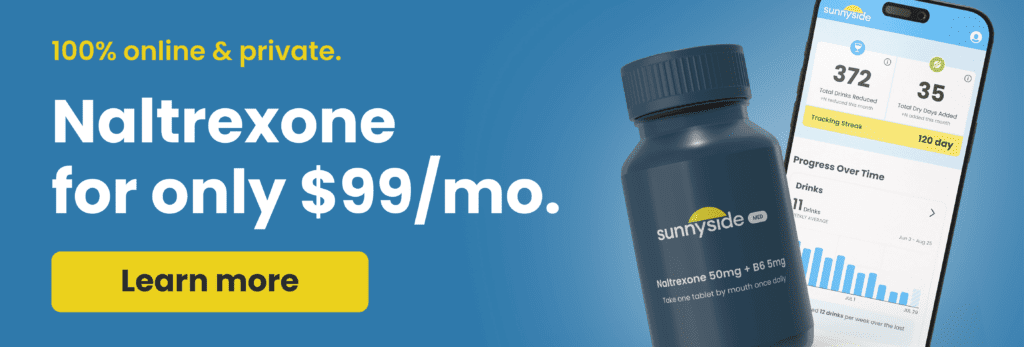
There is a medication designed to reduce the brain’s reward response to alcohol directly: naltrexone.
Naltrexone is an opioid receptor antagonist. When you take it, the opioid receptors that normally light up after drinking are occupied by naltrexone instead of endorphins. The reward signal gets weaker. The result: alcohol loses its payoff. The warm buzz fades. Stopping at one drink starts to feel natural instead of impossible.
This is not a “naltrexone versus Ozempic” situation. They work through complementary mechanisms on different pathways. Semaglutide reduces your food cravings by modulating dopamine, while naltrexone targets the reward signal that keeps alcohol specifically interesting.
Sunnyside Med members who take naltrexone describe the noise around alcohol getting quieter, as kind of a gradual recalibration rather than a dramatic overnight transformation. The medication does the pharmacological work while the person (with Sunnyside’s help) builds new patterns around it.
Medication helps on its own, but medication with structured behavioral support helps more. The research is consistent on this, and it’s the strategy behind Sunnyside Med.
The landmark COMBINE study (Anton et al., 2006) found that both naltrexone and structured behavioral support improved drinking outcomes, supporting a combined approach that addresses both the biological and behavioral sides of alcohol use. Even relatively brief clinician support sessions appeared to strengthen treatment outcomes when paired with medication.
That’s why, when you join Sunnyside, you’ll have access to:
These resources help address the cues, triggers, and routines that medication alone cannot rewire. The medication quiets the craving. The program helps you build a life where the craving matters less.
If Ozempic changed your appetite, but your alcohol cravings are not changing in the way you expected, that doesn’t mean you’ve somehow failed at the game of willpower. That is a plausible and increasingly recognized biological experience.
It’s also where naltrexone might come in handy. As mentioned above, naltrexone targets the opioid pathway directly. and it’s available through telehealth. No diagnosis or prior treatment history is required. When you join Sunnyside Med, a licensed clinician will review your history and determine if naltrexone is appropriate for you.
78% of active Sunnyside Med members achieved a meaningful reduction in their drinking. Members attest that the desire to have a drink (and then, to keep drinking) is largely gone — no white-knuckling through a party or battling cravings. The pharmacological reward signal gets quiet, and there’s finally room for new habits to fill the space.
Naltrexone is a prescription medication. This content is educational and should not be taken as medical advice. A licensed clinician reviews every Sunnyside Med application.
Sunnyside is the #1 mindful drinking app. Since 2020, we’ve been honing our harm-reduction approach and have helped over 400,000 people cut out 22 million drinks from their baseline habits. 96.7% of our members report success drinking less, and in a third-party study, our approach was demonstrated to reduce weekly drinking by 33% after 12 weeks.
Think of Sunnyside as the front door for anyone who wants to change their relationship with alcohol. If you want to drink less, we can help you get there. If you want to eventually quit, but want to take a gradual approach, that’s great, too.
When you sign up for Sunnyside, you’ll take a quick 3-minute quiz, then hop into the app. From there, we’ll give you weekly plans to gradually reach your drinking goals, providing nudges, coaching, exercises, and advice to help you get there. We also have daily tracking and journaling tools, including the option to chat with a real human coach at any time. And, of course, we provide great analytics so you can track your progress over time.
Sunnyside is a full-featured mindful drinking app, and thus the perfect companion for your Naltrexone journey. Naltrexone will actively help you reduce cravings around alcohol, and Sunnyside will help you understand your triggers and patterns, giving you a healthy system for habit change.
Everyone who signs up for Sunnyside gets a free 15-day trial, then the subscription is $8.25/month. And the best part is our members save an average of $50 per month, easily paying for the cost of the subscription.
Whether you’re currently taking naltrexone, or just doing some research on alcohol moderation, we’d love to have you sign up for our 15-day free trial today.
Yes. Ozempic (semaglutide) doesn’t create a dangerous reaction with alcohol, though it may exacerbate GI side effects. Some people experience reduced interest in drinking while on Ozempic, and some report that alcohol affects them more strongly on a smaller amount. If you’re taking Ozempic and have questions about alcohol, talk with your prescribing clinician.
Alcohol doesn’t block semaglutide's effectiveness directly. But heavy drinking can increase the risk of nausea , which is already a common side effect of GLP-1 medications. Some people find that drinking on Ozempic causes more intense nausea or gastrointestinal discomfort than they experienced before starting the medication.
If Ozempic isn’t working for alcohol the way it worked for food, consider discussing naltrexone with your clinician. Naltrexone reduces the brain's reward response to alcohol, and it can be used alongside GLP-1 medications. At Sunnyside Med , we pair naltrexone (45mg) with behavior change coaching, drink tracking, and clinical support.
Ian has a family deeply hurt by alcohol, and is on his own personal journey to drink less and live his healthiest life. He’s took naltrexone daily for two years and saw incredible results. As Sunnyside Med’s first customer, he’s deeply entrenched in alcohol health and naltrexone.
How long naltrexone stays in your system depends partly on which form of naltrexone you're taking. Oral naltrexone,...
Research on naltrexone use during pregnancy is limited, particularly among people taking it for alcohol use disorder. What...
Although naltrexone eventually became an established treatment for alcohol use disorder (AUD), getting it into routine clinical practice...
Naltrexone and Antabuse differ in how they work, what taking them is like, their safety considerations, and the...