Last Updated on August 18, 2026
Naltrexone may help reduce binge drinking by making alcohol feel less rewarding and the urge to keep drinking easier to interrupt. Research suggests it can benefit people who want to drink less, including those who don’t drink every day or want to quit completely.
You’re out with friends on a Friday. The plan was two drinks. But you keep on ordering, and you wake up the next morning not quite sure how you had eight. Again.
If you’ve thought some version of “I don’t drink every day. I just can’t stop once I start,” naltrexone for binge drinking might be an option worth considering. You don’t have to identify as someone with a “real problem” to want more control over your drinking. Plenty of functional, high-achieving people regularly drink more than they intend to.
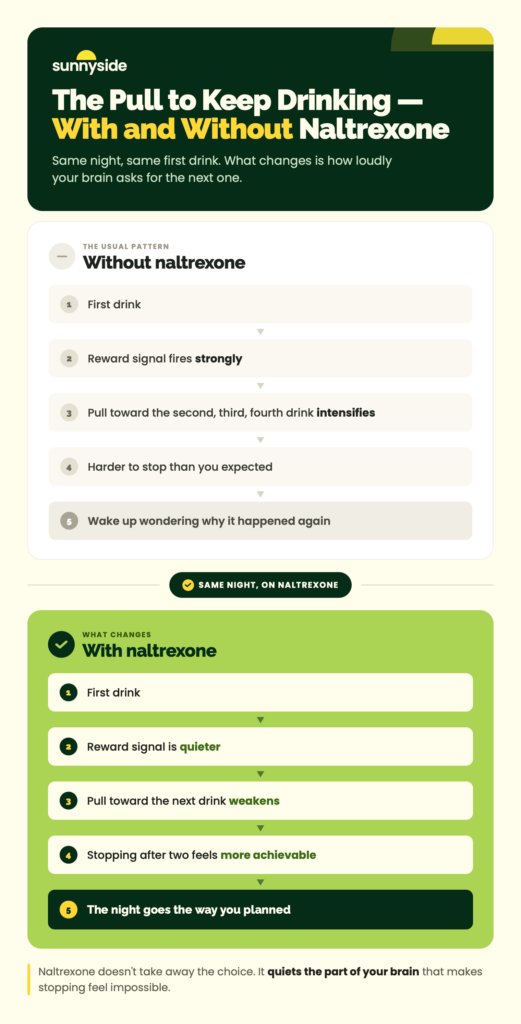
The problem usually isn’t a simple lack of willpower. Once alcohol activates the brain’s reward system, sticking to your original plan can feel much harder than it felt before the first drink.
Naltrexone can help reduce that pull, making it easier to drink less without white-knuckling your way through every night out. And when medication is paired with habit-change tools and ongoing support, like the Sunnyside Med toolkit, it can become part of a broader strategy for changing your relationship with alcohol.
What Is Binge Drinking?
The NIAAA (National Institute on Alcohol Abuse and Alcoholism) defines binge drinking as a pattern of drinking that brings blood alcohol concentration to 0.08% or higher, typically about four drinks for women or five for men within about two hours.
The term can sound more extreme than the reality. Binge drinking is common, and it can be easy to fall into the pattern without thinking of your drinking as particularly serious. In 2024, about 1 in 5 people aged 12 and older in the U.S., or roughly 57.9 million people, reported binge drinking in the last month, according to the NIAAA.
Repeated binge drinking is associated with a range of health and safety risks, including injuries and effects on the heart, liver, and brain. That’s why recognizing the pattern early can be a real advantage for your health.
Why Binge-Drinking Patterns Are Hard to Break with Willpower Alone
When you drink, alcohol stimulates the release of endorphins, contributing to the rewarding effects that can make you want to keep drinking. For some people, that makes stopping after one or two drinks much harder than it sounded before the first one.
The experience can be tough to recognize from the inside. It feels like an almost automatic pull toward the next drink, less a decision than a current you’re swimming against.
Over time, drinking also becomes tangled up with the cues and routines around it. Friday night. The first sip. A particular group of friends. The end of the workday. Any of these can become a trigger. Many of these habits started when drinking felt fun and unremarkable, like in college or during years of happy hours. Eventually, patterns you never consciously chose can become surprisingly hard to change.
That’s why thinking “I’ll just have two this time” and crossing your fingers can be such a frustrating strategy. Willpower isn’t operating in a vacuum. It’s competing with alcohol’s effects on reward and self-control, plus habits that may have been reinforced for years.
How Naltrexone for Binge Drinking Can Interrupt the Pattern
Naltrexone is an opioid receptor antagonist. It doesn’t sedate you or make you sick when you drink (that’s a different medication), and treatment doesn’t require abstinence. Instead, naltrexone blocks opioid receptors involved in alcohol’s rewarding effects.
For some people, the result is that alcohol simply feels less compelling. The pull toward the next drink gets weaker, and stopping after two or three doesn’t feel like the same internal battle. Over time, drinking less can also help weaken the habits that kept the old pattern going.
Brain-imaging research offers some insight into what’s happening here. In a small 2023 study of adult men, Spencer and colleagues found that naltrexone changed activity in brain regions involved in reward processing, including the striatum and pallidum. The researchers linked these changes to greater top-down control of attention around alcohol-related rewards.
A 2022 study of adolescents by Carpenter and colleagues found that, among participants taking naltrexone, greater negative mood after the first drink was associated with less subsequent drinking.
(You can read more about how naltrexone reduces the brain’s reward response to alcohol if you want to get further into the science.)
Sunnyside Med members tend to describe the change more simply. “The cravings have subsided significantly, and the mental chatter is much quieter,” one said. Another put it this way: “Alcohol just isn’t as interesting anymore.” For others, it takes even fewer words: “The chase is gone.”
Does Naltrexone Work If You Don’t Drink Every Day?
You do not have to drink every day, have severe alcohol use disorder, or want to quit completely to potentially benefit from naltrexone. Several studies have examined the medication in heavy drinkers who weren’t seeking abstinence, including people whose drinking was concentrated on certain days.
In a 2015 randomized controlled trial, O’Malley and colleagues studied 128 young adult heavy drinkers who were not required to have alcohol use disorder or be seeking treatment. Participants who received a combination of daily and targeted naltrexone had fewer drinks per drinking day and were less likely to reach an estimated blood alcohol concentration of 0.08% or higher.
Other research has looked at binge drinking more directly. In a 2022 randomized controlled trial, Santos and colleagues studied 120 sexual and gender minority men with mild-to-moderate alcohol use disorder. Naltrexone reduced binge-drinking days, weeks with any binge drinking, total drinks per month, and cravings, with some benefits still evident six months later. (This study used targeted rather than daily dosing and included a specific population, so its findings shouldn’t be treated as universal.)
Taken together, these studies challenge the idea that naltrexone is only for people who drink heavily every day. Studies have found benefits among non-daily heavy drinkers, people who want to moderate their drinking, and people specifically trying to binge less.
Sunnyside Med uses a daily naltrexone protocol, so you’ll take the medication consistently even if most of your drinking happens on weekends or a few specific days. This is paired with drink tracking, coaching, and habit-change tools designed to help you work on the psychological patterns around your drinking, too.
One Sunnyside Med member who struggled with weekend binges described the change this way: “One glass of wine, without the pull to keep drinking. That is a place I aim to dig in and stay.”
What to Expect With Naltrexone for Binge Drinking
There’s no universal timeline for naltrexone. Some people notice a difference early, and for others the change is more gradual.
During the first week or two, some people experience side effects like nausea, fatigue, or headaches. These side effects are generally mild and often improve as the body adjusts.
The first shift in drinking habits may be subtle: The urge to drink might still be present, but it might feel a little less loud. Then, if you do have a drink, it might be easier than you’re used to to stick to just the one.
One Sunnyside Med member described both the initial side effects and the eventual change like this: “I’m typically not one to turn to a med as a magic fix, but it certainly has helped. Once you can get past the nausea, you’ll find you have less cravings and less urge to binge.”
With continued treatment, those smaller changes often begin to affect the bigger pattern. Your old routines around drinking may feel less automatic, and drinking may start to occupy less of your mental space.
It is important not to expect one pill to transform your drinking overnight. Naltrexone works best when you take it consistently and give yourself time to notice what’s actually changing. Tracking your drinks, paying attention to triggers, and getting support along the way can help you use that shift to build habits that last.
How Long Should You Take Naltrexone for Binge Drinking?
There’s no single timeline for how long to take naltrexone. The right duration depends on how you’re responding to the medication, whether you’re experiencing side effects, your drinking patterns, and the goals you’re working toward.
Giving treatment enough time can be especially important when you tend to binge drink sporadically. Looking at your drinking over several months can give you a clearer picture of whether you’re having fewer binge episodes, drinking less when you do drink, or finding it easier to stop.
If naltrexone is helping you drink less, there’s no need to rush toward an arbitrary finish line. When you do consider stopping, talk with your care team about your progress and what support you’ll have in place to maintain it.
Why Pair Naltrexone With Other Tools?
Naltrexone can change the way your brain responds to alcohol, but it doesn’t erase the habits you’ve built around drinking. The Friday ritual, the social cues, the stress triggers. Those patterns still need attention.
That’s one reason support matters. In the landmark COMBINE trial, naltrexone was provided alongside structured medical management that included regular appointments, adherence support, and counseling. The study demonstrated that medication can be effective within a framework of ongoing monitoring and support.
Sunnyside Med’s internal data shows a similar pattern:
- Among active members, those who engage with the full program, including drink tracking, coaching, and community support, are 2.5 to 3 times more likely to stay on medication.
- Among engaged members, average weekly drinks dropped from 23.0 to 12.5, a 45.6% reduction. (Individual results vary.)
As Sunnyside co-founder and CEO Nick Allen puts it: “The medication is the scaffolding. The app, coaching, and community are the structure being built inside it.”
If binge drinking is taking more than it gives, Sunnyside Med pairs naltrexone with the tools and support that can help you change the patterns around it. Learn more and see if you’re eligible with a two-minute quiz.
Naltrexone is a prescription medication. This content is educational and should not be taken as medical advice. A licensed clinician reviews every Sunnyside Med application.
Frequently Asked Questions (FAQ): Naltrexone for Binge Drinking
What is binge drinking?
Binge drinking is a pattern that brings blood alcohol concentration to 0.08% or higher, typically about four drinks for women or five for men within about two hours. It doesn’t mean drinking every day.
What medication can reduce binge drinking?
Naltrexone may help reduce binge drinking by blocking opioid receptors involved in alcohol’s rewarding effects. It’s FDA-approved to treat alcohol dependence and has also been studied in people who want to drink less.
Does naltrexone work if you only drink on weekends?
It can. Studies have found benefits among non-daily heavy drinkers, including reductions in drinks per drinking day and binge-drinking episodes.
Is drinking still fun on naltrexone?
You can still drink while taking naltrexone, and it won’t make you sick if you do. Some people find that alcohol simply feels less compelling.
Can naltrexone help if I don’t think I have a drinking problem?
Potentially, yes. You don’t have to wait for your drinking to reach a crisis point to consider making a change, and naltrexone has been studied in people who want to cut back rather than quit completely.
Sunnyside is the Perfect Companion for Your Naltrexone Journey
Sunnyside is the #1 mindful drinking app. Since 2020, we’ve been honing our harm-reduction approach and have helped over 400,000 people cut out 22 million drinks from their baseline habits. 96.7% of our members report success in drinking less, and in a third-party study, our approach was demonstrated to reduce weekly drinking by 33% after 12 weeks.
Think of Sunnyside as the front door for anyone who wants to change their relationship with alcohol. If you want to drink less, we can help you get there. If you want to eventually quit but want to take a gradual approach, we can make that happen.
When you sign up for Sunnyside, you’ll take a quick quiz, then hop into the app. It’s as simple and quick as that.
We’ll give you weekly plans to reach your drinking goals gradually, along with nudges, coaching, exercises, and advice to help you get there.
We have daily tracking and journaling tools, including the option to chat with a real human coach. And our state-of-the-art analytics help you track your progress over time.
Sunnyside is a full-featured mindful drinking app. Naltrexone will actively help you reduce cravings around alcohol, and Sunnyside will help you understand your triggers and patterns, giving you a healthy system for habit change.
If you choose to stop taking naltrexone, the Sunnyside app remains a tool you can keep using to maintain your healthy habits.
Everyone who signs up for Sunnyside gets a free 15-day trial. After that, the subscription is $8.25/month.
Whether you’re currently taking naltrexone or just doing some research on alcohol moderation, we’d love to have you sign up for our 15-day free trial today.