
Last Updated on June 25, 2026
A naltrexone-friendly doctor is a healthcare provider who understands that naltrexone can help people reduce their drinking—not just quit entirely—and is comfortable prescribing it as part of an evidence-based treatment plan. If your primary care doctor isn’t familiar with naltrexone or doesn’t prescribe it, you can ask for a referral or use a telehealth service like Sunnyside Med that specializes in alcohol moderation and medication-supported care.
Finding a naltrexone-friendly doctor is harder than you might expect. That’s not because the medication is experimental or controversial — it’s been FDA-approved since 1994 and has been studied in plenty of clinical trials. It’s just that, for many doctors, naltrexone doesn’t come to mind.
It’s Not a Reflection of You
A 2022 multisite survey published in Frontiers in Psychiatry and affiliated with the Mayo Clinic found that only 23.3% of physicians had prescribed naltrexone in the three months prior. Internal medicine and family medicine doctors were significantly less likely than psychiatrists to believe it was effective — not because the evidence isn’t there, but because most were never trained on it.
The knowledge gap is real. But there is also a second layer underneath it. Research from the Recovery Research Institute has found that providers who assign personal moral responsibility for heavy drinking are significantly less likely to prescribe. Some doctors still treat this as a willpower issue rather than a neurological one — and that has nothing to do with you and everything to do with how medicine has historically framed alcohol.
Still, likely, your doctor is not withholding this on purpose. They don’t know enough about it yet.
What a Naltrexone-Friendly Doctor Actually Looks Like
Knowing what you’re looking for makes the conversation less stressful before it even starts. There are real, observable differences between a prescriber who understands naltrexone and one who doesn’t.
Green flags worth paying attention to
A naltrexone-friendly doctor asks about drinking in terms of frequency and quantity — not just “do you drink?” They are familiar with NIAAA guidelines and comfortable with the idea that people can drink more than they want to without fitting neatly into a clinical category. They don’t require enrollment in a formal treatment program before discussing options; that specific barrier appeared repeatedly in the Mayo Clinic-affiliated survey as a common reason naltrexone goes unprescribed. And they take moderation seriously as a legitimate goal.
Flags that might signal a knowledge gap
If a doctor immediately redirects you toward an inpatient program or says naltrexone is “only for severe cases,” please know that does not reflect medical consensus.
Worth noting: naltrexone is sometimes confused with disulfiram, a completely different medication that does cause physical illness if you drink. Naltrexone works differently. It blocks opioid receptors in the brain that generate the reward signal from alcohol, so drinking becomes less compelling over time. It does not make you sick.
How to Ask Your Doctor About Naltrexone
The conversation doesn’t have to be complicated. You don’t need a diagnosis or to “call yourself” anything. You need to describe what’s happening and ask a direct question.
Language you might want to try: “I’ve been drinking more than I want to, and I’ve read about a medication called naltrexone that can help reduce the urge to keep going after the first drink. I’d like to talk about whether it’s right for me.”
Or: “I’m not looking to quit entirely. I just want to drink less. I know naltrexone can be a useful option. Can we discuss it?”
If they redirect you toward something else, ask whether they have personal experience prescribing naltrexone. If the answer is no, ask for a referral and know that other options exist.
Another Option: Sunnyside Med
At Sunnyside Med, countless members have described going to their primary care doctor, asking about naltrexone, and being redirected to AA instead. There is nothing wrong with AA — but for someone who drinks more than they want to, doesn’t necessarily identify as an alcoholic, and is looking for a modern tool to moderate their drinking, it is not the answer to the question they actually asked.
A 2022 feasibility study published in PMC found preliminary evidence that integrated telehealth naltrexone combined with behavioral support is feasible and effective for engaging people who don’t thrive in traditional clinical settings. Preliminary is the operative word — this is an emerging evidence base. But it points in a clear direction, and it explains why online naltrexone prescribing has become a meaningful alternative for people who have already been failed once.
“A prescription without support is just a pill,” says Nick Allen, CEO of Sunnyside Med. “Sunnyside Med is both.”
You Don’t Have to Be Diagnosed to Deserve This
Gray area drinking is exactly what it sounds like. You are not in crisis, and you function well. You also drink more than you want to, and willpower alone hasn’t changed that in any lasting way.
A 2019 meta-analysis found that naltrexone shows greater effect sizes for reducing heavy drinking than for abstinence outcomes. The medication works while people are still drinking, which is precisely the point for someone who wants to drink less, not stop entirely. Understanding how naltrexone actually works helps explain why: with opioid receptors blocked, alcohol stops triggering the same reward loop. The pull to keep going after the first drink fades.
One Sunnyside Med member described it like this: “The noise around alcohol got quieter.” That is what many people are actually looking for — a little more space between the impulse and the action.
Among Sunnyside Med members with 50% or greater engagement with the app, 78% achieved meaningful reductions in drinking. These are observational outcomes from member data, not a randomized controlled trial, and individual results vary. But they reflect what consistent, supported use looks like in practice.
One member came in convinced they wouldn’t benefit. “I was skeptical that this was for someone like me. But I persisted.” That hesitation is normal, but so are the benefits that follow.
If what you have read here sounds familiar, the next step is a short intake quiz at joinsunnysidemed.com/quiz — designed to help a naltrexone-friendly doctor on the Sunnyside Med clinical team understand your situation and determine whether this is the right fit.
Naltrexone is a prescription medication. This content is educational and is not medical advice. A licensed clinician reviews every Sunnyside Med application.
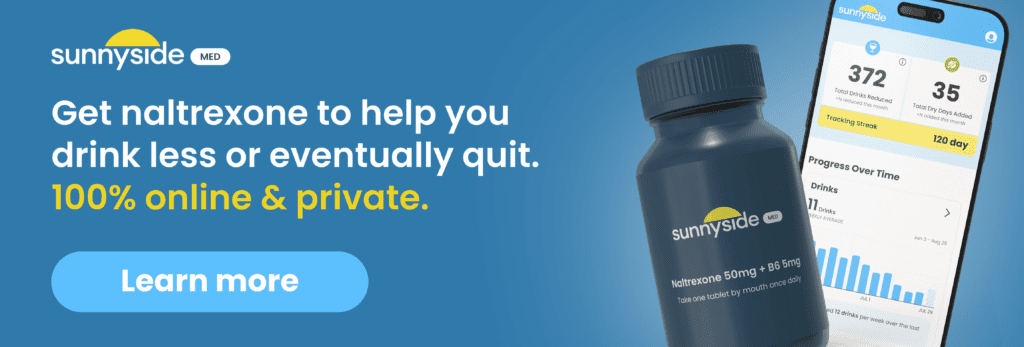
Sunnyside is the Perfect Companion for Your Naltrexone Journey
Sunnyside is the #1 mindful drinking app. Since 2020, we’ve been honing our harm-reduction approach and have helped over 400,000 people cut out 22 million drinks from their baseline habits. 96.7% of our members report success in drinking less, and a third-party study found that our approach reduced weekly drinking by 33% after 12 weeks.
Think of Sunnyside as the front door for anyone who wants to change their relationship with alcohol. If you want to drink less, we can help you get there. If you want to eventually quit, but want to take a gradual approach, we can make that happen.
When you sign up for Sunnyside, you’ll take a quick 3-minute personalization quiz, then hop into the app. It’s as simple and quick as that.
We’ll give you weekly plans to gradually reach your drinking goals, and we’ll provide nudges, coaching, exercises, and advice to help you get there.
Sunnyside is a full-featured mindful drinking app, and thus the perfect companion for your Naltrexone journey. Naltrexone will actively help you reduce cravings around alcohol, and Sunnyside will help you understand your triggers and patterns, giving you a healthy system for habit change.
If and when you see success drinking less, and you choose to stop taking naltrexone, Sunnyside is a tool you can keep using to maintain your healthy habits.
Everyone who signs up for Sunnyside gets a free 15-day trial. After that, the subscription is $8.25/month. Our members save an average of $50 per month, easily paying for the cost of the subscription.
Whether you’re currently taking naltrexone or just doing some research on alcohol moderation, we’d love to have you sign up for our 15-day free trial today.