How Long Does Naltrexone Stay in Your System?
How long naltrexone stays in your system depends partly on which form of naltrexone you're taking. Oral naltrexone,...


If you’re considering naltrexone to help you drink less, you may be wondering whether to take it daily or only before you drink, an approach known as The Sinclair Method (TSM). Research supports naltrexone for reducing heavy drinking, but there’s much more evidence behind daily use than targeted dosing. While some studies suggest targeted naltrexone can work, research has not established that it works better than daily dosing. Daily use also has a practical advantage: you don’t have to anticipate every time you might drink.
Search for naltrexone online, and you’ll find strong opinions about when to take it. The Sinclair Method has an especially devoted following, with proponents arguing that taking naltrexone before drinking is essential to how the medication works.
There’s real science behind TSM, but research hasn’t established that targeted dosing works better than daily naltrexone. In fact, much of the evidence establishing naltrexone as an effective treatment comes from daily use. Here’s what we know about both approaches and why Sunnyside Med favors daily dosing.
Before comparing schedules of naltrexone timing, there’s an important point that isn’t particularly controversial: naltrexone can help people change their drinking.
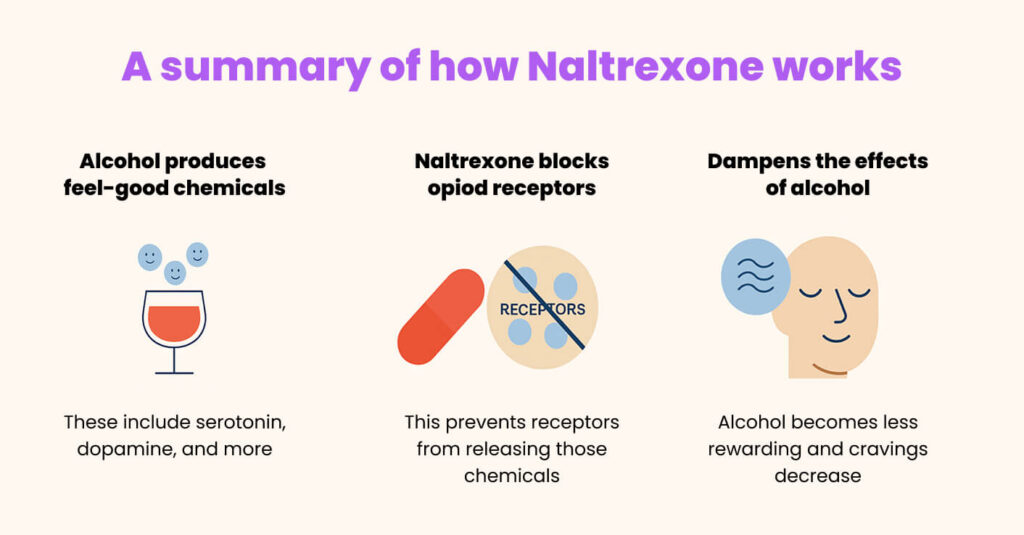
Naltrexone blocks opioid receptors involved in alcohol’s reward response. For many people, that can reduce cravings and make drinking feel less rewarding, making it easier to stop after fewer drinks.
And the evidence base is substantial. A 2023 JAMA systematic review and meta-analysis evaluated 118 clinical trials involving nearly 21,000 participants. Researchers found that oral naltrexone reduced the likelihood of returning to heavy drinking compared with placebo and concluded that the evidence supports it as a first-line medication for alcohol use disorder.
Most importantly for this comparison, much of the evidence supporting naltrexone comes from regular daily use. That doesn’t mean targeted dosing can’t work, but the evidence doesn’t apply equally to every dosing strategy.
The Sinclair Method, developed by researcher John David Sinclair, is based on a concept called pharmacological extinction. Alcohol triggers endorphins that interact with opioid receptors and reinforce drinking. Because naltrexone blocks those receptors, TSM proposes that repeatedly drinking while taking the medication can gradually weaken (or make extinct) the learned association between alcohol and reward.
That’s why timing is central to TSM: naltrexone is taken before drinking rather than every day. There’s research behind this theory, but the mechanism itself doesn’t establish that targeted dosing works better than daily use.

Some of the earliest research on naltrexone provides support for the ideas behind TSM.
In a 2001 review, Sinclair examined eight placebo-controlled naltrexone trials and argued that the medication performed better when treatment allowed for continued drinking than when paired with abstinence-oriented support. The pattern supported his pharmacological-extinction theory, but the studies weren’t all trials of what we now call TSM, so they don’t establish that targeted dosing is superior to daily use.
The Heinälä et al. trial provides more direct evidence. Participants initially took medication regularly, with naltrexone performing best when paired with coping-skills therapy. After 12 weeks, they switched to targeted use, and improvements were generally maintained.
That supports targeted naltrexone as a legitimate approach, particularly after a period of regular treatment. But participants didn’t start with targeted dosing and outperform those taking naltrexone daily.
So the early research gives TSM a legitimate scientific foundation. What it doesn’t give us is strong evidence that taking naltrexone only before drinking is more effective than taking it consistently every day.
Consider someone who drinks three or four days a week but not on a schedule. Monday might be fine. Tuesday, something stressful happens, and they pour a glass at 6 pm. Thursday, they’re out with friends, so their drinking is more likely to escalate. There’s no reliable moment to take a pill 60 minutes beforehand, because the drinking isn’t planned. This can cause compliance issues.
By contrast, daily naltrexone is likely to work better when:
Addiction researchers often distinguish between long-term goals and the brain systems involved in reward and habit formation. You may plan to take naltrexone before drinking, but that plan can become harder to execute in the moment when alcohol cues and cravings are strongest. Daily dosing reduces that friction by turning medication into a routine rather than a decision tied to each drinking occasion.
Daily naltrexone provides blanket coverage. It works even when drinking is unplanned, emotional, or habitual. You don’t have to predict when cravings will hit or when a casual evening will turn into something harder to control.
Sunnyside Med uses daily dosing for this reason. It’s the approach most likely to work for the widest range of people.
Direct comparisons of daily and targeted naltrexone are limited, and the results are mixed.
A 2003 randomized trial found a modest benefit from daily naltrexone on heavy drinking, while targeted treatment reduced some drinking outcomes whether participants received naltrexone or placebo. A later analysis found an advantage for targeted naltrexone on daily drinking, but also found a smaller targeted-placebo effect, suggesting that planning for high-risk situations may itself influence drinking.
A 2009 trial found stronger results for targeted naltrexone on some outcomes, particularly among men. But the overall difference in drinks per day across the study wasn’t statistically significant.
These studies support targeted naltrexone as a legitimate approach, but they haven’t shown that it’s consistently more effective than daily dosing. They’re also relatively small compared with the broader body of research supporting regular naltrexone use.
There’s a lot of misinformation online about daily naltrexone. Some of it comes from well-meaning TSM advocates. Some of it is just wrong.
This is a personal note from Sunnyside Med’s co-founder Ian Andersen, who has been taking naltrexone daily for nearly two years and was Sunnyside Med’s first customer.
I’d already cut my drinking way back by 2024, but I still had one piece I couldn’t crack: binge drinking. Once I started, stopping was hard. So I tried naltrexone.
I was a fast responder. The alcohol noise went quiet almost immediately. I stopped thinking about drinking so much, and started thinking about everything else more. Nearly two years later, I drink less than I ever have. A couple times a month, on my terms, and I can stop when I want to. If you’d told me that ten years ago when I was white-knuckling my way through cutting back, I wouldn’t have believed you.
After about a year on daily naltrexone, I got curious. I’d heard so much about the Sinclair Method online that I decided to try it: stop taking it every day, and only take it an hour before drinking. Same medication, different timing. I figured it was worth an experiment.
It didn’t go well.
The first thing that happened was I just… stopped taking it. I wasn’t drinking much, so I stopped medicating. Then a weekend rolled around, I decided to have a drink, took my pill, and overdid it. More than I wanted. So I kept trying. But what I noticed was that throughout the week, this anticipation of drinking was quietly building up in a way it hadn’t before. And when I did drink, even with the naltrexone on board, I drank more than I intended.
There was also this mental gymnastics thing I wasn’t expecting. Every time I thought about having a drink, I had to decide: do I take the pill or not? When you’re dosing daily, that decision doesn’t exist. It’s already handled.
After a few weeks, I went back to daily. I talked to Dr. Volpicelli about what I’d experienced, and he confirmed it’s a real phenomenon: when you’re not consistently blocking the reward signal, cravings can build up a kind of reserve. That tracked perfectly with what I felt.
I also did a gut check on long-term use. Naltrexone doesn’t blunt my joy or my dopamine in any other area of life. If anything, I feel sharper and more present, because I’m not spending mental energy on alcohol. I got bloodwork done. Everything came back clean. After two years on naltrexone, I’m healthier than I’ve been in a long time.
Alcohol use disorder runs deep in my family. For me, naltrexone isn’t just a tool for cutting back; it’s a preventative measure I feel genuinely good about. Someday I’ll probably stop taking it. Maybe I’ll quit drinking entirely. But right now, alcohol barely crosses my mind, and when it does, I’m the one in charge. That’s the whole thing, really.
The daily-versus-targeted debate can make it sound like the hardest part is choosing a protocol. For many people, the harder part is actually just taking naltrexone consistently.
That matters because adherence is one of the biggest barriers in alcohol medication treatment. In a 2018 study, Dermody et al. found that people were more likely to take daily naltrexone on days when they completed mobile support check-ins. Fortunately, this is exactly what we offer at Sunnyside Med: daily support check-ins via our text messaging and mobile app support.
Percy Menzies, a pharmacist and alcohol treatment specialist, put it this way in an essay on Dr. Joe Volpicelli’s Substack: “Naltrexone [has been] not so much a failure of its pharmacology as a failure of its delivery … If adherence limits efficacy, adherence becomes the intervention.”
In other words, naltrexone can help. But getting people to keep taking it is often the real challenge.
That’s where support matters. Among active Sunnyside Med members with 50% or more app engagement, 78% achieved a meaningful reduction in drinking. Engaged members also refill at 3x the rate of members who just take the medication. Individual results vary.
The likely mechanism is not mysterious: daily tracking, coaching, check-ins, and the habit of opening the Sunnyside app all create more chances to stay connected to the goal.
“I’ve noticed that I now get a feeling that I’ve had ‘enough’ and at that point I absolutely don’t want any more,” reports one Sunnyside Med member.
Sunnyside’s Co-Founder Ian Andersen said: “I connect with dozens of customers weekly in our private Zoom calls. In every meeting, customers encourage others to take advantage of everything we have to offer, from our podcast, to our coaching, to our in-app challenges. I don’t even have to bring it up, because the support we offer around the medication is so beloved. It’s amazing to watch people engage with every tool we offer, and maximize their naltrexone results with the support we offer.”
The Sunnyside Med approach includes daily compounded naltrexone, clinician-guided protocol, app-based tracking, and coaching. It’s 100% online, waiting room-free, and private. If you’re wondering how naltrexone could fit into your life, take a free 2-minute assessment at Sunnyside Med.
Naltrexone is a prescription medication. This content is educational and should not be taken as medical advice. A licensed clinician reviews every Sunnyside Med application.
Research has not shown that The Sinclair Method is more effective than daily naltrexone. Some smaller studies have found benefits from targeted dosing on certain drinking outcomes, but results are mixed. Daily naltrexone has a much larger overall evidence base, including major clinical trials and systematic reviews.
No. Much of the research establishing naltrexone as an effective medication for alcohol use disorder studied regular daily use. The Sinclair Method specifically pairs naltrexone with drinking, but that isn’t the only evidence-based way the medication is used.
Sunnyside Med uses daily naltrexone because it has a deep clinical evidence base and doesn’t require you to anticipate every drinking occasion. Making medication part of a routine can also provide coverage when drinking or cravings are unexpected. Your Sunnyside Med clinician can provide guidance based on your individual health history and goals.
Ian has a family deeply hurt by alcohol, and is on his own personal journey to drink less and live his healthiest life. He’s took naltrexone daily for two years and saw incredible results. As Sunnyside Med’s first customer, he’s deeply entrenched in alcohol health and naltrexone.
How long naltrexone stays in your system depends partly on which form of naltrexone you're taking. Oral naltrexone,...

Research on naltrexone use during pregnancy is limited, particularly among people taking it for alcohol use disorder. What...
Although naltrexone eventually became an established treatment for alcohol use disorder (AUD), getting it into routine clinical practice...

Naltrexone and Antabuse differ in how they work, what taking them is like, their safety considerations, and the...