How Long Does Naltrexone Stay in Your System?
How long naltrexone stays in your system depends partly on which form of naltrexone you're taking. Oral naltrexone,...

For years, the message around behavior change has been simple: if you want to eat better, drink less, or build healthier routines, you “just need more discipline.”
But that idea is starting to break down.
A growing body of research—and real-world results from platforms like Noom and Sunnyside—points to something more nuanced. Lasting change isn’t just about trying harder. It’s about changing the conditions that make certain behaviors feel automatic in the first place. Sometimes that includes medication, whether it’s a GLP-1 (like Ozempic) or naltrexone.
One of the most useful frameworks to emerge recently is the idea of “noise.”
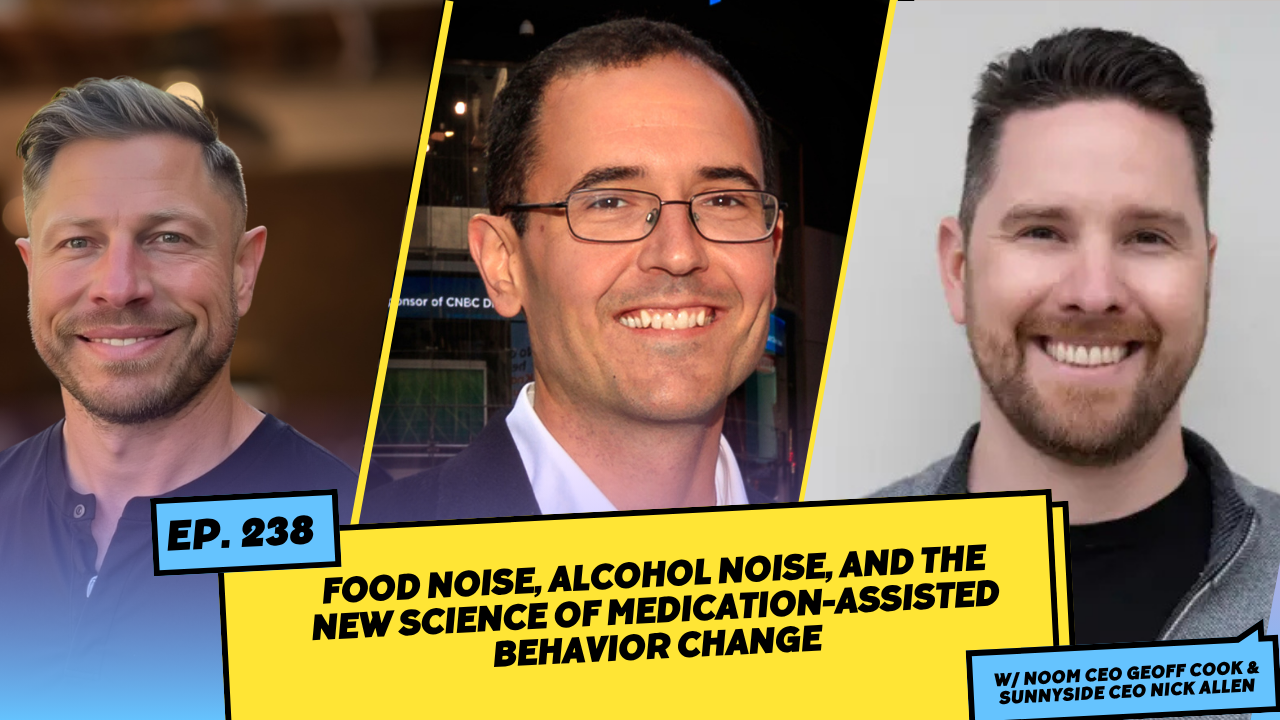
As Noom CEO Geoff Cook explains, “food noise” is “persistent unwanted thoughts about food… what to eat next? When am I gonna eat? How much should I eat?”
It’s more than just hunger or cravings; it’s the constant background chatter that keeps pulling your attention back, often without you realizing it.
This kind of thinking lives in the brain’s default mode network, the system that runs when you’re not focused on a task. And because we spend so much time in that state, whatever fills it tends to shape behavior in powerful ways.
A similar pattern shows up with alcohol. Over time, repeated habits create strong associations—like linking a drink with stress relief, relaxation, or the end of the workday. Eventually, those associations become automatic. The urge isn’t always a conscious decision; it’s something that shows up on its own.
“Those associations become so strong that ultimately they can be really dominating of one’s subconscious and psyche,” says Sunnyside CEO Nick Allen. That’s why it can feel like you’re stuck in a loop, even when you genuinely want to change.
Most people default to willpower when they want to change a habit. But willpower isn’t stable—it’s limited and fluctuates throughout the day, not to mention throughout seasons of your life.
As Cook notes, self-control is perhaps a depletable resource. If you use it in one area, you’ll have less available later.
That helps explain why evenings are often the hardest. You’ve already spent mental energy all day, and now you’re expected to resist the strongest habits at your weakest moment.
It’s not a fair fight! And when you lose iterations of that fight repeatedly, it’s easy to assume the problem is you. But it’s really the systems you’re working within.
This is where newer tools—especially medications like naltrexone—start to change the equation.
Instead of forcing behavior change through effort alone, they work by altering the underlying signals that drive behavior.
Cook describes the experience of GLP-1 medications this way: “What we find is [patients] experience this uncanny silence… a lot of times, you’re not even aware of the food noise until it’s gone.”
Naltrexone often prompts a similar feeling for people trying to change their relationship with alcohol. For many folks, it helps cut the “noise” around alcohol.
“The parallels [between food and alcohol noise] jump out off the page when you read the writing in this space, when you start to think about kind of the way that alcohol interacts with the brain as well,” says Allen.
When the noise quiets down, you’re no longer in a constant state of resistance. You’re not fighting urges at full intensity. You actually have space! And that makes it so much easier to make a conscious choice.
“What’s so interesting is observing the patterns of folks and hearing the stories of people who are just saying: ‘Wow. I have control of my Friday afternoons for the first time in decades because that voice and that immediate pleasure center … [have] been dampened,'” Allen adds.
When that space opens up, it creates a window where change feels more accessible. Habits are easier to start. Progress feels more immediate. Motivation tends to rise. But that window doesn’t last forever.
Cook points out that many people eventually stop taking medication: “as many as eleven out of twelve by year three.”
That makes this period especially important—if nothing else changes, old patterns are more likely to come back. But if you use the window to build new habits, the story can look very different. You’re not relying on the same level of effort anymore—you’ve changed the baseline.
So how do you take real advantage of that window?
Cook emphasizes the power of a basic loop: cue, habit, reward. “Lay out the clothes the day before… start small… and then at the end of that, give yourself kind of a dopamine surge.”
In practice, that means:
These small loops build momentum. And over time, they start to feel automatic. That’s when behavior change stops feeling like effort and starts feeling like identity.
“It’s not that you walk down [the snack aisle] and you’re trying not to pick five things,” Cook says. “You don’t walk down it.”
That shift—from resisting a behavior to simply not engaging with it—is when lasting change can begin to happen. And as a tool in your arsenal, naltrexone can make it easier.
One of the biggest misconceptions about behavior change is that there’s a single solution.
In reality, the most effective approach combines multiple layers:
Medication can help reduce the noise, and what you do with that space matters just as much.
At Sunnyside, you’ll have support in setting a clear plan, tracking progress, and building awareness of your own patterns. Just as importantly, it includes connection through coaching and the vibrant Sunnyside community—because behavior change is easier to sustain when you’re not doing it alone.
Another important shift is how we define success.
For a long time, especially with alcohol, the standard was all-or-nothing. Either you quit completely, or you haven’t really succeeded. But that binary approach doesn’t work for everyone.
For many people, meaningful progress looks like drinking less, feeling better, and gaining more control over their choices. That kind of change still matters. It might be all the change an individual needs, or it might become the starting point for something bigger.
Looking ahead, the direction is clear. We’re moving toward a model that blends behavioral science with modern medicine, using both to create outcomes that actually change people’s lives.
Cook expects this trend to continue, with longer-lasting medications and more integrated approaches becoming the norm.
At the same time, there’s a cultural shift happening.
Habits around food, alcohol, and health are being understood less as personal failures and more as the result of complex systems—biological, psychological, and environmental.
That shift reduces stigma and opens the door to earlier, more effective support.
If you’ve been trying to change a habit and it hasn’t worked, it’s easy to think you just need more discipline. But that’s not what this new model—the exciting one—suggests.
It suggests that:
As Cook puts it, one of the most important things to understand is that “you’re not often conscious of the things you’re doing.” Not everything is an active, calm-and-collected decision.
Which means change doesn’t start with forcing better decisions. It starts with adjusting the system from which those decisions come.
For a long time, behavior change was framed as a test of discipline. Now it looks more like a design problem: How do you reduce the noise? How do you create space? How do you make better choices easier—and automatic?
Those are the questions that actually lead somewhere. And once you start asking them, change tends to follow.
Get started on your mindful drinking journey with a 15-day free trial of Sunnyside. If you’re interested in naltrexone, learn more at Sunnyside Med.
Sunnyside is a holistic program to help you build a healthier relationship with alcohol, using a proven, science-backed method. Whether you want to become a more mindful drinker, drink less, or eventually quit drinking, Sunnyside can help you reach your goals. We take a positive, friendly approach to habit change, so you never feel judged or pressured to quit.
When you join Sunnyside, you’ll start by completing a 3-minute private assessment so we can learn a bit about you. Once that’s done, you’ll get a 15-day free trial to test out everything, including our daily habit change tools, tracking and analytics, community and coaching, and education and resources. It’s a full package designed specifically to adapt to your goals and help you reach them gradually, so you can make a huge impact on your health and well-being.
In addition, Sunnyside Med now offers access to compounded naltrexone, a prescription medication that can reduce cravings and binge drinking, giving you the peace of mind to make long-term change.
Get your 15-day free trial of Sunnyside today, and start living your healthiest life.
Ian has a family deeply hurt by alcohol, and is on his own personal journey to drink less and live his healthiest life. He’s took naltrexone daily for two years and saw incredible results. As Sunnyside Med’s first customer, he’s deeply entrenched in alcohol health and naltrexone.
How long naltrexone stays in your system depends partly on which form of naltrexone you're taking. Oral naltrexone,...

Research on naltrexone use during pregnancy is limited, particularly among people taking it for alcohol use disorder. What...
Although naltrexone eventually became an established treatment for alcohol use disorder (AUD), getting it into routine clinical practice...

Naltrexone and Antabuse differ in how they work, what taking them is like, their safety considerations, and the...