Last Updated on March 28, 2026
You probably don’t have an information problem when it comes to drinking.
You probably already know what helps. As in: Sleep improves. Anxiety drops (eventually). Energy comes back. You don’t need another article to tell you that drinking less is generally a good idea. And still, there’s that gap between what you think and what you actually do.
You make a plan, maybe even feel good about it, and then a few days later, you’re right back in the same pattern. Not because you forgot what to do. Something else just… takes over.
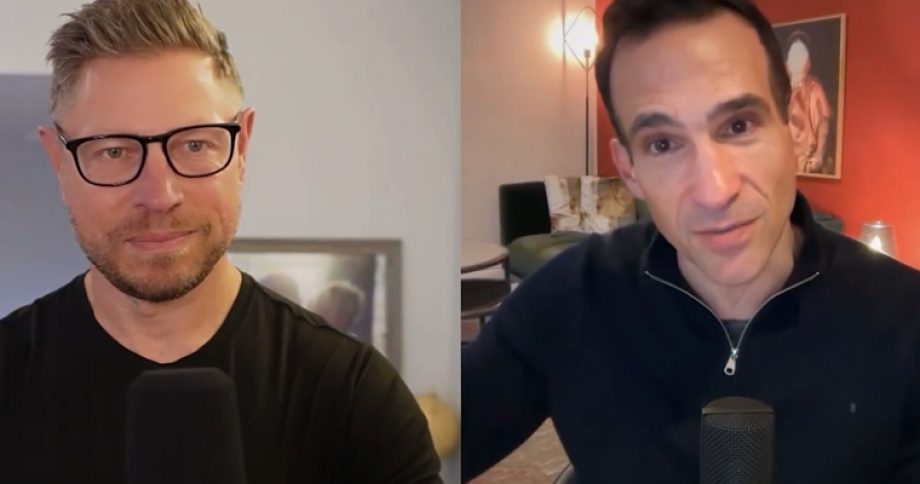
That’s the part New York Times-bestselling author Nir Eyal is interested in. Not the “what,” but the why not.
Watch The Related Podcast
The Part No One Really Talks About
Eyal puts it pretty bluntly: “We basically all know what to do to improve our lives… The information is all out there, and the question is why not?”
It’s a fair question. If knowledge were enough, behavior change would be easy. It’s not like cutting back on alcohol is some hidden secret.
What he suggests instead is that we’ve been thinking about motivation too simply. Like it’s a straight line: want something → do the thing → get the result. But that skips over something important.
“Motivation is not a straight line, motivation is a triangle… we need to have the behavior, the benefit, and most importantly, the belief,” Eyal says.
That last piece, belief, tends to get ignored, assumed, or glossed over, but it’s actually extremely important.
You Don’t Actually Need More Discipline
Some people might default to thinking they just need to try harder. More willpower. More consistency. Fewer “slip-ups.”
But Eyal frames it differently: “I think what determines whether you meet a goal is persistence… It’s not that persistence guarantees success; it’s that quitting guarantees failure.”
That lands a little differently. It’s less about doing everything perfectly and more about not dropping out of the process entirely.
Still, persistence isn’t something you can just force indefinitely. At some point, if it feels pointless or impossible, you stop.
Which brings it back to belief. If some part of you doesn’t think you can keep going—or that it’s even worth it—you’ll find a way out of the endeavor. Usually pretty quickly, too.
How We Decide We’re “Done”
One of the stories Eyal shares is hard to forget once you hear it.
In an old experiment, rats placed in water would give up after around 15 minutes. That was their limit. But when researchers briefly pulled them out—just long enough for them to catch their breath—and then put them back in, something changed.
They didn’t last a little longer. They lasted dramatically longer. Hours. Nothing about their bodies changed. Same environment. Same setup. What changed was the expectation that maybe something would intervene again. That tiny shift stretched what they were willing to endure.
This raises an uncomfortable question for the rest of us. “When do we think that we’re at our limits… that we have to take another drink… that we have to stop because it’s just too much for us?”
Because a lot of those moments feel final when they’re not.
Thoughts That Feel Like Facts
One of the trickier parts of this is that beliefs, no matter how untrue they are, often feel like reality.
Eyal defines it this way: “The definition of a belief is a conviction that is open to revision based on new evidence.”
Which sounds obvious, but in practice, it’s not how most of us experience our thoughts.
- “I can’t do moderation.”
- “I always end up here.”
- “I need something to take the edge off.”
Those don’t feel flexible. They feel settled.
But these thoughts are not facts! They’re interpretations that have been repeated enough times to feel permanent.
That distinction matters more than it seems, because if something is a belief, it can shift. Even if slowly.
Labels Can Help (Until They Don’t)
There’s also the issue of identity.
Labels can be useful. They explain things. They give context. Sometimes they’re even a relief.
But they can also turn into something heavier.
“When we see ourselves through a particular identity… what most people hear is that’s who I am, and you can’t change who you are.”
That’s where things get sticky.
Because once something feels like “who I am,” it’s harder to question. Harder to experiment with. Harder to outgrow.
This shows up a lot with drinking. Not always in obvious ways, either. Sometimes it’s subtle:
- I’m just someone who overdoes it in social situations
- I’m not good at stopping once I start
- I don’t really have the personality for moderation
None of those are fixed traits. But they can start to act like they are.
Where To Look If You Feel Stuck
Eyal has a term for the places where this shows up: the “muck.” It’s not a technical term. It’s just… the stuff that keeps dragging.
“You look for suffering,” he says. “It’s that project, that goal that you still haven’t finished… you know you could do, you know how to do, you want the benefit of doing them, but you don’t do them.” That gap is where something’s off.
With drinking, it might look like circling the same intention over and over. Cutting back for a bit, then sliding back into old habits. Telling yourself you’ll handle it differently next time.
Usually, there’s a belief underneath that loop. Something about what’s possible—or not.
The Physicality of Belief
One of the more surprising parts of Eyal’s work is how physical belief can get. He shares an example of someone who experienced what looked like a severe overdose—low blood pressure, collapsing, the whole thing—after taking pills he believed were dangerous. They weren’t. They were placebos. Once he found that out, the symptoms faded.
This is an extreme case, but the underlying idea shows up in smaller ways all the time. Expectations shape experience.
Cravings are a good example. They can feel urgent, almost like something bad will happen if you don’t respond. But part of that intensity comes from what you believe the craving means.
The Limits of Positive Thinking
At this point, it’s tempting to swing toward the usual advice: just think differently. (And for many people, visualization might work!)
But Eyal doesn’t buy that. “When people did that,” he says, “they became less likely to do what’s required to get what they want.”
Which is a little counterintuitive, but it makes sense—if imagining the result gives you some of the emotional payoff, it can reduce the urgency to act. You feel closer to the goal without actually moving toward it.
What Actually Helps
Instead of focusing on the outcome, Eyal suggests focusing on what gets in the way. “Everything worth having in life is on the other side of discomfort,” he says. That’s not particularly glamorous advice, but it’s practical.
If you’re trying to drink less, it’s worth getting specific. Ask yourself:
- What happens when someone offers you a drink?
- What do you say when you’ve already had enough?
- What does a craving actually feel like, minute to minute?
Those are the moments that tend to decide things—not the big intentions you set earlier in the day.
So What Now?
If you’ve been stuck in the same pattern with drinking, it might not be because you don’t know enough or care enough.
It might be that some of the beliefs underneath it haven’t been questioned yet.
The ones that say:
- This is just how it goes
- This is what I need
- This is what I’m like
Those aren’t fixed. They just feel that way because they’ve been there for a while.
Start there. Notice them. Push back a little. Try something slightly different and see what happens.
Get started on your mindful drinking journey with a 15-day free trial of Sunnyside.
What is Sunnyside?
Sunnyside is a mindful drinking and alcohol moderation app that can help change your habits around alcohol using a proven, science-backed method. Whether you want to become a more mindful drinker, drink less, or eventually quit drinking, Sunnyside can help you reach your goals. We take a positive, friendly approach to habit change, so you never feel judged or pressured to quit.
When you join Sunnyside, you’ll start by completing a 3-minute private assessment so we can learn a bit about you. Once that’s done, you’ll get a 15-day free trial to test out everything, including our daily habit change tools, tracking and analytics, community and coaching, and education and resources. It’s a full package designed specifically to adapt to your goals and help you reach them gradually, so you can make a huge impact on your health and well-being.
Sunnyside is a digital habit and behavior-change program that is incredibly effective on its own, but can also be the perfect complement to other work you’re doing to cut down on drinking, whether that includes talk therapy or medication such as Naltrexone.
Get your 15-day free trial of Sunnyside today, and start living your healthiest life.